
At Aptus, we treat volatility as an asset class. We own hedges so we can own more stocks. Most readers of our commentary have heard that more than once. But options do more work in our portfolios than hedging alone. We use them to protect the downside, to add yield, and to shape the range of outcomes a client experiences. Those are different jobs, and the same question decides whether each one gets done well: which option, and why?
Buying or selling an option is easy. Choosing the right one, at a cost you can live with, is where the work is. We view every options position on three dimensions at once, whether we are the buyer or the seller. We call them the 3 C’s.
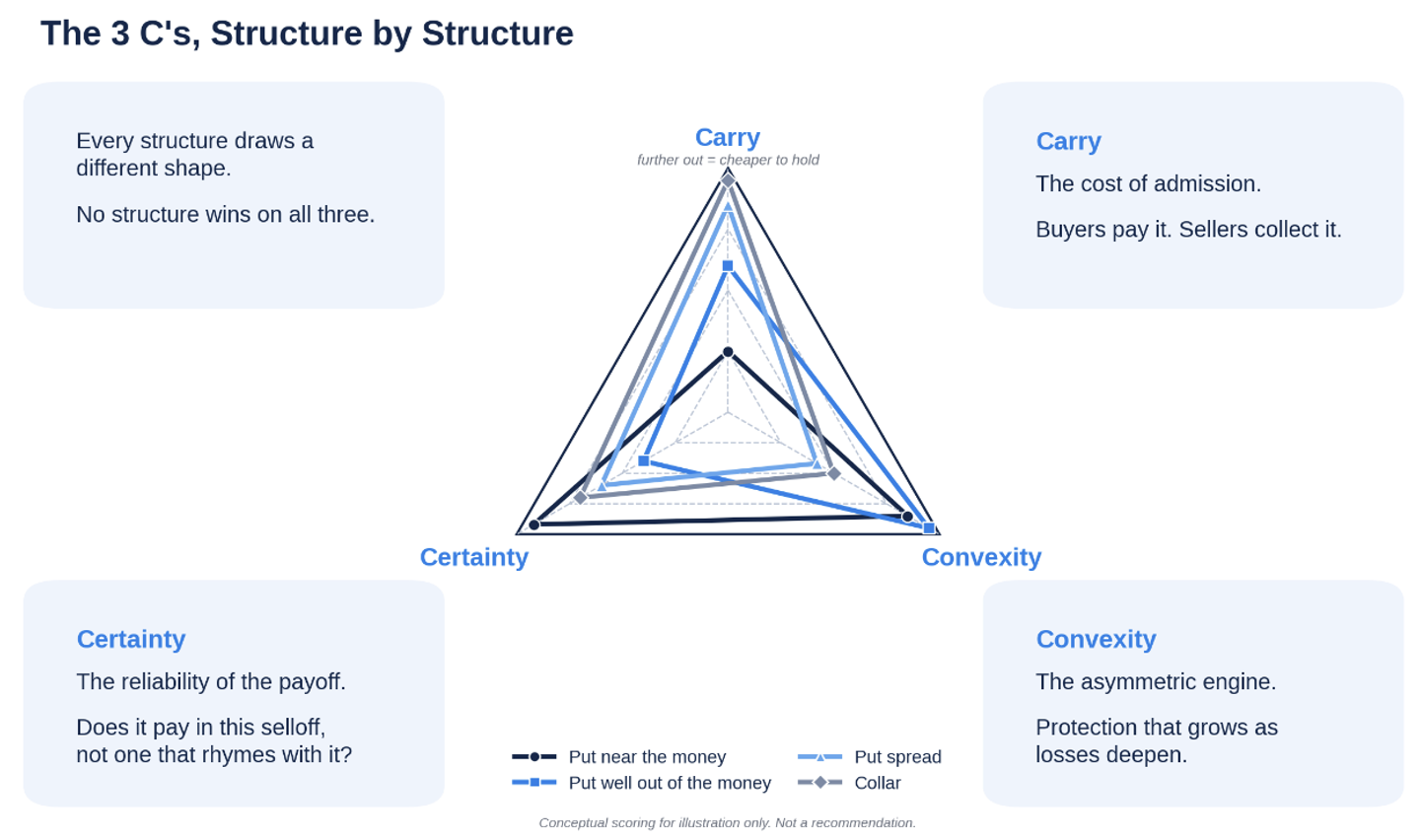
The cost of admission. What the position costs you, or pays you, while nothing happens.
The reliability of the payoff. How reliably the position does the job you gave it, in the scenario that actually shows up.
The asymmetric engine. Whether the payoff bends in your favor or against you, as the market moves further.
No structure wins on all three. Every dollar of carry you save or collect comes out of certainty or convexity somewhere else. That is the first lesson of options, and the rest of this piece is an argument for taking it seriously. Hedging is where we lean hardest, so it gets the most ink, but the lens is the same for every use.
Carry
Carry is what it costs to own protection over time. Every option loses a little value each day as the clock runs, and that decay speeds up as expiration gets close. The last few weeks of an option’s life see the fastest rate of time decay relative to its remaining value, which is why rolling short-dated options month after month rapidly compounds carry costs. Cheap-looking monthly protection is often the expensive way to hedge.
What You Are Really Paying For
The cleaner way to think about carry is this: when you buy an option, you are paying for an expectation of how much the market will move. What you end up owning is based on how much it actually moves. If the market moves less than the option priced in, you overpaid and the hedge cost you. If it moves more, the hedge earned its keep. Nobody knows which way that will go in advance.
History does give us a strong prior. On average, options have priced in a bit more movement than the market went on to deliver. That gap is the volatility risk premium, and it exists for a reason: whoever sells the option is bearing tail risk, and they get paid for it. Two things follow. Selling options has been a profitable business over long stretches. And buying protection has a persistent cost.
We say this plainly because it is the honest framing of what a hedge is. It is insurance. The premium is real, it compounds, and it is the cost of admission for owning the stronger engine. What we refuse to do is pretend the cost away. The job is to pay it efficiently.
Carry Runs Both Directions
The same premium that costs the hedger is income to whoever sells the option. That is the entire logic of a covered call or a cash-secured put: collect the volatility risk premium rather than pay it.
In our yield-enhancement sleeves, we are the seller, and the carry is positive. We focus on short-dated options with the fastest time decay, so the same steep part of the curve that punishes a buyer who rolls monthly is the part that rewards us. It shows up as a steady stream of premium that lifts the portfolio’s yield without a bet on style, sector, or duration. Positive carry is attractive, and it is never free. The seller is being paid to give something up, and the next two sections are about what.
Not All Protection is Priced the Same
Far out-of-the-money puts on an index, the ones that only pay in a real crash, trade at a markup relative to puts closer to the money. Buying them means paying the inflated cost on top of the base premium. That is doubly expensive protection, and it is why we often pair a long put with a short one further down to sell some of that markup back. Cheaper carry, but you have given something up. We will cover that “give something up” part here in a bit.
Carry is the premium on the insurance policy. You do not buy the cheapest policy. You buy the one that pays when the house burns down, and then you shop hard on the premium.
Certainty
Certainty asks one question: when the bad thing happens, does this hedge actually pay? Not roughly, not in a similar scenario. In the one you bought it for. A hedge that pays in a different crisis than the one you have is a diversifier with a premium attached, and we have spent a long time explaining why diversifiers are not hedges.
The Strike is a Bet on the Odds
The first certainty decision is where to set the strike. A put that pays only after a 20 percent decline is cheap because most years it pays nothing. A put that pays after a 5 percent decline costs far more because it pays far more often. Moving the strike is how you trade certainty for carry, and there is no setting on that dial that gives you both.
Does the Hedge Match the Loss?
Even with the right strike, the instrument has to line up with the risk.
The index is not the portfolio. Buying index puts protects a portfolio only to the extent it behaves like the index. In a broad selloff, everything falls together, and index puts work beautifully. In a drawdown concentrated in one sector or one position, the index may barely move while the client’s account does.
Markets gap. Prices do not always move in a smooth line. They open sharply lower after a weekend or a headline. An owner of a put is fine with that; the contract locks the payoff in. Anyone hoping to just sell as the market falls, or own a hedge that has to be adjusted along the way, is not.
Volatility has its own path. A put draws its power from two sources: the market falling and fear (implied volatility) rising. Usually they arrive together. In a slow, grinding decline, fear can stay muted even as the market drifts lower. The put gets only one of its two engines, and it may not perform the way its owner expected. A hedge has to be judged on how the market falls, not only on how far.
Certainty For the Seller
Selling options has its own certainty question: how sure are you that you keep the premium? A covered call written close to the current price pays well and gets called away often, so the income is certain but the upside is not. Write it further out and you keep more of the rally, but the premium shrinks and so does its reliability. A defined-outcome structure aims to take this to its logical end, trading away upside beyond a cap in exchange for a known buffer on the downside. The client gets certainty about the range of results. What they give up is the right tail. Neither choice is wrong. Both should be made knowingly.
A hedge should show up on schedule, not on hope. Certainty is the discipline of matching the instrument to the actual loss, not to something that rhymes with it.
Convexity
Convexity is why options exist. It is also why they cost money. Nearly everything else in a portfolio has a payoff that is a straight line: fall 10 percent, lose 10 percent. Options bend. The further the market falls, the more each additional point of decline pays. This is the mechanism underneath one of our favorite lines: convexity equals confidence.
A Hedge That Leans the Right Way
Hold a put into a falling market, and its sensitivity to each further decline grows. The hedge gets bigger exactly when you need it bigger. In a rising market, the opposite happens: the put’s sensitivity shrinks, and it stops dragging on the portfolio. That built-in lean is the raw material of a hedge, and it is also why a long option rewards attention rather than replacing it. A put that has grown into a large position after a selloff is worth reassessing. One that has faded after a rally is worth reloading. The convexity does the heavy lifting. Deciding what to do with it is still the job.
That is the whole point, and it is what separates a long option from simply owning less stock. Selling down equity protects you proportionally and stops there. The option protects you more the worse it gets. You pay for that protection through carry, and that tradeoff sits at the heart of every options decision.
The Mirror Image
Selling an option flips the shape. The seller collects a little premium every day and watches losses accelerate if the market moves hard against them. That describes covered calls, cash-secured puts, and every short-volatility fund ever launched. In calm markets, the premium accrues and it looks like free money. In a stress event, the losses are nonlinear. The 2018 episode in short-VIX products, where several lost most of their value in a single session, is the textbook case.
When we sell options using deep out-of-the-money puts rather than calls, we are comfortable doing so for two reasons. First, we know where the outcomes are worst. A short put loses in a sharp selloff. We know that going in and we size for it, and because the puts are short-dated, the portfolio can adapt quickly when conditions change. Second, we do not leave that left tail uncovered. The same portfolios that sell puts for income own convexity against the true tail environment, so the scenario where the short puts hurt most is the scenario where a long hedge pays most. Selling premium with the tail protected is a very different position from selling it naked. The mistake is not selling options. The mistake is selling them without knowing where you have sold convexity, or without owning it back where it matters.
Convexity On the Upside
Convexity is not only a downside idea. A call option bends the same way in the other direction: small cost if the market goes nowhere, accelerating gain if it rips higher. That is how a portfolio can hold a meaningful slice of upside participation for a fraction of the capital, or replace a chunk of stock exposure with calls plus cash and free up dry powder for the next drawdown. Same property, pointed the other way.
A convex hedge is the one that shows up more precisely when it is needed most.
How the 3 C’s Trade Against Each Other
Push on one and the other two move. More convexity costs more carry. A cheaper strike costs certainty. Collecting premium means selling convexity. Financing a put with a short call buys back carry and gives up the upside. Plotted on the same three axes, every structure draws a different shape, and none of them fills the whole triangle. The table puts words to the shapes and adds the income and upside structures. None of these rows is wrong. Each is a different answer to the question of what you are willing to give up.
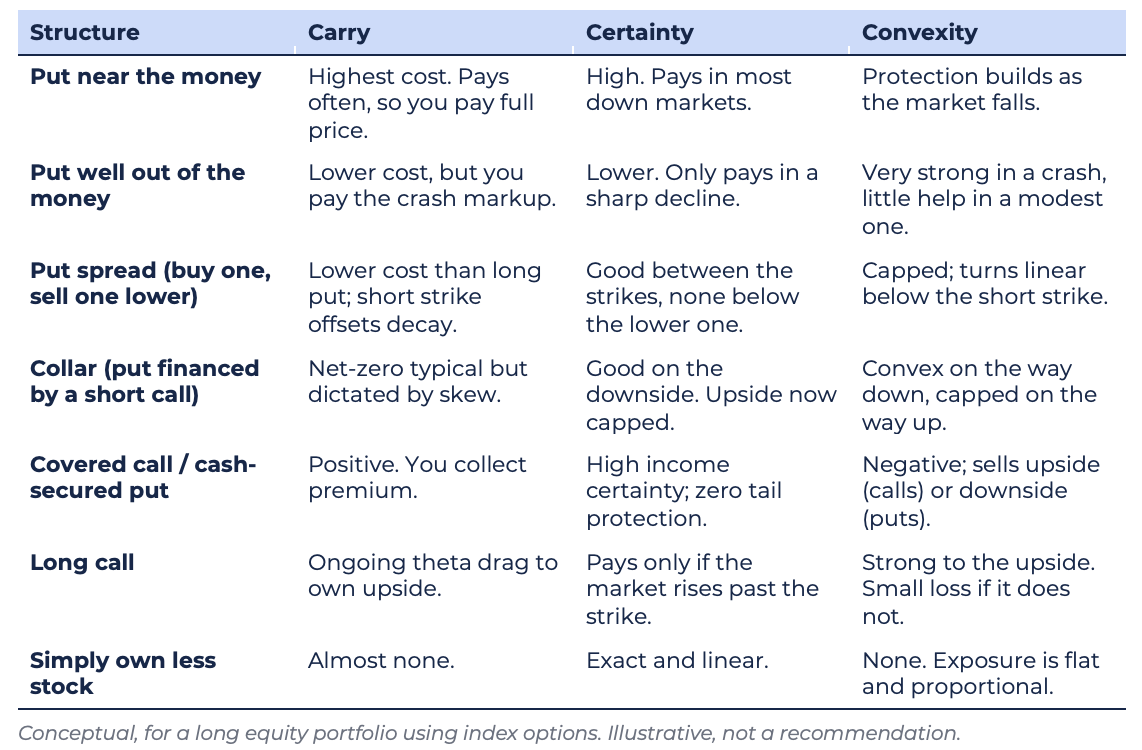
Look at the bottom row. Simply reducing equity scores perfectly on certainty and costs almost nothing to carry, and it has no convexity at all. It also forfeits the upside: every dollar moved to cash sits out the rally, and rallies are where compounding happens. That is a fine way to hold less risk. It is not a way to own more of it. The reason we reach for options rather than dialing down stocks is that only a convex hedge lets the portfolio keep the bigger engine. Better brakes, not a smaller car.
The most useful thing about the 3 C’s is that they turn a debate about products into a conversation about tradeoffs. A collar is not good or bad. It is a near-zero-carry structure that pays for it with capped upside. A covered call is not conservative or reckless. It is carry bought with the right tail. A far out-of-the-money put is neither a lottery ticket nor a masterpiece. It is low certainty and high convexity at a low price. Once every structure is described in the same three words, the right one for a given job tends to become obvious.
That is how our hedged equity and yield-enhancement strategies are built, and it is how we would encourage you to judge any options position, ours or anyone else’s. Ask what it costs, or pays, to hold. Ask whether it does its job in the scenario you actually expect. Ask whether the payoff bends for you or against you. Then decide what you are willing to trade.
Thank you for reading, and for your trust. If any of this raises questions about a specific structure or a specific portfolio, we would enjoy the conversation.
Disclosures
Past performance is not indicative of future results. This material is not financial advice or an offer to sell any product. The information contained herein should not be considered a recommendation to purchase or sell any particular security. Forward-looking statements cannot be guaranteed. Hypothetical examples are for illustrative purposes only, do not reflect the deduction of fees or expenses, and are not indicative of any actual investment result.
Conceptual Illustration: Information presented in the above charts are for illustrative purposes only and should not be interpreted as actual performance of any investor’s account. As these are not actual results and completely assumed, they should not be relied upon for investment decisions. Actual results of individual investors will differ due to many factors, including individual investments and fees, client restrictions, and the timing of investments and cash flows.
This commentary offers generalized research, not personalized investment advice. It is for informational purposes only and does not constitute a complete description of our investment services or performance. Nothing in this commentary should be interpreted to state or imply that past results are an indication of future investment returns. All investments involve risk and unless otherwise stated, are not guaranteed. Be sure to consult with an investment & tax professional before implementing any investment strategy. Investing involves risk. Principal loss is possible.
Advisory services are offered through Aptus Capital Advisors, LLC, a Registered Investment Adviser registered with the Securities and Exchange Commission. Registration does not imply a certain level of skill or training. More information about the advisor, its investment strategies and objectives, is included in the firm’s Form ADV Part 2, which can be obtained, at no charge, by calling (251) 517-7198. Aptus Capital Advisors, LLC is headquartered in Fairhope, Alabama. ACA 2609-26.