
We understand that pricing drives narrative around stocks, not fundamentals. And when a stock underperforms, it’s perceived by investors that the company is not executing or has lost its edge. It’s also expected that good companies will only go up. This is not always the case. Sometimes certain types of stocks are simply out of favor, and since 4/8/2025, high-quality stocks have been out of style, while the more speculative parts of the market have capitulated higher.
When this occurs, it tends to be seen in returns via a lower valuation – the market’s sentiment gauge – not in fundamentals or overall growth.
As one can see in the chart below, fundamentals haven’t changed for the Aptus Compounders strategy stocks – just sentiment has shifted for the time being.
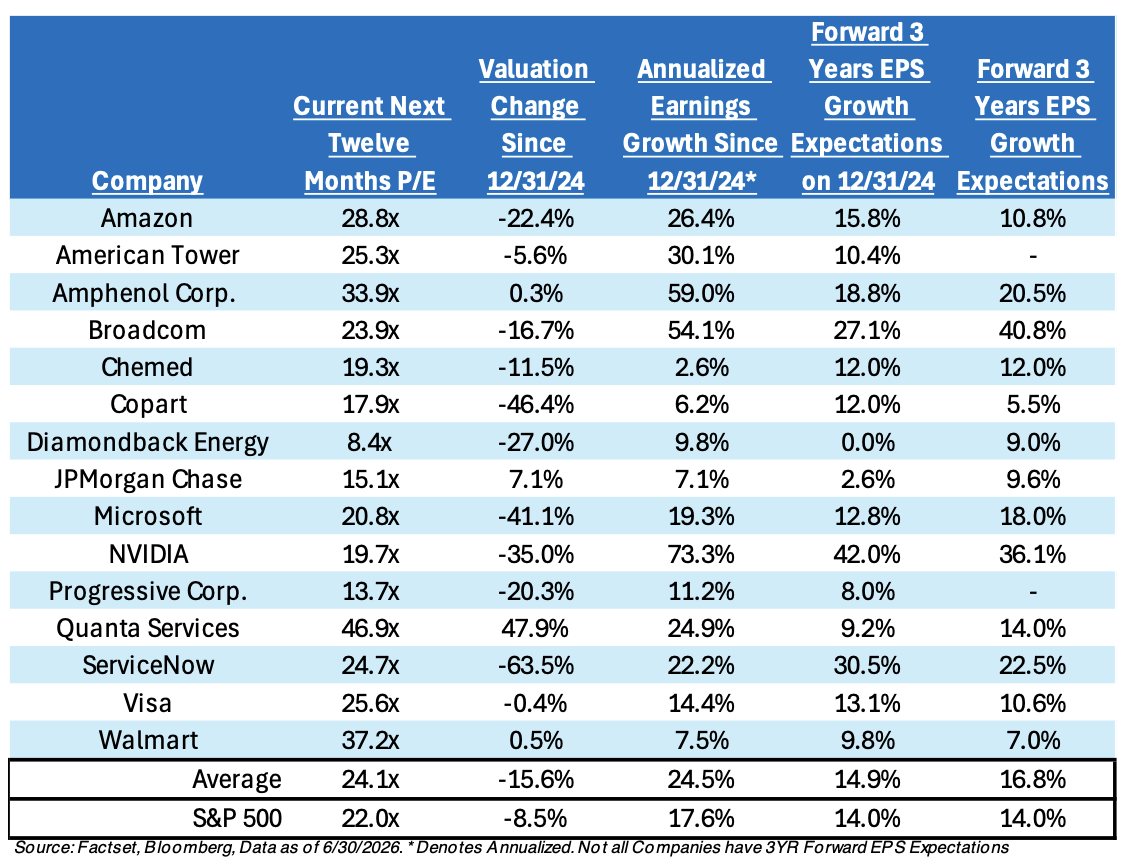
Since the end of 2024, the aggregate valuation for the Aptus Compounders strategy has decreased by 15.6%. Yet, the expected forward growth expectations from the end of 2024 (+14.9%) have increased as of end of quarter Q2 2026 (+16.8%). The same cannot be said for the S&P 500. Said differently, Compounder stocks see higher future growth today relative to before.
While many investors are likely tired of hearing about the low-quality rally, it remains fully intact. The stock market goes through cycles, and cycles tend to last longer than just a few quarters – this is normal. While many rational investors would like to hope that the recent speculative rally is long in the tooth, they must be reminded that the ending is always unknown.
It’s in these periods of time that we likely find out which investors are not patient and more prone to chasing returns. Remember, Investors must invest for the long-term, and in the grand scheme of investment time horizons, a few years isn’t that long.

In our opinion, time arbitrage provides the ultimate investing edge because it allows investors to exploit the structural, mandate-driven short-termism of modern capital markets, absorbing high-quality assets when shorter-duration players are forced to trade. By extending your holding horizon beyond the standard quarterly appraisal window, you turn immediate liquidity and tracking-error pressures into a compounding premium, effectively letting time dissolve the temporary pricing inefficiencies created by the market’s mechanical noise.
What Has Been Going on Underneath the Hood of the Portfolio?
It’s no secret that the Aptus Compounders strategy has lagged the S&P 500, underperforming by 9% net YTD (see table on Page 1), only returning just under 1%. As frustrating as another stretch of relative underperformance is, the drivers are consistent with what we outlined last time – and none of them change our conviction in the underlying philosophy. Nor will we change our philosophy. There’s a difference between evolving with the underlying changes in the market and simply chasing stocks and their performance.
Three things are going on beneath the surface that we want to walk through plainly.
Three Drivers of Underperformance
1. Low Quality has Continued to Win
2. The Strategy Hasn’t Owned the Memory (DRAM) Trade, Which Has Been the Largest Driver of the S&P 500: And we won’t apologize for that. One of the biggest sources of relative pain this period has been our lack of exposure to memory chip makers, which have ripped higher on AI-driven demand for DRAM and HBM. It’s a real and understandable move, but memory is fundamentally a commodity business. DRAM chips are largely undifferentiated; a gigabyte of memory from one producer is functionally interchangeable with another’s. Producers compete primarily on price and manufacturing scale rather than on a durable product edge, which is why the industry has a long history of brutal boom-bust pricing cycles and margins that can evaporate as quickly as they appear. That’s the opposite of the kind of business we look to own for the long haul, and it’s why the strategy has intentionally stayed away, even as the trade has worked in the near term.
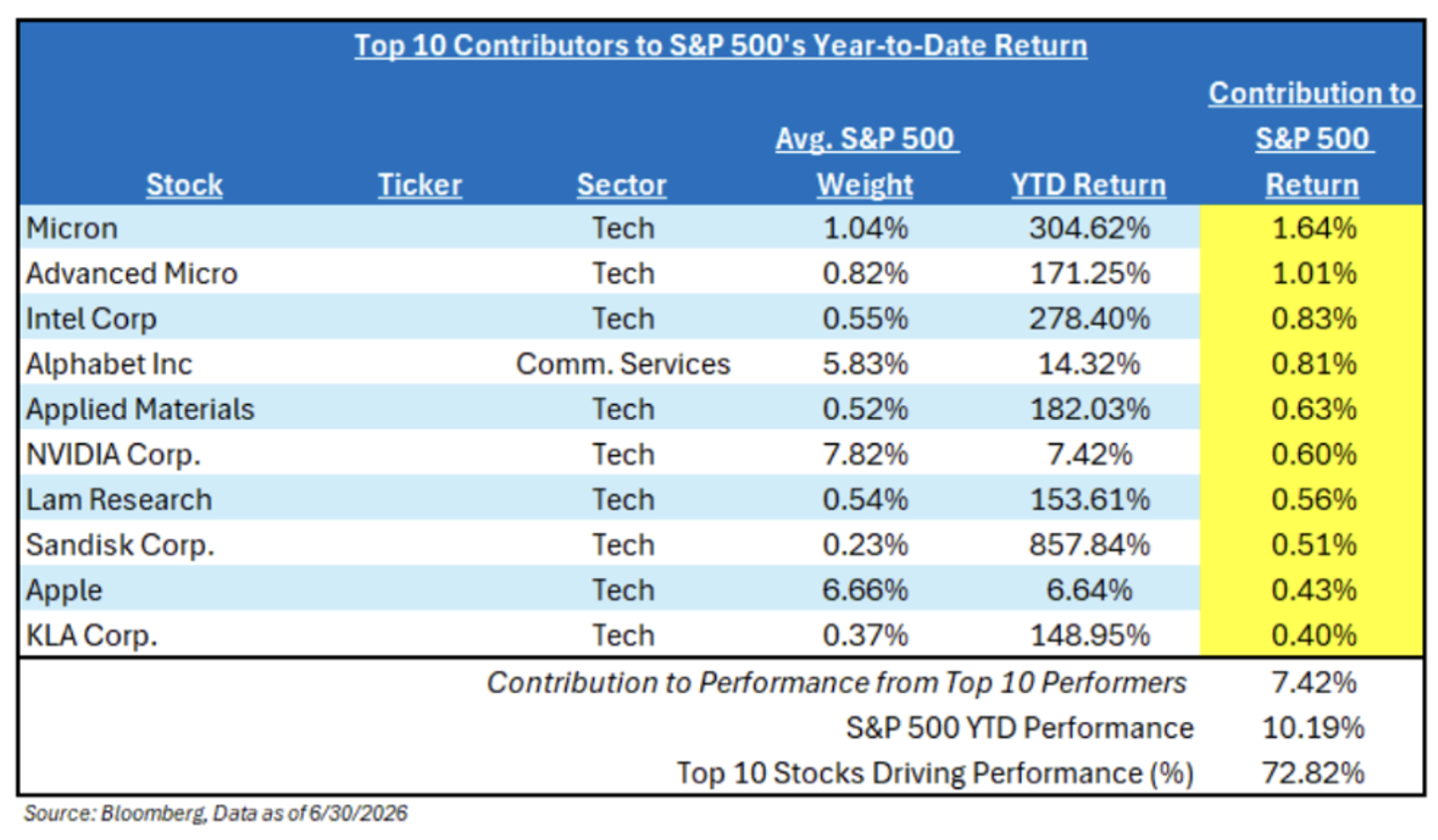
3. Some of Our High-Quality Holdings Simply Underperformed: It wasn’t only a case of being on the sidelines for the trade of the moment; a handful of the durable, high-quality businesses we do own also lagged the index during the period. Dispersion within the portfolio has remained elevated, and not every one of our compounders’ holdings pulled its weight. That’s the nature of running a concentrated book: we won’t get every name right in every window, but we believe the collective quality and durability of the holdings will show through over time.
Where We Go From Here
None of this changes how we run the strategy. We’re not going to reach for commodity trades or chase low-quality names just because they’re working right now – that’s not what this portfolio is for. We’d rather own a concentrated book of durable, high-quality businesses and accept that there will be stretches, like this one, where that discipline costs us in the short run.
We remain confident that it pays off over the long run, and we appreciate your continued partnership through a difficult stretch
Why Do We Own What We Own?
American Tower Corporation (AMT)
Not only are the fundamentals strong with AMT, but the strategy owns it as the team believes that it is a hedge for a lower interest-rate environment and has shown historical outperformance during periods of volatility. Unfortunately, the risk-on and higher interest rate environment has dominated the markets in 2026, so AMT’s total return has lagged the broader equity rally that has carried into 2026, even as the underlying business has continued to strengthen. Thus, as you can see in the table on page one, the overall valuation has decreased.
Fundamentally, Q1 2026 results beat expectations and management raised full-year guidance, even as DISH’s default and Latin American churn create a modest, largely one-time drag on organic tenant billings growth (~1% reported, ~4% excluding DISH). CoreSite continues to be a source of upside, and we still view the data center business as heavily undervalued within the current stock price.
We continue to like the stock for the following reasons:
1. Highly predictable revenues due to long-term escalators and master-lease agreements, coupled with high revenue-to-cashflow conversion rates.
2. Following elevated leasing contributions from mid-band deployment initiatives by AT&T, DISH, and Verizon in 2022 and 2023, Sprint/DISH network decommissioning has weighed on billings growth into 2026. We expect activity to reaccelerate as carriers continue to expand the reach and capacity of their 5G (and, increasingly, fixed wireless) networks.
3. Minimal balance sheet risk, having reached its targeted 3–5x leverage range following the integration of recent acquisitions, with room to complement capital returns with buybacks; management’s new multi-year efficiency program targets 200–300bps of additional tower margin expansion.
4. A steadily rising dividend, now at $1.79/share quarterly, following the full depreciation of older assets (e.g., acquired Alltel towers) and utilization of NOLs, should gradually broaden the company’s base of potential investors.
Amazon.com Inc. (AMZN)
The stock has performed in line with the S&P 500 in 2026, with Q1 results showing a reaccelerating AWS (28% growth, its fastest pace in 15 quarters) alongside record operating margins and a boost from Amazon’s Anthropic investment gains. Investors got much of the granularity they had wanted on how AWS is positioned relative to the evolving AI landscape, capacity constraints abating, and the scope for revenue growth and margin trajectory into 2H’26 and 2027 (even if not explicitly quantified due to management typically not providing segment guidance). That said, we believe elements of capacity constraints continuing to abate (external chip supply and custom silicon efforts), scaling of both AI and non-AI workloads, and how that translates into forward revenue growth are likely to remain the biggest incremental driver of investor sentiment going forward.
Looking over a multi-year timeframe, we believe that Amazon will continue to compound a mix of solid revenue trajectory with expanding margins, even as capex accelerates further (toward a ~$200B annual pace) to build out AI infrastructure. We continue to see AMZN as well positioned for future outperformance as eCommerce margins continue to expand, its advertising business continues to scale and gain share, and AWS stands to benefit from the broadening adoption of Gen AI workloads and from the remaining long-tailed structural growth opportunity in the broad shift of enterprises towards the Cloud.
Amphenol Corp. (APH)
The bullish thesis for Amphenol (APH) relies on its status as the ultimate “pick-and-shovel” play for the modern electronics revolution. Rather than betting on a single technology winner, Amphenol provides the essential, high-performance connectors, sensors, and fiber-optic cabling that allow complex systems to talk to each other. This positions the company as an indispensable gatekeeper across multiple secular growth engines: it is deeply embedded in the buildout of AI data centers, the digitization of military defense infrastructure, and the hyper-electrification of modern vehicles. What truly separates Amphenol from other component manufacturers is its highly decentralized, entrepreneurial corporate culture. Instead of operating as a rigid bureaucracy, it behaves as a fleet of agile, small business units that can rapidly innovate custom engineering solutions for clients. Combined with a masterful programmatic acquisition strategy – consistently buying up smaller, niche hardware players and aggressively integrating them into their vast distribution web – Amphenol functions as a premium industrial compounder that captures upside across the entire technology spectrum while remaining insulated from individual product obsolescence.
Amphenol’s fundamental engine is firing on all cylinders, highlighted by a blowout first quarter that significantly outpaced Wall Street expectations. The primary accelerator is an explosive surge in the IT datacom segment – where sales nearly doubled year-over-year – fueled by massive, relentless infrastructure spending from hyperscalers expanding their AI capabilities. This organic tailwind was further amplified by the strategic integration of the recently closed CommScope acquisition, expanding the company’s competitive footprint in building and enterprise connectivity. Crucially, demand isn’t just a flash in the pan; Amphenol secured a record-high pipeline of new business, pulling in $9.4 billion in orders to achieve a powerful book-to-bill ratio of 1.24:1.
Despite absorbing the leverage and transaction costs of its aggressive buying program, the company defended its excellent pricing power with adjusted operating margins expanding to 27.3%, translating into robust free cash flow generation and giving management the confidence to issue highly bullish double-digit growth guidance for the upcoming quarters.
Broadcom Inc. (AVGO)
Broadcom continues to be one of the more direct ways to play the AI infrastructure buildout without taking on GPU-cycle risk, given its franchise in custom AI accelerators (XPUs) and networking silicon for hyperscalers. Fiscal Q2 2026 results were another step in that direction, with consolidated revenue up 48% year-over-year to a record $22.2 billion and AI semiconductor revenue growing 143% to $10.8 billion, both ahead of the company’s own forecast.
The stock sold off after the print, as CEO Hock Tan reiterated (rather than raised) the full-year AI semiconductor revenue outlook of roughly $56 billion (~180% growth) and the fiscal 2027 target of over $100 billion. We think the market’s reaction says more about how high the bar had been set than about any deterioration in the underlying franchise: management guided Q3 AI semiconductor revenue to more than double again, to $16 billion (+200% YoY), and disclosed $6 billion of new AI orders from two additional customers on top of existing multi-year commitments with Google, Meta, OpenAI and Anthropic.
We continue to like Broadcom for its combination of a highly profitable, recurring infrastructure software business (anchored by VMware Cloud Foundation) alongside a semiconductor franchise with unusually long order visibility – management has pointed to backlog extending into 2028 – and margins (adjusted EBITDA of roughly 69% of revenue in the most recent quarter). With free cash flow conversion remaining strong and capital returned to shareholders via a growing dividend, we view any AI-driven volatility in the shares as an opportunity rather than a reason to abandon the thesis.
CHEMED Corp. (CHE)
Saying that the Health Care space has been a very difficult place to invest in would be an understatement. Even the bellwethers of United Healthcare (UNH) and Elevance Health (ELV) couldn’t dodge the carnage. Like AMT, CHE is in the portfolio to provide exposure to smaller capitalization stocks and protect capital during periods of volatility. Of which, the heavy risk-on rally since the March 30th lows has created an environment where we’d expect the stock to underperform. But during the quick bouts of volatility in 2025 and 2026, CHE insulated the portfolio by protecting capital during downturns – just like we would expect.
Heading into 2026, we saw some investor skepticism for CHE, as Wall Street expectations weighed on growth and margin deceleration resulting from Medicare cap mitigation. Since then, VITAS’s Q1 2026 performance exceeded even the high end of management’s expectations, and Medicare Cap billing limitations are now projected to fall to just $9.5M in 2026 from $27.2M in 2025. Management raised full-year adjusted EPS guidance to $23.25–$24.25 (up from $21.55 in 2025) and continues to repurchase shares (roughly 72% of the current authorization used through Q1), which should help support the stock near-term.
Being cognizant of performance, we acknowledge that investors will want to see continued execution against this raised guidance to confirm that cap issues and Roto-Rooter margin headwinds are indeed manageable before valuing the stock at its historical trading range.
We continued to believe that CHE is the best way to play the current Health Care sector given its capital allocation policies and diversified revenue streams.
Copart, Inc. (CPRT)
Copart may be the stock that we have received the most questions regarding – we understand, given the relative underperformance year-to-date. We’ve owned the stock since the inception of the strategy in late 2018, and it has added value relative to the benchmark. In fact, it has doubled the S&P 500 performance since we purchased the name. It’s key to understanding that not all stocks go up all the time. Some stocks slowly drift higher, while others go up, take a break, and then continue their upward trajectory – something we call the “stair-step method”. This is normal, and we believe that CPRT tends to fall into the latter.
Copart operates the largest global marketplace for salvage vehicles, with expanding businesses in non-insurance and construction equipment markets. Fiscal Q3 2026 results showed revenue up 2.1% to $1.24 billion and diluted EPS up 2.4% to $0.43, with international revenue growth of 14.1% (led by the UK, Germany and Canada) offsetting softer U.S. insurance unit volumes as claims frequency has cooled. The company has repurchased over $1.6 billion in stock fiscal year-to-date and ended the quarter with roughly $5.5 billion of liquidity and no debt. We like the consistent “Rule of 40” metrics (revenue growth plus EBITDA margin), which should support a premium multiple, and continue to view international expansion and rising total loss frequency as durable, multi-year growth drivers even as U.S. insurance volumes churn near-term.
Jay Adair, who previously led Copart as CEO, is set to resume that role effective July 31, 2026, with Jeff Liaw remaining involved as Special Advisor. We’d like to think his interests are aligned with shareholders, given that he owns $800M of CPRT stock.
Diamondback Energy Company (FANG)
Diamondback is an inflation hedge in the portfolio and also should perform well in risk-on rallies. It has continued to deliver on the former, and 2026 has brought a more constructive setup on the latter as well, with oil pricing and supply dynamics stabilizing after weighing on the Energy space through 2025 – even with FANG, being the highest-quality operator in our opinion, not being fully immune to the volatility.
Nonetheless, we believe FANG remains among the most resilient E&P’s that is underpinned by leading-edge operational, capital, and production performance in the Permian. Leading-edge drill and frac days provide room to further improve, which can further reduce the current peer-leading break-even point. We also think near-term potential asset sales could significantly enhance FANG’s balance sheet and support increased stock buyback optionality.
Management remains disciplined on the oil macro but has grown incrementally more constructive as some of the risks seen in 2025 have dissipated. Q1 2026 oil production averaged 521 MBO/d, ahead of the company’s own target, prompting management to raise full-year oil production guidance to 520+ MBO/d (from 500-510 MBO/d) and total production to 972+ MBOE/d, implying ~5% organic year-over-year growth. FANG also raised its base cash dividend 10% year-over-year to $1.10/share and continues to prioritize debt paydown, targeting $10 billion of net debt in the near term.
The 2026 outlook has gotten stronger, though we still see room for further improvement. Full-year cash capital expenditures were increased to approximately $3.9 billion (from ~$3.75 billion) to support the higher activity level, while portions of the cost outlook, including DD&A and interest expense guidance, were lowered, highlighting continued operational efficiency gains. Drilling performance remains an operational strength, with the best wells achieving spud-to-TD in under five days, and Q1 free cash flow of $1.7 billion supported both the higher dividend and $548 million of share repurchases. Natural gas and NGL production continue to improve given better capture and yields, keeping overall capital efficiency strong even as management explores strategic gas marketing tied to in-basin power and data center demand.
In the Compounders portfolio, we want to own the best, and FANG is the best in Energy – in our opinion.
JPMorgan Chase & Company
This may surprise a lot of investors, but JPM has kept its momentum from 2025 into 2026 and, we think, remains one of the best-performing stocks in the portfolio.
The main takeaways from the stock are simple: Customer sentiment remains strong. Q1 2026 CIB revenue grew 19%, with Markets revenue reaching a record $11.6 billion (up 20%) and IB fees up 28% on stronger advisory and ECM activity. Net income rose 13% to $16.5 billion ($5.94/share), with ROTCE of 23%. Heading into next quarter’s results, consensus expects some normalization in Markets revenue off that record base, alongside continued expense growth of roughly 14% year-over-year tied to the strong CIB performance, but management’s tone has remained optimistic, and a constructive update at recent conferences served as a good reminder of JPM’s excellent momentum and scale, in our view.
Microsoft Corporation (MSFT)
Microsoft has continued to execute on its strategy, and fiscal Q3 2026 results put many of the lingering questions around Azure durability to rest – Azure growth accelerated to 40% year-over-year (39% constant currency), well ahead of both guidance and consensus. Lingering debate around the evolving relationship with OpenAI and the health of Productivity apps amid Agentic computing persists, but we have full conviction in a path to shedding those concerns and witnessing a broadening set of tangible growth drivers.
We like the setup for the stock going forward. With Azure growth accelerating and capex guided to roughly $190 billion for calendar 2026 (driven by an ever-growing revenue backlog and an AI business already running at a $37 billion+ annualized revenue rate), the stock is set up extremely well. Most of the software is slowing, and no other company can deliver Microsoft’s combination of strong double-digit revenue growth and GAAP margins in the mid-40%s. Microsoft 365 Copilot has now surpassed 20 million paid commercial seats, up sharply from 15 million just a quarter earlier. With the downside risk protection of Microsoft and the EPS/FCF growth, we believe this is a stock that every investor should have significantly in their portfolio. With the strength of the results, we believe the stock can continue to yield a higher valuation.
ServiceNow, Inc. (NOW)
Our thesis attempts to balance our positive long-term view on the business with the acknowledgement that near-term sentiment is challenging. Q1 2026 results support that view: subscription revenue grew 22% year-over-year, beating the high end of guidance, and management raised full-year subscription revenue guidance to $15.735-$15.775 billion (22-22.5% growth), helped by early contributions from the Armis acquisition. We see the relative valuation multiple holding as growth durability and incremental margin improvement from monetizing and deploying AI should power the stock to outperform if this holds true.
We believe ServiceNow has a substantial GenAI monetization opportunity, from the low hundreds of millions to multi-billions. ServiceNow assists customers spending over $1 million in annual contract value grew over 130% year-over-year in Q1 2026, evidence of the traction we expected. We see ServiceNow’s advantages to drive GenAI/Now Assist adoption lying in being the incumbent with a critical foothold in daily operations, being able to invest heavily in innovation with its balance sheet/cash flow/R&D team (and building on existing capabilities, including the recently closed Armis acquisition).
Overall, we believe that ServiceNow is the bellwether in the space and is a long-term cornerstone position in a growth strategy.
NVIDIA Corporation (NVDA)
There’s not much to say about NVDA – except for keep on, keepin’ on.
Overall, the most recent quarterly results (fiscal Q1 2027, reported May 2026) were excellent: total revenue of $82 billion, up 85% year-over-year, marking the company’s third consecutive quarter of year-over-year revenue acceleration. Data center revenue reached $75 billion, up 92% year-over-year, driven by continued Blackwell demand, and free cash flow hit a record $49 billion. Bears might still point to messy China dynamics – which we don’t see an end in sight for – but guidance continues to leave China as upside rather than something to count on, and management indicated production shipments of the next-generation Vera Rubin platform are set to begin in Q3, suggesting core fundamentals remain robust. And the general outlook and environment overall still seem encouraging, with compute requirements moving ever upward, a new $80 billion share buyback authorization and a raised dividend underscoring management’s confidence, and Jensen continuing to suggest potential for trillions of dollars of AI infrastructure spending by the end of the decade.
Progressive Corporation (PGR)
Simply said, the stock has taken a breather – and that’s OK, especially against the backdrop of continued strong fundamental execution. Q1 2026 results showed net income up 10% to $2.8 billion ($4.80/share) on an 86.4% combined ratio, and net premiums written grew 6% to $23.6 billion. A lot of the pessimistic sentiment weighing on the stock is due to expected slowing growth as the personal auto rate cycle matures.
The bullish thesis for Progressive (PGR) centers on its reputation as the insurance industry’s technological pioneer. Long before “big data” became a corporate buzzword, Progressive was weaponizing telematics via its Snapshot program, allowing it to price risk with surgical precision compared to traditional legacy underwriters. This technological head start creates a powerful flywheel: by accurately identifying and attracting lower-risk drivers, they can offer highly competitive rates while preserving excellent underwriting profitability. Furthermore, Progressive operates with a highly efficient direct-to-consumer digital model that scales beautifully, bypassing the heavy overhead of brick-and-mortar competitor networks. While other carriers struggle to react to macroeconomic volatility and changing claims filing behaviors, Progressive’s industry-leading data engine gives it unmatched agility to recalibrate premiums in near real-time, consistently capturing market share and maintaining compounding book value growth through all phases of the insurance cycle.
Going to-to-toe against the loudest bearish sentiment – autonomous vehicles and the PGR narrative. Why we don’t believe it:
-
- Frequency and severity trends don’t seem to corroborate the sell thesis. Related technologies are bringing frequency down modestly, but severity is up materially, more than offsetting the benefit. Meanwhile, the frequency of high-severity accidents (fatalities, total wrecks, unreported incidents/high deductibles, etc.) is flat to up.
-
- The personal auto industry doesn’t underwrite liability profitably and might benefit from shifting liability to commercial carriers. The managed care and warranty insurance markets make lots of money without the liability burden.
-
- The personal auto market (66% of market share among the top 5, 200 companies with less than 100bps of market share) is in a massive consolidation phase (that Progressive is winning). AI should accelerate it. There are a lot more earnings to come before 2060.
All in all, we continue to love Progressive, albeit Flo.
Quanta Services, Inc. (PWR)
Broadly based, after decades of flat demand growth, the increasing need for electricity to run data centers has boosted profitability for utilities and power companies, transforming a sector previously known thought of as reliable and slow-moving. We don’t see this narrative slowing down. In fact, PWR has been, in our opinion, the best-performing stock in the strategy on the year.
We see the company’s ability to translate best-in-class execution (this is our belief) into a structurally larger TAM, ultimately reducing cyclicity and providing downside risk. Q1 2026 results reinforced this thesis: revenue grew 26.3% to $7.87 billion, adjusted EPS rose 50.6% to $2.68, and backlog reached a record $48.5 billion, prompting management to raise full-year guidance to $34.7-$35.2 billion of revenue and $13.55-$14.25 of adjusted EPS. We see Quanta uniquely positioned to capture solution-based data center partnerships, incremental renewable tailwinds, long-cycle 765kV transmission projects, and large-diameter pipeline recovery, supporting a high-teens EPS CAGR into the next decade. Management is also investing $500-$700 million to roughly double its power transformer manufacturing capacity, addressing a key supply bottleneck for grid and AI data center-related projects.
We understand that the stock is trading at a premium, but the consistency, lower risk of Quanta’s biz model, and accelerating prospects all make this a compelling stock to own, even after the recent rally. We don’t think that investors should sit on the sidelines after recent performance, as the strong management team continues to raise guidance further into next year. Amidst concerns of excessive hype, this company has found a way to consistently hit targets, find innovative angles, and, in our opinion, is the most successful at consistently executing M&A in its peer space.
Visa, Inc. (V)
Some could say that Visa is the hyperscaler for the payments industry. We are increasingly convinced that Visa can maintain its double-digit growth algorithm, and fiscal Q2 2026 results support that view: net revenue grew 17% to $11.2 billion, non-GAAP EPS rose 20% to $3.31, payments volume grew 9% in constant dollars, and cross-border volume (ex-intra-Europe) grew 11%, supported by growth internationally (including share gains from domestic schemes), structurally high growth in cross-border transactions, sustained and growing contribution from value-added services (now ~30% of net revenue, growing over 25%), and optionality from new flows like Visa Direct and stablecoin-linked programs. The board authorized a new $20 billion multi-year share repurchase program on top of $9.2 billion returned to shareholders in the quarter. Separately, we are increasingly confident that Visa’s moat will remain intact (and perhaps solidify) as the changing nature of commerce and perceived rivals (FinTechs, Crypto) increasingly look like partners for growth rather than threats.
Walmart Inc. (WMT)
The most recent earnings report illustrated that the core fundamentals of the WMT bull case remain intact and accelerating. Revenue grew 7.3% to roughly $165 billion, comparable sales came in above expectations on positive transaction growth, and the quarter showed continued strength across the high-margin growth vectors including advertising up ~37% YoY (Walmart Connect ex-VIZIO up ~44%), continued double-digit membership income growth, and eCommerce growth of ~26% (with the U.S. and global eCommerce businesses now consistently profitable). Tariffs remain an overhang for retail broadly, but we view Walmart’s scale, agility, and pricing strategy as key differentiators. Management reiterated its full-year sales and operating income guidance, citing confidence that recent margin headwinds (including elevated fuel and distribution costs) are temporary. Each of these aspects continues to give us confidence in Walmart’s value proposition and opportunity for growth as we move through 2026.
Longer-term, WMT’s transformation into a people-led, tech-powered, omni-channel retailer is driving above-trend top-line growth, improved profitability (business mix), faster asset turns (supported by heavy tech/automation investments), and higher ROIC. Importantly, WMT’s fastest-growing revenue streams generate the highest incremental margins, which in turn fuel reinvestment back into the business. This virtuous cycle places WMT in an enviable position to play offense while simultaneously improving margins/ROIC.
Disclosures
Past performance is not indicative of future results. This material is not financial advice or an offer to sell any product. The information contained herein should not be considered a recommendation to purchase or sell any particular security. Forward looking statements cannot be guaranteed.
This commentary offers generalized research, not personalized investment advice. It is for informational purposes only and does not constitute a complete description of our investment services or performance. Nothing in this commentary should be interpreted to state or imply that past results are an indication of future investment returns. All investments involve risk and unless otherwise stated, are not guaranteed. Be sure to consult with an investment & tax professional before implementing any investment strategy. Investing involves risk. Principal loss is possible.
The content and/or when a page is marked “Advisor Use Only” or “For Institutional Use”, the content is only intended for financial advisors, consultants, or existing and prospective institutional investors of Aptus. These materials have not been written or approved for a retail audience or use in mind and should not be distributed to retail investors. Any distribution to retail investors by a registered investment adviser may violate the Marketing Rule under the Investment Advisers Act. If you choose to utilize or cite material, we recommend the citation be presented in context, with similar footnotes in the material and appropriate sourcing to Aptus and/or any other author or source references.
Advisory services are offered through Aptus Capital Advisors, LLC, a Registered Investment Adviser registered with the Securities and Exchange Commission. Registration does not imply a certain level of skill or training. More information about the advisor, its investment strategies and objectives, is included in the firm’s Form ADV Part 2, which can be obtained, at no charge, by calling (251) 517-7198. Aptus Capital Advisors, LLC is headquartered in Fairhope, Alabama. ACA-2607-13.