
 They’ve called Dolly Parton the Backwoods Barbie for decades, and she’s been warning folks not to buy the act since her very first hit. It was 1967, the song was “Dumb Blonde,” and the message was plain as a Tennessee morning: don’t mistake the hair for the head underneath it. The wigs. The rhinestones. The nails long enough to keep time on. People took one look and figured they had figured her out. They were wrong then, and they’ve stayed wrong for sixty years. Behind all that sparkle was a songwriter who wrote her own songs, a businesswoman who kept her own publishing, and a kingdom in Pigeon Forge built one ticket at a time.
This bull market wears the same rhinestones, and it gets the same treatment. The bull market turns four years old in October, and every birthday brings a fresh round of obituaries: too old, too flashy, too good to be true. The critics keep calling it fake. But it keeps showing up for work anyway – from 9 to 5 – with earnings still climbing and margins at record levels. Like Dolly, it never needed anyone’s permission to be real. It just keeps singing, and the crowd keeps getting bigger. We’d suggest that you become a Backwood Barbie Bull Market Groupie.
The way Dolly put it, if you want the rainbow, you gotta put up with the rain. There’s plenty of rain out there: a 10-year north of 5% for the first time since 2007, a Fed that’s hiking again, $40 trillion of federal debt, and consumer confidence at a 12-year low. Rates deserve the attention. They set the price on every future dollar of profit. But profits matter just as much, and right now they’re the ones doing the work. Earnings are tracking a third straight quarter of 25%+ growth, and margins just hit record highs. A year ago, investors paid 23x for those earnings; today they pay 19x. The market got cheaper on the way up. That’s the rainbow, and we’re standing right in front of it.
There’s an old adage that bull markets don’t die of old age; they get assassinated. The Fed usually holds the knife, but it’s rarely the first hike that does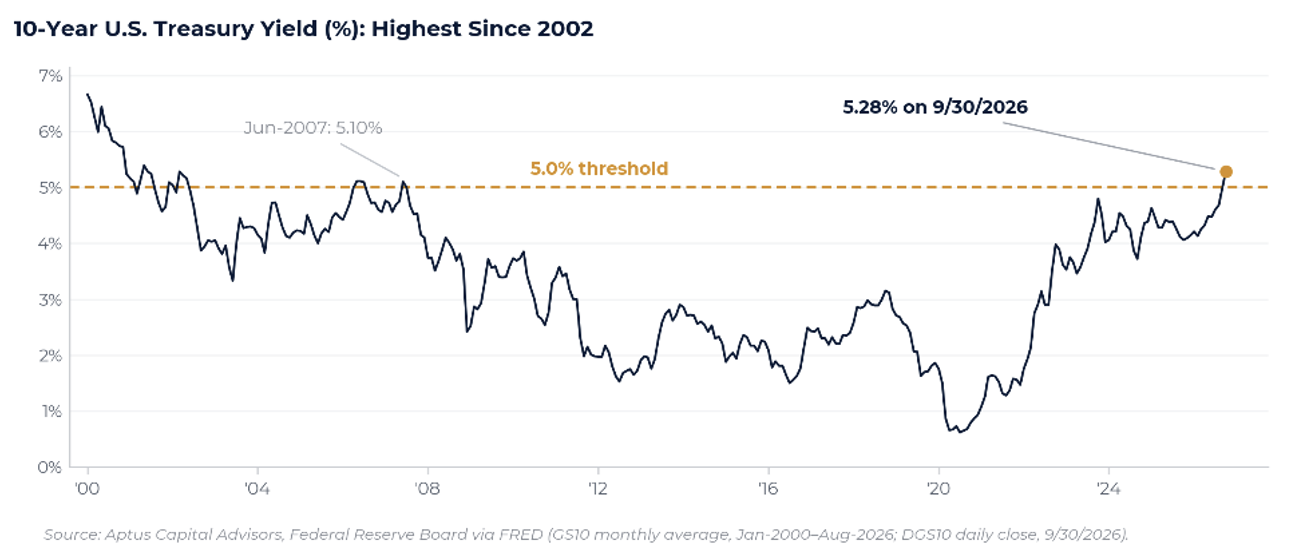 it. In 1987 it was the third. In 2000 it was the fifth. What both had in common was the long end. Long rates ran from 6% to 9% in 1987 while the S&P was up 30% on the year, and the 10-year climbed from 4.25% to 6.66% into 2000 while stocks kept right on rising. Rising rates alone aren’t the problem. Stocks climbing while blithely ignoring them is. We’ve had one hike this cycle, and the move in the 10YR Treasury has been steady rather than violent, which is worth watching without losing sleep over.
With all the rainstorms occurring, many investors lose sight of the ultimate goal – compounding capital. And the part that most people underestimate: the hurdle rate. It isn’t the 5% a Treasury pays you; it’s not the Fed’s inflation target. It’s whatever dollar is losing underneath you. There are only three ways out of a debt problem. Austerity, growth, or inflation.
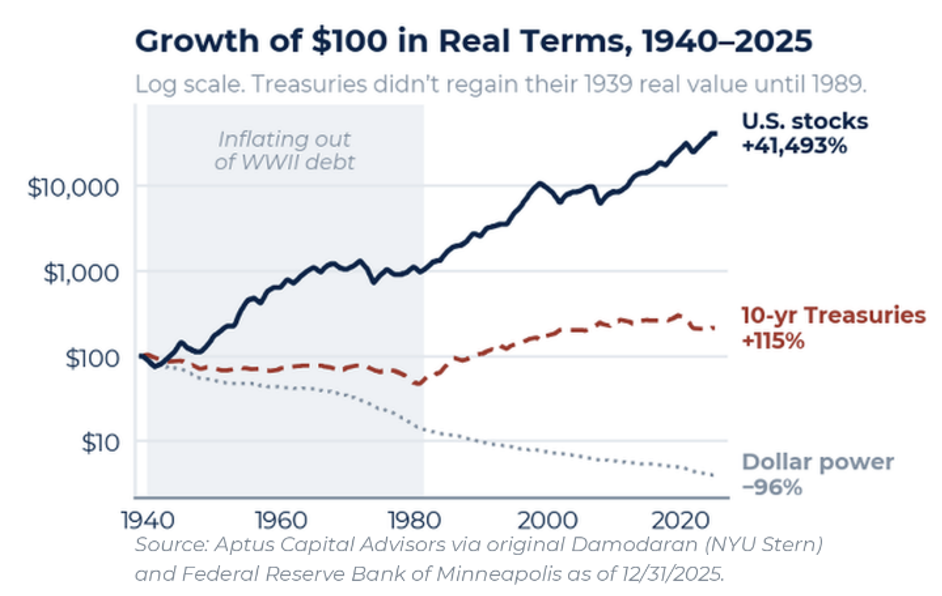 Austerity never lasts long enough to matter, which leaves growing out of it or inflating out of it, and government is leaning on both. Either path is a problem for bonds – no matter the real yield. Grow out of it and equity captures the upside. Inflate out of it and bonds pay the bill. Since 1940, $100 in stocks has become about $41,500 in real terms. That same $100 in 10-year Treasuries became $215, and Treasuries didn’t recover their 1939 purchasing power until 1989. Half a century of standing still – you either own the risk assets that appreciate, or you own the currency that gets debased. With the hurdle that high, the biggest risk in a portfolio right now isn’t being too aggressive. It’s being too conservative.
Which raises the obvious question: if you’re leaning less on bonds, what’s protecting the portfolio? Bonds still have a job. They deliver income and near-term clarity, and Aptus still owns them. What they can’t do is carry the defense by themselves. A bond isn’t a hedge; it’s a diversifier, and its cushion depends on a negative correlation that has never been dependable. Stock/bond correlation has spent more of history positive than negative, and 2022 is the recent proof: rates spiked, and both sides of the 60/40 fell together. So Aptus stops asking bonds to be the hedge and buys the protection directly, with convex payoffs that show up on schedule rather than on hope. Fund the brakes with hedges, then spend the freed-up risk budget on stocks. Bigger engine, better brakes, and an investor can hold meaningfully more of what compounds at a drawdown profile close to what they already own.
Pessimism will always sound smarter. It’s specific, it cites data, and it carries the tone of someone who has seen a few things. Optimism sounds naive by comparison, right up until you check the scoreboard. Bears sound smart. Bulls make money. Betting that right now is the beginning of the end is a bet against all of human history and against human nature itself, and progress has always come against a backdrop of catastrophe. Always has, always will. Investors tend to find whatever they go looking for, and results usually mimic the worldview they brought with them. Dolly spent sixty years being underestimated by people who thought they were the serious ones in the room, and she outlasted every one of them. Follow Dolly’s wisdom: Blondes have more fun. Same goes for bulls.
Market Recap Q3 2026: Don’t Let Jolene Steal This Market
 Dolly wrote “Jolene” after a red-haired bank teller kept flirting with her husband. Notice that the song never tells you whether Jolene won – the narrator just spends three verses pleading. Investors spent Q3 in the same posture, and the quarter gave them plenty to plead about.
The S&P 500 added 2.30% for the quarter and sits up 12.73% on the year, while the average stock lost 1.87% and small caps fell 7.27%. Leadership narrowed to the companies whose earnings did not need cheap money. Bonds took the real damage: investment grade lost 5.10% for the quarter, the Aggregate 3.51%, and the Aggregate is now negative 2.91% on the year with a quarter still to go. Rates did the damage, and they did it to bonds, not to stocks
Q3 came down to two prices: the 10-year Treasury yield and a barrel of oil. Yields climbed in all three months and finished at 5.3%, a level last seen in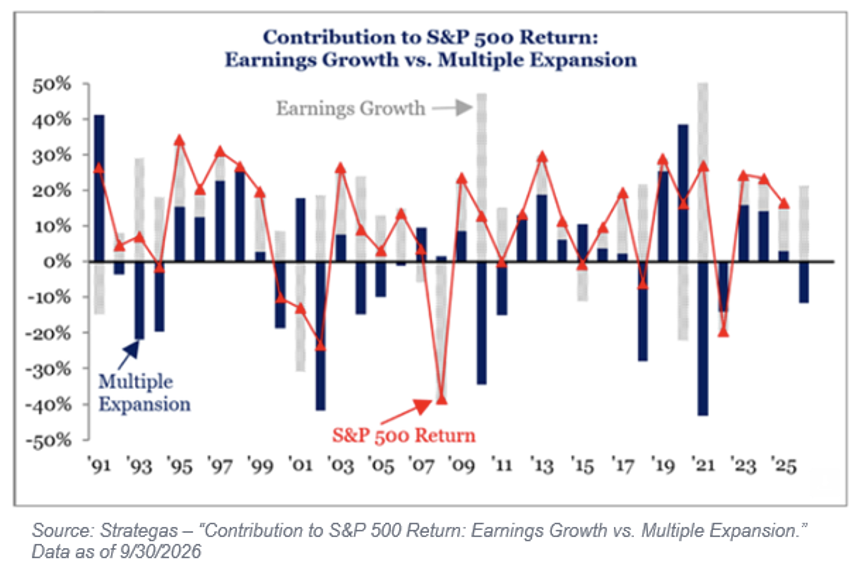 the summer of 2007, while crude stayed elevated with the Strait of Hormuz effectively shut. Nearly everything else in the quarter was downstream of those two moves. Rate-sensitive corners got repriced, and anything carrying floating-rate debt or a long-dated promise of profits had a hard three months.
Pulling the other way was AI, and it won. The capital spending cycle behind it no longer needs cheap money to justify itself, which is why the market shrugged off a September rate hike, the Fed’s first since 2023, with a signal that at least one more is coming. Five of the eleven sectors finished the quarter higher, energy first and utilities last. Within technology, the gains went to the companies cashing the checks rather than the ones writing them. A market carried out by earnings instead of by the Fed is a different market than the one investors spent the last decade learning to trade.
At the end of the day, it’s worth repeating that the stock market is not the economy. The S&P 500 is a collection of the largest and most adaptable companies in the world, and adaptability is the whole point.
Dolly has written more than 3,000 songs, and most of them come back to the same few stories: (1) the one that walks back through the door, (2) the villain who never shows, (3) the heartbreak that comes later, and (4) the sure thing she was smart enough to turn down. This market played all four at once. Four different Jolenes came for this bull market last quarter, and Dolly’s catalog tells you how each one actually ended.
1. The One That Walks Back Through the Door (“Here You Come Again”). In this market, that’s interest rates. Dolly’s crossover hit is about an old flame showing back up, and the 10-year yield just did the same, returning to levels not seen since the summer of 2007 after seven straight monthly climbs.
2. The Villain Who Never Shows (“Baby I’m Burnin’”). In this market, that’s inflation. Dolly cut this one in 1978, right as inflation was catching fire, and in 2022 inflation played the villain again, taking a wrecking ball to everything. This time, it never showed up. Inflation expectations have barely budged while yields climbed. A year ago, the 10YR paid 4.1%, and the S&P traded at 23x forward earnings. Today it’s ~5.3% and 19x. Stocks got a little cheaper, and earnings made up the difference. Rates matter. So do profits.
3. The Heartbreak That Comes Later (“Dagger Through the Heart”). In this market, that’s the Fed. The song sounds bright on top with heartbreak underneath, which is exactly how a hiking cycle feels. Bull markets don’t die of old age. The Fed puts a dagger through their heart, but only after it keeps twisting the blade, and we’ve had one turn of it so far. The damage shows up in corporate borrowing first, when companies that got used to refinancing cheaply suddenly can’t. Credit is holding up fine. If the heartbreak comes later, later isn’t now.
4. The Sure Thing She Turned Down (“I Will Always Love You”). In this market, that’s bonds. When Elvis wanted to record it, his manager told Dolly the deal came with a catch: sign over half the publishing. She said no, and Whitney Houston’s version later made that publishing worth a fortune. A fixed payday feels safe, but ownership compounds. Washington can’t cut its way out of its debt either, which leaves growth or inflation. Grow out, and owners get paid. Inflate out, and lenders get paid back in weaker dollars. So, investors need to be positioned like Dolly: more stocks, fewer bonds, the same amount of risk, with hedges doing the defending instead of bonds.
Heading into Q4, three things are worth watching: the pace of the Fed, the reopening of the Strait, and the politicalization of Advanced Computing. Earnings are tracking a third straight quarter of 25%-plus growth, and the index has not kept up – a year ago you paid 23x; today you pay 19x. Dolly has called herself a workhorse that looks like a show horse. So does this market: loud on the surface, with the returns ground out by profits rather than a rising multiple.
Market Fireside Chat: Islands in the Stream (The Bond v. Equity Stream)
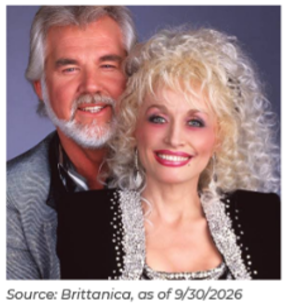 Kenny Rogers brought “Islands in the Stream” into the studio as a Bee Gees song he could not make work – four days of takes, nothing. Then Dolly Parton walked in, they cut it as a duet, and it went No. 1 on both the country and the pop charts. The fix was never the melody. It was that the song needs two voices singing different lines – Kenny asks, Dolly answers – and it only holds together because neither one is trying to do the other’s job.
Investors are having the opposite reaction to the same arrangement. The bond market looks like it is waving red flags: deficits near 6% of GDP, relentless issuance, a term premium that will not come down, and a 10-year yielding more than it has since 2007. The equity market, meanwhile, is handing the economy an all-clear on record margins and accelerating earnings, with stocks sitting near all-time highs. Put those two side by side, and the instinct is that one of them has to be lying. So, every quarter we get the same question: which one is wrong?
The premise is the problem. It implies that they are disagreeing over one thing when stocks and bonds are answering two entirely different questions. It’s not that one is singing off-key but that it’s two markets within one economy.
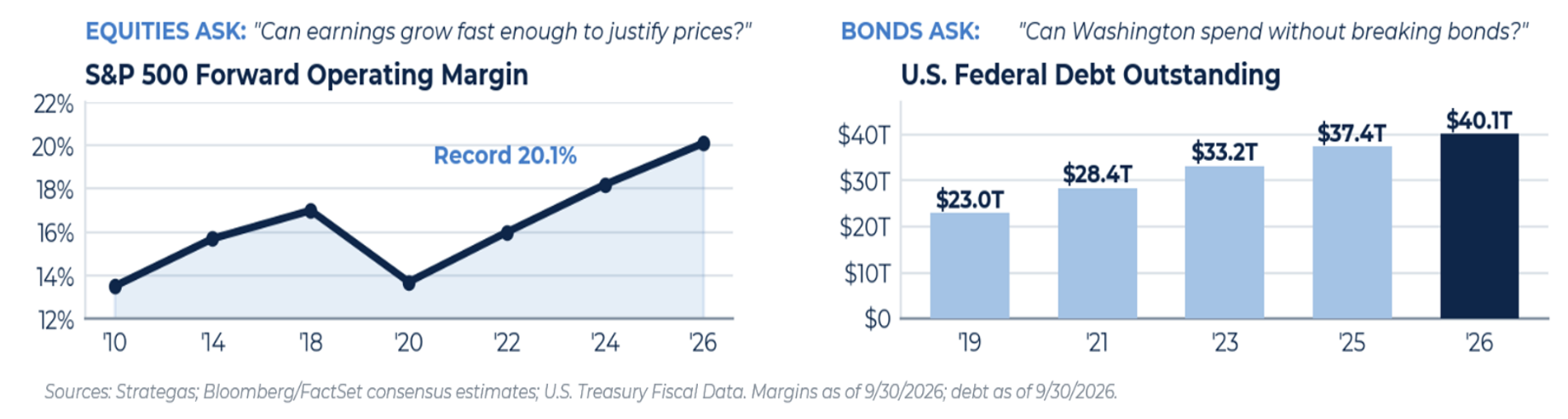
The equity market is having an earnings conversation. Two things are going right at the same time. First, companies are earning a lot more than they were a year ago – profits for the S&P 500 are expected to grow about 25% this quarter, and 85% of companies beat their estimates last quarter, the best showing in five years. Second, they are keeping more of what they bring in. Profit margins just hit a record 20.1%, meaning every dollar of sales is producing more profit than at any point in history. Growing profits and expanding margins are a tough combination to get in trouble with. Markets can usually handle flat margins too. It is when margins start to slip that profits stall and the market notices. Right now both are pointing the right way, and the gains are spreading beyond the AI names.
The bond market is having a fiscal conversation. Simply said, the bond market is finally starting to price in the ‘run it hot’ economy and we can prove that by looking at the three things that can drive longer-term interest rates.
1. Economic Growth: Growth is hot. The economy is running much faster than the Fed expected. Nominal growth is tracking near 8.4%, and that is the number bonds have to compete with.
2. Inflation Breakevens: The bond market is still betting inflation averages about 2.2% over the next decade, and that bet has not moved in three years. Inflation itself has picked back up, but expectations have not followed. This is not what is pushing yields higher.
3. Term Premium: The government has $40 trillion of debt outstanding and has to refinance more than half of it within three years. That is a flood of new bonds, and when supply goes up, buyers demand to be paid more. It has nothing to do with the Fed or inflation – just supply and demand.
Notice which two are doing the work. Growth and term premium are both pushing yields up. Inflation expectations are sitting still. That tells you something important: the bond market is repricing the economy, not repricing inflation. And that it may be very difficult to call a ceiling.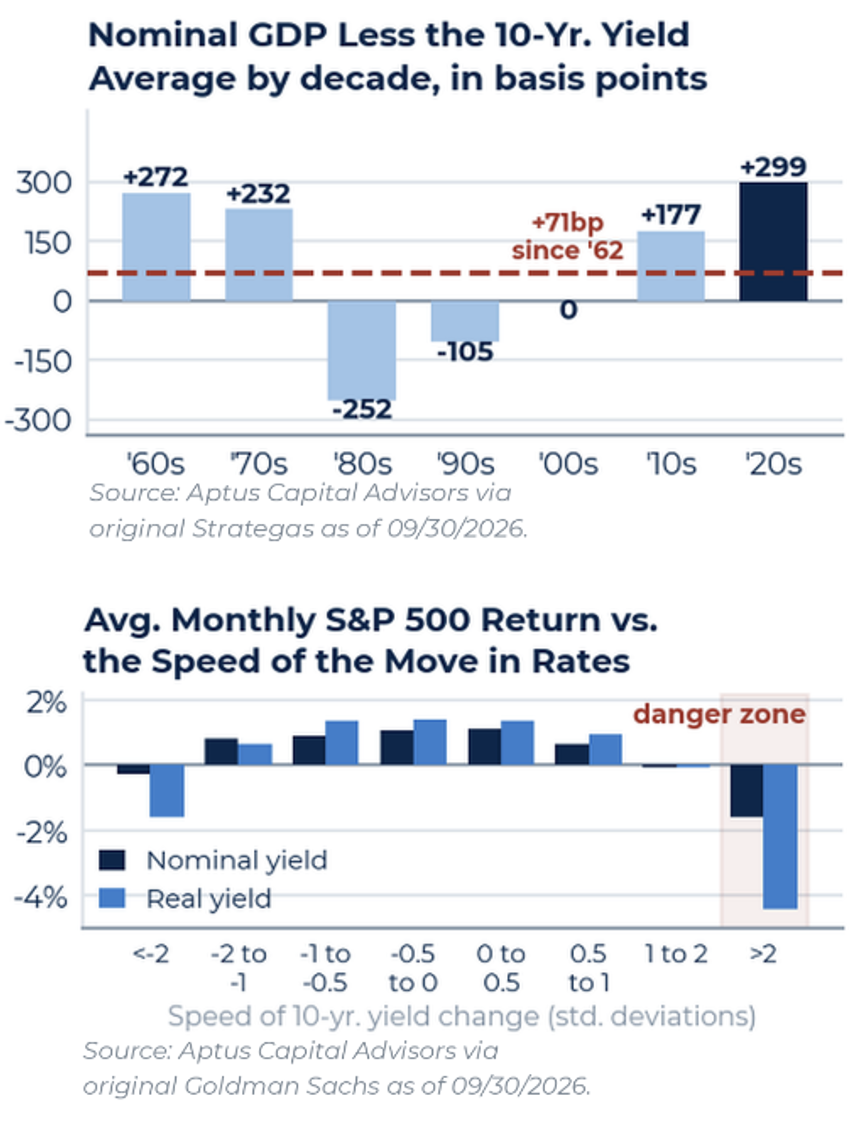
The old rule of thumb is that the 10YR should sit somewhere near nominal growth – the government has to pay you at least what you could earn in the economy you are lending to. Since 1962, that gap has averaged just 71 basis points, and only 33bp before the Fed started QE. This decade it has averaged 299bps, the widest on record. Even with the 10-year above 5%, nominal growth is still running ahead of it, and if that 8.4% pace holds, the gap widens rather than closes.
Put simply, bonds still are not paying you for the economy we actually have. Equities have already capitalized on that growth. Bonds have not. One of them has to move, and with the Fed stepping back from its balance sheet, the easier path is higher yields.
Which raises the obvious question: if yields climb further, does that break the stock market? Not necessarily – and this is where most investors get it backwards. It is not the absolute level of rates that hurts equity valuations. It is the speed of movement. Equities digest slow, grinding moves just fine. But once the pace crosses roughly two standard deviations – about 50bps inside 30 days – it starts to show up in equity valuations, and that is worth watching.
A duet, like Islands in the Stream, only works while each voice waits its turn. What breaks the song is not disagreement – it is both singers reaching for the same note at the same moment. Bonds and stocks are not at odds about this economy. They are working through the same story at different speeds, which is how this usually goes. As long as the bond market takes its time digesting above-average growth, the song holds together just fine.
Conclusions: Nobody Gets Paid to Wait
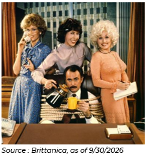 In the song 9 to 5, Dolly, Jane Fonda, and Lily Tomlin get fed up with a boss who steals credit and runs the office like his own personal kingdom. So they get him out of the way and run the place themselves: flexible hours, job sharing, an on-site daycare. The office does not fall apart. It gets better. Turns out most of what made that office miserable was never necessary. It was just friction nobody had bothered to remove.
Artificial Intelligence (“AI”) is about to do the same thing to a lot of business models, and a lot faster than Dolly did.
Nobody knows exactly how AI will change companies, sectors, or consumer behavior, which until now has always just been human behavior. But claiming it will not have an impact lacks both humility and creativity. Plenty of companies make real money off of us not bothering: the flight credits and loyalty points we never use, the subscription we forgot we had, the insurance claim nobody fights because it means five hours on hold. Then there is the savings account earning next to nothing while a money market fund sits a few clicks away. None of that is an accident, and at scale that inertia is worth real money to the firms sitting on the other side of it. Agents do not get tired, do not forget, and do not sit on hold. Friction that used to be a profit center is about to become a cost center, and the companies that do not adapt will get left behind.
When technology is being created faster than adoption, it can create a hesitant investor and can create an obvious temptation. A change this big makes it feel prudent to wait until the winners and losers sort themselves out or for the proverbial bubble to burst, and then invest. That instinct is the expensive one. Think about where this sat in 1997. Amazon had just gone public selling books, Google did not exist yet, and the companies everyone assumed would own the internet – AOL, Yahoo, Excite – mostly did not survive the decade. Anyone waiting for the picture to clarify was still waiting years later, and the market never held the door. The sorting takes far longer than the compounding does.
So how does an investor handle a paradigm shift nobody can see the end of? We think you have to be delusionally optimistic about the future while staying completely detached from how the universe gets there. Optimism is what keeps you invested. Detachment is what keeps you from pretending you know which companies get there first. Or put it the way Dolly has handled a 60-year career: you get up and go again, whether or not the morning gives you a reason. Keep showing up.
Take two theoretical investors, each putting $10,000 into the S&P 500 every year for 20 years. The first is the luckiest investor who ever lived. Every year,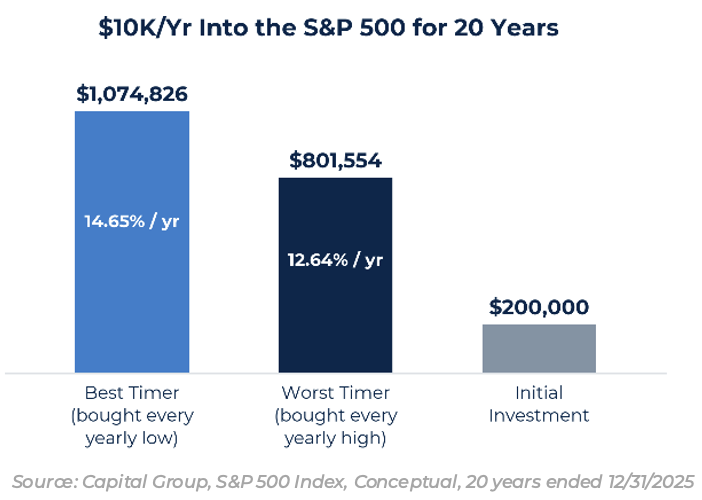 all twenty of them, she puts her money in at the market’s low for the year. Not near the low. The low. The second is her opposite. Every year, without fail, he buys at the market’s high. He is wrong twenty times out of twenty, at the worst possible moment each time.
You would expect that gap to be enormous. It is about 2% a year. The unluckiest investor in history still turned $200,000 into more than $800,000, four times what he put in. Neither of them got paid for sitting in cash waiting for a better entry point. Both got paid for showing up.
Time does the heavy lifting. Over the past 98 years, the S&P 500 has been positive in 74% of 1-year periods, 84% of 3-year periods, 88% of 5-year periods, and 94% of 10-year periods.
Right now there are plenty of reasons not to show up: (1) AI is rewriting the rules, (2) the 10YR Treasury is north of 5%, and (3) the Fed is hiking rates again. Waiting for clarity feels safe, but it’s actually very expensive. Investors should rather own more of a market with growing earnings near 30%, keep the guardrails on with hedges, and let time do what it always does. The coming years will be some of the most interesting ever for investors who like paradigm shifts and their ripple effects, and investors should watch it play out from inside the market rather than from the sidelines.
Dolly’s most famous song – I Will Always Love You – is a goodbye that never stops being a commitment. That is roughly where investors sit. A lot of what made the last decade work is leaving: cheap money, a Fed with your back, business models built on customers not bothering. You can say goodbye to all of it without saying goodbye to the thing that actually pays. Regimes end, cycles turn, and the rules get rewritten. What has never changed is that the money gets made by the people who stay in the room.
Time in the market beats timing the market, even for the unluckiest investor alive.
Disclosures
Past performance is not indicative of future results. This material is not financial advice or an offer to sell any product. The information contained herein should not be considered a recommendation to purchase or sell any particular security. Forward looking statements cannot be guaranteed.
This commentary offers generalized research, not personalized investment advice. It is for informational purposes only and does not constitute a complete description of our investment services or performance. Nothing in this commentary should be interpreted to state or imply that past results are an indication of future investment returns. All investments involve risk and unless otherwise stated, are not guaranteed. Be sure to consult with an investment & tax professional before implementing any investment strategy. Investing involves risk. Principal loss is possible.
The content and/or when a page is marked “Advisor Use Only” or “For Institutional Use”, the content is only intended for financial advisors, consultants, or existing and prospective institutional investors of Aptus. These materials have not been written or approved for a retail audience or use in mind and should not be distributed to retail investors. Any distribution to retail investors by a registered investment adviser may violate the new Marketing Rule under the Investment Advisers Act. If you choose to utilize or cite material, we recommend the citation be presented in context, with similar footnotes in the material and appropriate sourcing to Aptus and/or any other author or source references. This is notwithstanding any considerations or customizations with regards to your operations, based on your own compliance process, and compliance review with the marketing rule effective November 4, 2022.
Advisory services are offered through Aptus Capital Advisors, LLC, a Registered Investment Adviser registered with the Securities and Exchange Commission. Registration does not imply a certain level of skill or training. More information about the advisor, its investment strategies and objectives, is included in the firm’s Form ADV Part 2, which can be obtained, at no charge, by calling (251) 517-7198. Aptus Capital Advisors, LLC is headquartered in Fairhope, Alabama. ACA-2609-28.