
First, it’s been a longstanding tradition for me to always send out Ronald Reagan’s Soldier’s Pledge on the 4th of July… I’m just a little (lotta) late this year. It’s a great reminder that it’s always a great time to be an American.
Second, please send some ideas for future Musings. The list of potential topics is as long as a CVS receipt, but the data and information are changing faster than the direction of the wind. Nonetheless, please send ideas.
For those who may have missed it, we always distribute our quarterly market update on business day 1 of the quarter. Please reach out if you’d like to view the update or any of our Quarterly Investment Packet – Q2 2026 materials.
Even though we are here to talk earnings, I feel like we must at least briefly mention Iran. I acknowledge that I’m saying very little here because it’s difficult to offer a high-conviction view, as is often the case with geopolitical events of this nature. Market consensus lacks a clear edge. That said, recent developments remain concerning, though I believe the equity markets will continue to look through this, even with front-month Brent futures up 33% month-to-date.
The primary focus this week has been not only the escalation of military activity, but its geographic broadening; most notably regarding the Houthis and Red Sea shipping routes. Looking at the broader picture, I align with the view that neither side is achieving its strategic objectives, suggesting a period of controlled escalation until a turning point is reached. Yet, time continues to be the enemy here, particularly given the lack of tax stimulus that buttressed US household income in Q2.
Bigger picture, I believe that there are other factors that will contribute more to driving the market in the future. For example, is the market at peak profitability?
Nonetheless, it’s a big market week with earnings and a Fed meeting. My money is on no hike, but I will yield to John Luke on that front.
My favorite chart of the week:
Q2 2026 Earnings Preview
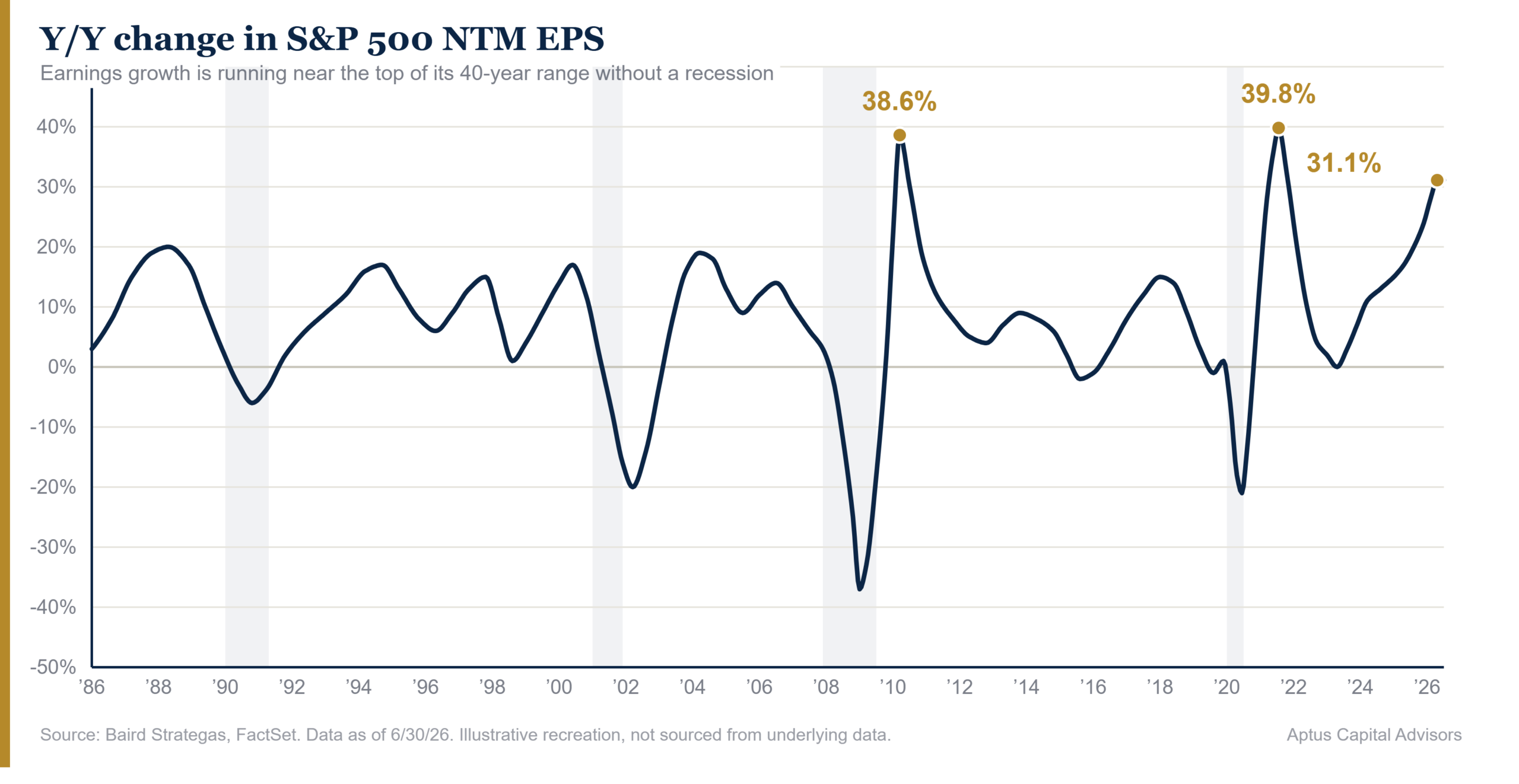
If you’ve been on any quarterly call with me, I’ve focused a lot on earnings. Specifically, I’ve focused on the earnings growth rate we are currently witnessing, which tends to occur only around market bottoms and recessions. Stated differently, we are experiencing unbelievable earnings growth. Despite the strong fundamental outlook, next-12-month (NTM) earnings growth has reached historically elevated levels. Looking back to the mid-1980s, there have been only two periods when NTM earnings growth exceeded today’s pace – both following major economic shocks.
Earnings growth peaked at 38.6% during the recovery from the Global Financial Crisis and 39.8% during the post-COVID reopening, fueled by unprecedented fiscal and monetary stimulus. Today’s 31.1% NTM earnings growth is occurring in the middle of the economic cycle, underscoring just how extraordinary the current environment is. The key question for investors is not whether earnings remain strong, but how the market will respond as earnings growth inevitably begins to decelerate.
 As of 7/26/2026
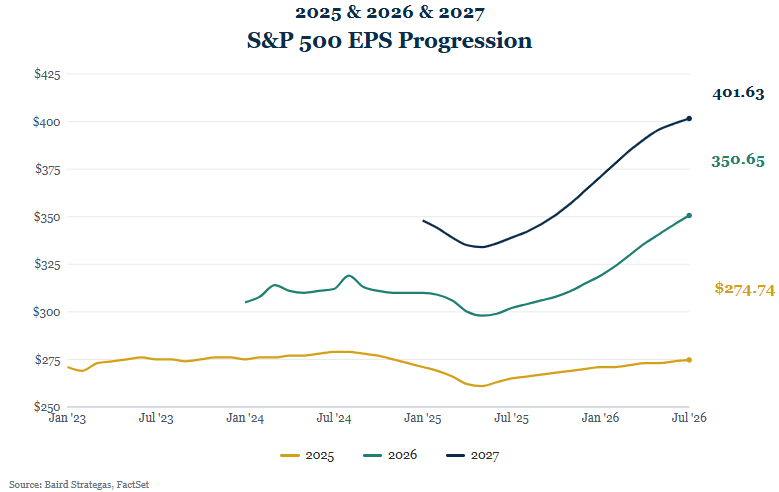
The bar for earnings is high entering this quarter (consensus called for +22% YoY EPS growth vs +17% in Q1) and, personally, I’d expect it to be met. But, even if the bar is met, that doesn’t necessarily always translate into a higher equity market, as the market is still grappling with higher capital expenditures (“capex”) from the hyperscalers (MSFT, AMZN, GOOGL, ORCL, and META) and the timing of a return on those investments.
2026 Growth Rate: +27.63%
2027 Growth Rate: +14.54%
 As of 7/26/2026
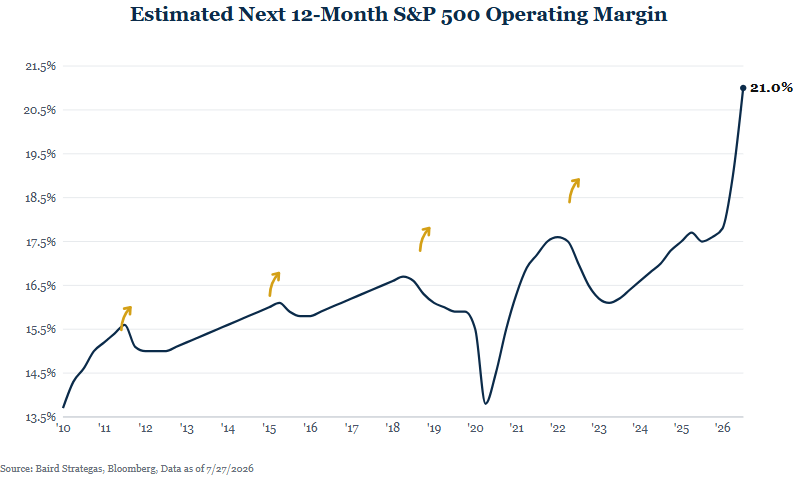
Here’s what I’m focusing on during this earnings season: profit margin.
Earnings growth is showing up where it’s supposed to, though the mix underneath is getting more concentrated. Margin expansion has been the engine of this cycle, and it’s still running, just less broadly than before. Equal-weighted margin expansion has flatlined, and market-cap-weighted gains are increasingly carried by a handful of mega-cap names, many of which are also footing the bill for AI infrastructure spend. We don’t see this as peak margins; pricing power still looks intact, and there’s no obvious catalyst forcing margins lower.
What’s worth watching is the pace of growth rather than the level, with input costs and rising depreciation as AI capex comes online creating some friction at the margin. The lack of upward revisions to third and fourth quarter estimates is the key indicator to track. Even a shift from tailwind to neutral wouldn’t be alarming on its own, but it’s a good reminder to keep expectations grounded as the easy comparisons fade.
Valuation in the equity market looks quite palatable relative to where sentiment might suggest. In fact, despite investor enthusiasm for stocks this year, valuation in the broader market hasn’t kept pace, with the S&P 500’s forward P/E ratio now sitting below where it started 2026. The math is straightforward: when the earnings denominator grows faster than the price numerator, the multiple compresses, and the S&P 500 has been tracking toward back-to-back quarters of earnings growth above 20%.
In other words, earnings haven’t just kept pace with the market’s advance this year; they’ve done the heavy lifting and then some, leaving the multiple cheaper today than when the year began even as prices have climbed.
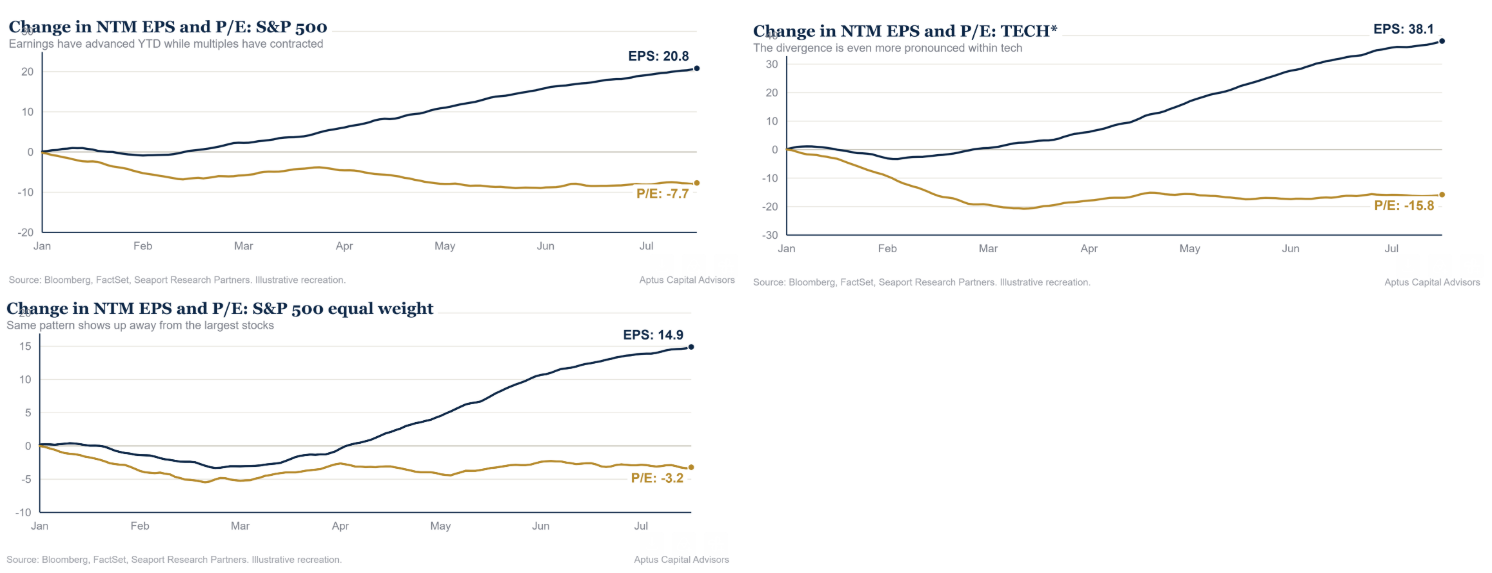 Illustrative recreation. Source: Bloomberg, Factset, Seaport Research Partners as of July 2026
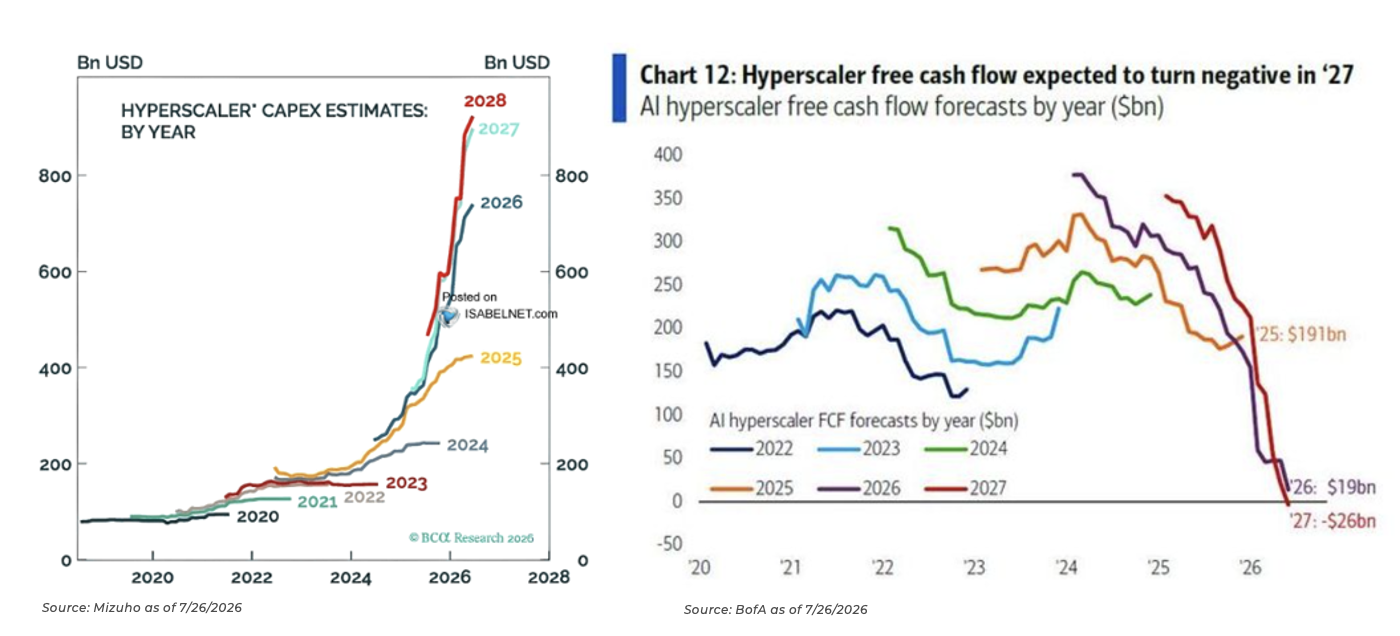
As stated above, capital expenditures (“CapEx”) continue to be front and center in all market commentary. Investors are asking a question that has surfaced repeatedly throughout market history: When does extraordinary capital spending cease being a competitive advantage and begin destroying shareholder returns? While this may sound alarming, I’m not too worried about it. Last week, on CNBC Asia, I spoke about GOOGL’s increased CapEx expectations for ’26:
“Bears will call that reckless. I’d call it conviction. When Search is still printing money, Cloud is accelerating, and YouTube is humming, you don’t play it safe – you build the moat deeper while you can. If Alphabet keeps converting its cloud backlog into real revenue at this pace, this isn’t just a good quarter – it’s a signal that Alphabet has fully arrived in the AI era, not as a follower, but as one of the companies setting the pace.“
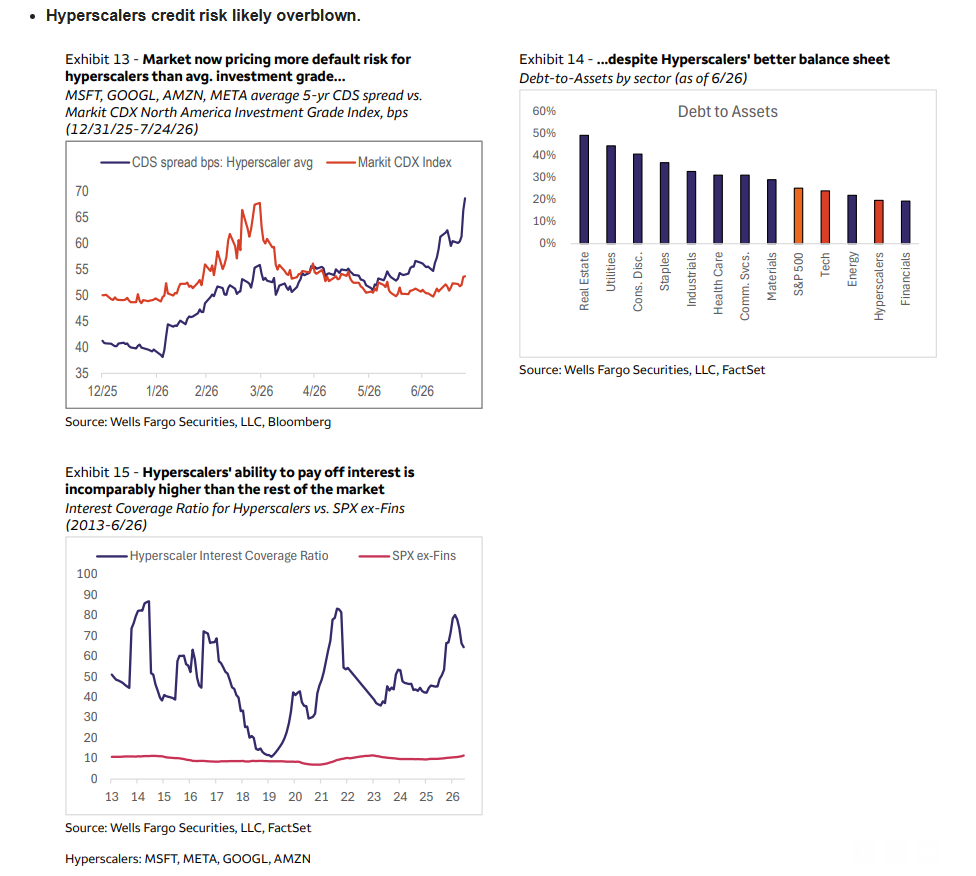
Negative free cash flow for the hyperscalers isn’t a red flag so much as a reinvestment story – the shortfall is being driven by surging AI capex, not deteriorating operations, and operating cash flow is still growing about 23% a year even as capex growth outpaces it at roughly 70%. All five hyperscalers remain profitable, and increasingly so, which means the cash being consumed is going toward building out infrastructure for a longer growth runway rather than papering over a weakening core business. In that light, negative FCF looks less like a warning sign and more like the natural cost of front-loading investment ahead of a payoff that’s expected to show up over years, not quarters.
Buckle up, though, because the market is pricing in a lot of implied volatility around single names.
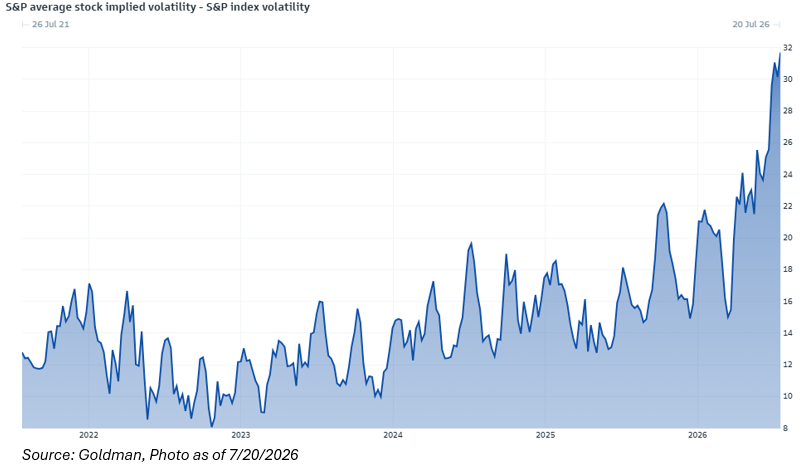
As always, given the record amount of dispersion in the market, please hit me up if you’d like to talk through any individual names.
Disclosures
Past performance is not indicative of future results. This material is not financial advice or an offer to sell any product. The information contained herein should not be considered a recommendation to purchase or sell any particular security. Forward looking statements cannot be guaranteed.
This commentary offers generalized research, not personalized investment advice. It is for informational purposes only and does not constitute a complete description of our investment services or performance. Nothing in this commentary should be interpreted to state or imply that past results are an indication of future investment returns. All investments involve risk and unless otherwise stated, are not guaranteed. Be sure to consult with an investment & tax professional before implementing any investment strategy. Investing involves risk. Principal loss is possible.
Advisory services are offered through Aptus Capital Advisors, LLC, a Registered Investment Adviser registered with the Securities and Exchange Commission. Registration does not imply a certain level of skill or training. More information about the advisor, its investment strategies and objectives, is included in the firm’s Form ADV Part 2, which can be obtained, at no charge, by calling (251) 517-7198. Aptus Capital Advisors, LLC is headquartered in Fairhope, Alabama. ACA-2607-32.
