
When many things are happening in the world, like right now, remember to keep things in perspective:
1) We don’t know what we don’t know – that’s OK, and
2) The importance of keeping an open mind.
We approach this by prioritizing price first and narrative second. In other words, price drives narrative. When the market endures these types of geopolitical events, it tends to accelerate existing trends more than cause a regime change.
So don’t lose the plot when the market screens are flashing red. I know it’s hard to stay focused sometimes, but pay attention to what’s most important: Economic Growth and Profitability.
Let me know if you’d like me to send you our commentary on the Iran situation.
This Musing will be a bit different; it won’t focus on the current market dynamics, like the majority of our musings. Since the information below is the main principle of our allocations, I wanted to do this passion project. But I can tell you that it took even more passion to keep it relatively simple. This will be a two-part Musing:
Part I: The Importance of Structure
Part II: Why the Tails Matter
In an investment world with substantial tilt consensus, where investors are forced to either double down on their tilts or constantly defend performance, we believe there is a better way. We continually find advisors who don’t know how to frame performance challenges – what is their biggest fear? Is it underperforming? Drawdowns? Or is it being too similar or too different from the benchmark?
We don’t believe those answers are mutually exclusive. Proper asset allocation structure answers all of those performance questions. Follow our rationale below:
We’ve Preached This a Ton: What Are Aptus’ Core Beliefs?
We’ve Preached This a Ton: Why Do We Focus So Much on Structure?
New Preaching: Proving that Asset Allocation Structure Means Everything. We’ve said it qualitatively; now let’s show it quantitatively.
Utilizing proper asset allocation structure is Aptus’ #1 conviction – Always has been, always will be.
The Importance of Structure
1. What are Aptus’ Core Beliefs?
Most readers know our core investment belief regarding asset allocation: More Stocks, Less Bonds, While Remaining Risk Neutral.
How would you answer this question: What is the most important market dynamic to occur in our lifetimes?
My answer would be the 4-decade-long secular decline in interest rates. Why? Markets thrive when rates continuously decline because (1) this lowers the discount rate, thus increasing valuations, and (2) it allows for cheap access to capital that accommodates consumer and corporate growth.
Analogously, having a secular decline in interest rates is like riding the moving sidewalk at the Atlanta airport. When you reach the end, you feel like you completed an arduous task successfully, but in reality, did you really achieve it all by yourself? No. Lower rates provided investors with significant support along the way. What if that is not the case moving forward?
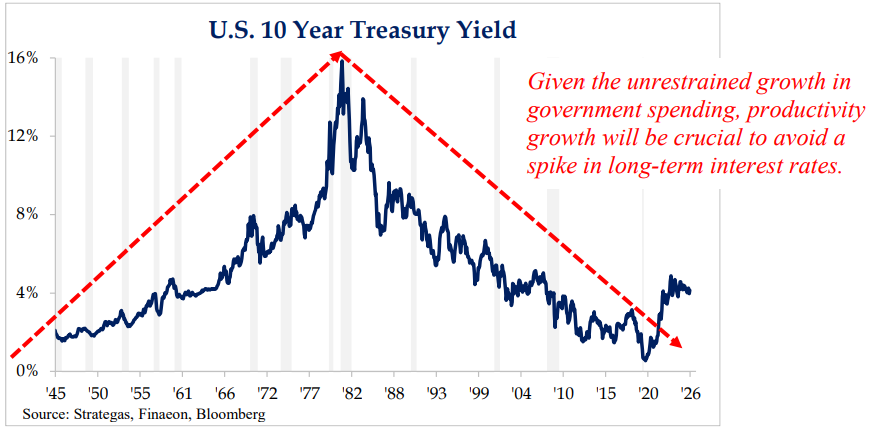 Data as of 03.07.2026
Whether interest rates regain momentum and head lower, or remain structurally higher for longer, Aptus believes it has a better mousetrap to challenge modern portfolio theory, and that relying solely on the antiquated 60/40 approach is one of the best ways to unintentionally inject longevity risk into a portfolio.
It all starts with proper asset allocation structure. We believe that more stocks, less bonds, while remaining risk neutral does a better job of addressing the following
Modern Portfolio Theory problems:
-
-
-
- Drawdown Dilemma (Left Tail): Bonds may not provide protection during bouts of volatility
-
-
-
-
-
- Longevity Dilemma (Right Tail): Bonds do not provide the necessary after-tax real returns
-
-
-
-
-
- Understanding that the investment hurdle rate is much higher than the arbitrary 2% inflation target
-
-
Basically, how do we construct a portfolio that minimizes fixed income exposure without increasing risk?
2. Why Do We Focus On Structure So Much?
Get the big things right, and the little things matter much less. Many investors believe that conviction on tilts/exposures drives long-term results. In fact, we believe it adds very little benefit over longer periods of time.
Focus on What You Can Control, Prepare for What You Cannot: Understand what’s important, understand what you can control, and focus your time and resources accordingly. Per Vanguard, the majority of an investor’s long-term return comes from proper asset allocation (91% contribution to returns) and not individual exposures (9% contribution to returns).
The Controllable (Asset Allocation Structure) – This may be one of the most overlooked aspects of investing, even though an investor controls it. Without a proper asset allocation structure, you can inadvertently expose clients to unintentional risk. With proper structure, we believe that investors can obtain alpha by mitigating risk, and
The Uncontrollable (Fund Performance Outcomes) – Tilts towards sectors, durations, and factors are active ways to adjust the portfolio to a certain view over time. However, these tilts typically receive more attention than they deserve. Studies have shown that making these “bets” does not add much value over longer periods and actually injects an unwanted volatility tax.
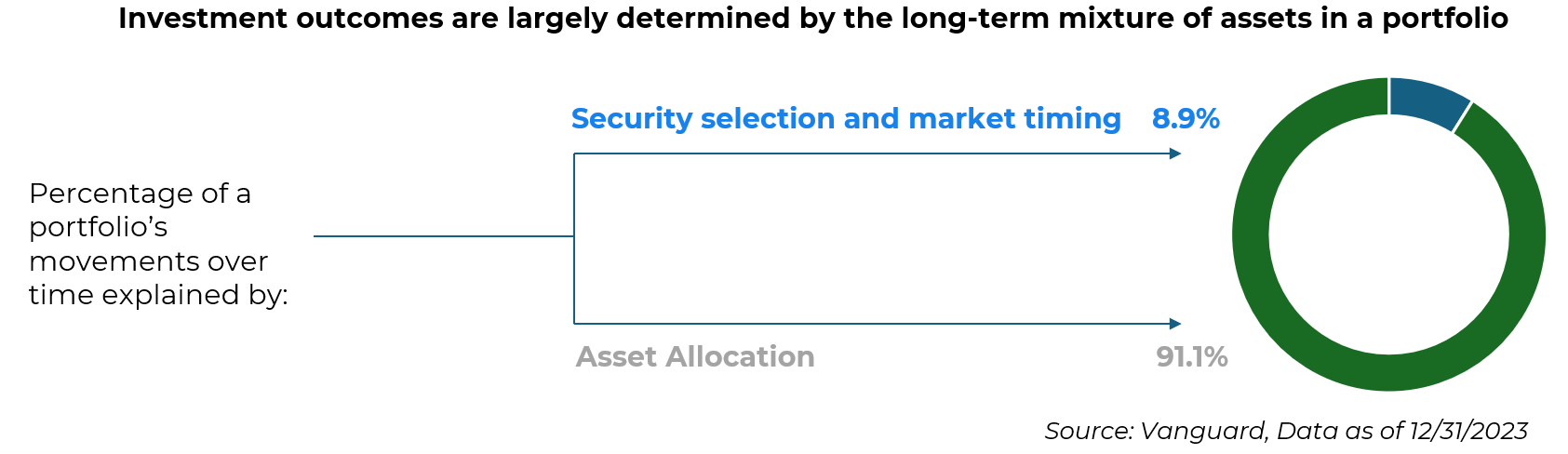
Yet, most investors spend their time on security selection and market timing, not on what actually drives returns. Or investors confuse proper structure with investment due diligence processes.
What is our Asset Allocation Structure? More stocks, less bonds, while remaining risk neutral.
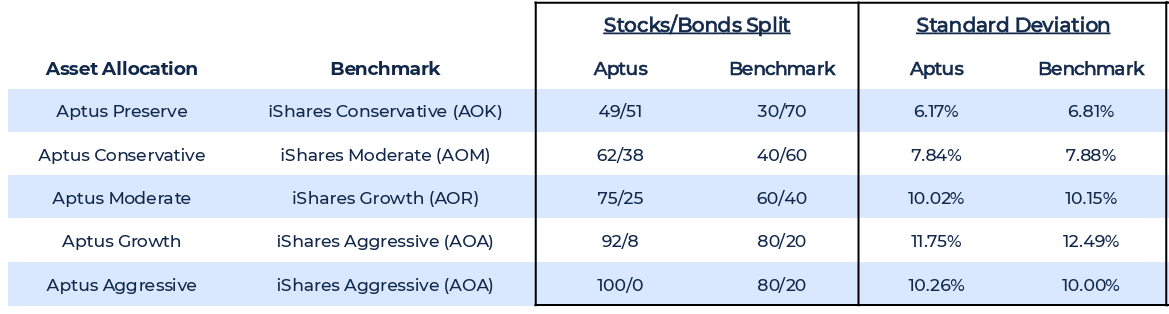
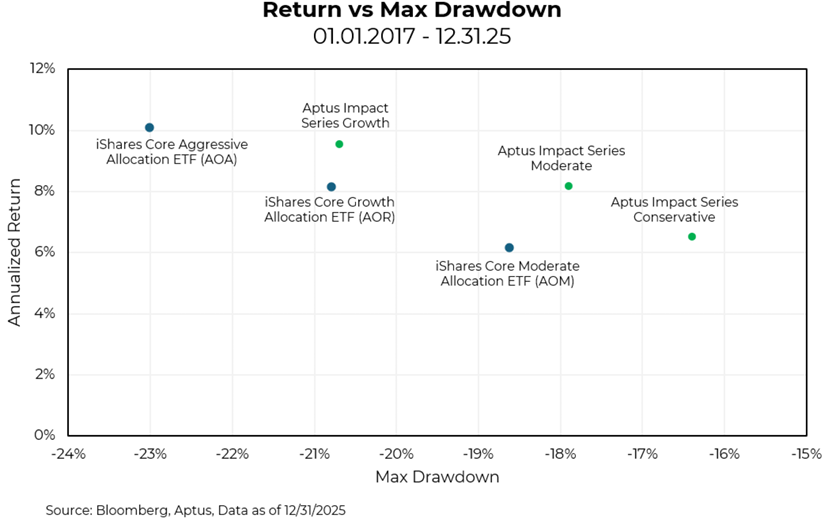
- Proving that Asset Allocation Structure Means Everything:
This is the new part for longtime listeners and first-time callers.
What is the overall lesson learned in this section? A lot of Investment Sins Can Be Forgiven With Proper Structure.
Let’s set the stage. We’ll look at three (3) different portfolios and their returns since 2020.
Portfolio 1: Modern Portfolio Theory – A Classic 60/40 portfolio that utilizes the exact same tilts (as a % of equity) as the Aptus Impact Series Moderate Portfolio (Which is Portfolio #2)
Portfolio 2: Aptus Impact Series Moderate – This is Aptus’ 60/40 equivalent portfolio that utilizes more stocks and fewer bonds, while remaining risk-neutral, ultimately becoming a 75/25 portfolio
Portfolio 3: The Benchmark – Blackrock iShares 60/40 Portfolio (ticker: AOR)
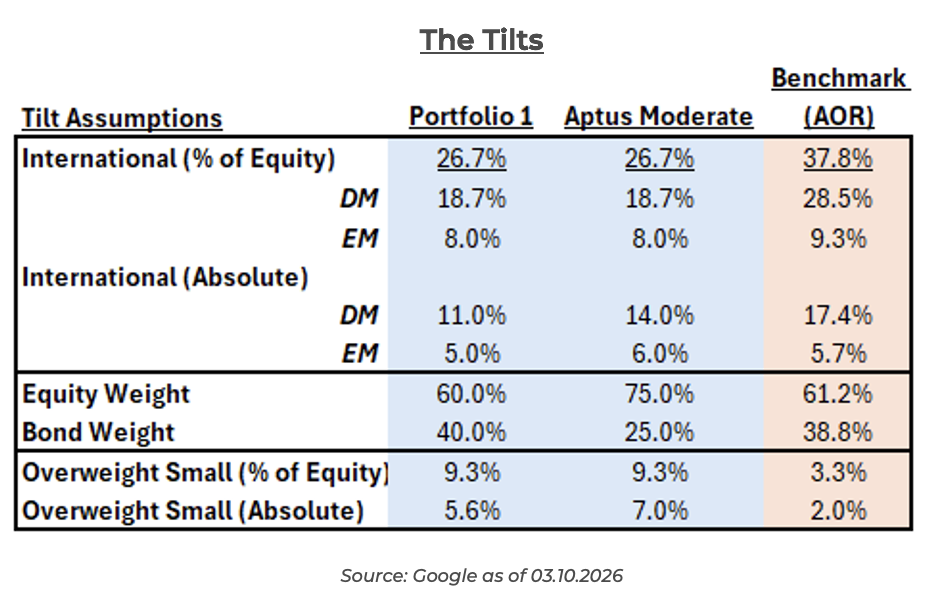
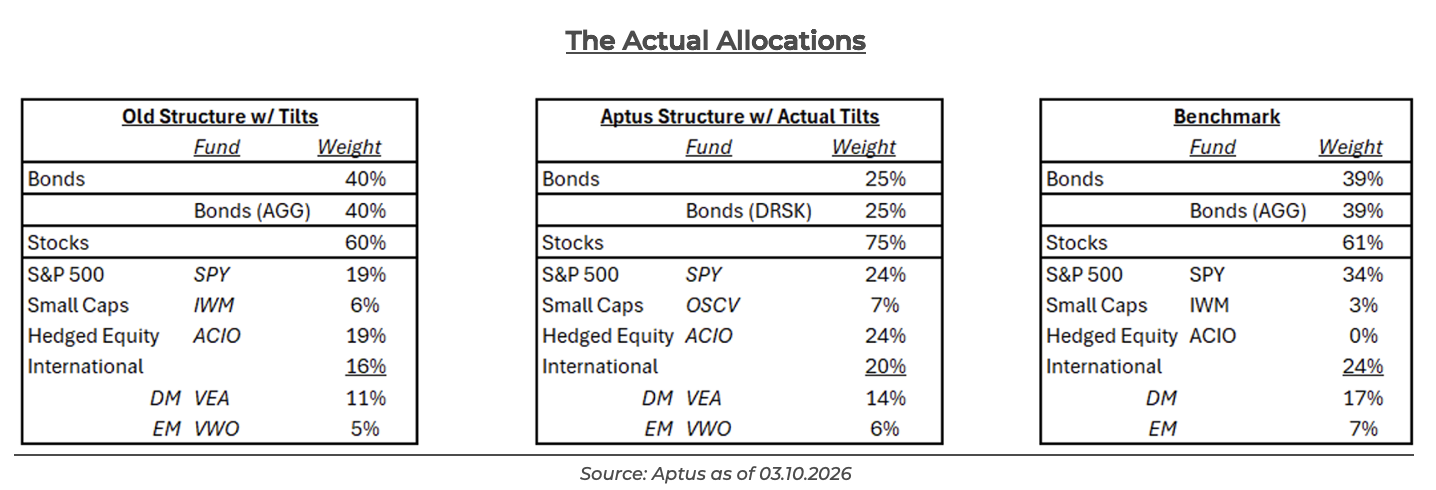
Notice that Portfolio 1 (MPT that is 60/40 w/ Aptus tilts) and Aptus Moderate have the exact same tilts as a percentage of equity. For example, international equities constitute 26.7% of equities, and small caps constitute 9.3%. Everything else remains constant between the portfolios. This keeps the study static for a better apples-to-apples comparison. Portfolio 3 is just the BlackRock iShares 60/40 Benchmark (AOR).
Investors tend to have stylistic tilts, such as being overweight domestic stocks, small caps, or quality assets. Picking stocks, selecting funds, and timing the market is why many investors enter this industry, because it’s fun. But many investors’ performance tends to ride or die with how their tilts perform. Over longer periods of time, that’s not a winning game plan, as being correct over 51% in this industry puts one in hall of fame status. However, if one doesn’t consistently win 51% of their bets, it can substantially deviate from their compounded annual growth rate (“CAGR”), lowering a portfolio’s terminal value, a disservice to clients.
Proper structure allows many investment mistakes to be forgiven. While proper structure doesn’t outperform all the time, it does a great job of minimizing return environments that substantially underperform the benchmark. Said differently, it can help mask tilts that underperform.
Looking at the returns below, you’ll realize that, while it doesn’t always outperform, it performs well because it follows the rules of sequencing of returns. It seeks alpha by mitigating really bad absolute and relative return years. Seeking alpha through risk mitigation.
 Source: Bloomberg as of 02.27.2026
While we are proud to outperform the benchmark returns, that performance isn’t what stands out most to us. Look at the returns of Portfolio 1 (60/40 structure with the same allocation tilts as the Aptus Moderate portfolio) versus the Aptus Structure. Remember, these two portfolios have the exact same tilts as a percentage of equity (e.g., International at 26.7% of equities, US Small Caps at 9.3%, etc.). The Aptus Moderate over-allocates to stocks while keeping risk in check (as seen in the second section). Many may question this analysis, as the market has been in a secular bull market since October 2022, but look at CY 2022 – even with the overallocation to equities (overweight by 15% in the Aptus Moderate), protection on the downside was stellar.
Aptus’ Moderate Portfolio outperforms Portfolio 1 by 21% over a six-year timeframe; that is, over 3% annualized. Structure. Drives. Returns.
To us, this shows that one can take on more equity exposure than they think. By over-allocating to risk assets, you directly negate longevity risk, attacking the necessary higher hurdle rate head-on. However, utilizing proper guardrails through hedged equity can still keep risk in check during left tail events. More stocks… less bonds… while keeping risk in check.
We believe that this is the recipe for success.
We always say that the hardest way to get new ideas into one’s head is to get the old ideas out. We understand that school teaches modern portfolio theory and reinforces the 60/40 portfolio. But, this analysis is antiquated and was pushed well before the innovation of hedged equity ETFs and other efficient tools that can better asset allocation structure. Specifically, ones that have liquidity, unlike other alternatives. So, if your custom moderate portfolio has less than 75% equity exposure, ask yourself why. Get the old ideas out of your head.
Remember, simple beats complex. Let the structure work for you.
We’re always available for calls and questions.
Disclosures
Past performance is not indicative of future results. This material is not financial advice or an offer to sell any product. The information contained herein should not be considered a recommendation to purchase or sell any particular security. Forward looking statements cannot be guaranteed.
This commentary offers generalized research, not personalized investment advice. It is for informational purposes only and does not constitute a complete description of our investment services or performance. Nothing in this commentary should be interpreted to state or imply that past results are an indication of future investment returns. All investments involve risk and unless otherwise stated, are not guaranteed. Be sure to consult with an investment & tax professional before implementing any investment strategy. Investing involves risk. Principal loss is possible.
Advisory services are offered through Aptus Capital Advisors, LLC, a Registered Investment Adviser registered with the Securities and Exchange Commission. Registration does not imply a certain level of skill or training. More information about the advisor, its investment strategies and objectives, is included in the firm’s Form ADV Part 2, which can be obtained, at no charge, by calling (251) 517-7198. Aptus Capital Advisors, LLC is headquartered in Fairhope, Alabama. ACA-2603-12.