
Tiger Woods, one of the greatest golfers of all time, has changed his swing four times in his professional career. One might ask why someone with two separate streaks of more than 260 weeks as the top ranked player in the world, 82 career victories and 15 major wins, would ever change what has helped him to reach this level of success?
His explanation was that he was in pursuit of preventing what he called the “Big Miss”. The “Big Miss” is that one bad swing that can cause a player to hit a stray tee shot that costs them the tournament, and each change Tiger made was one he hoped would eliminate the potential for that result.
From our perspective, there are two “Big Misses” in investing; the failure to stay invested, and a short time horizon. Let’s walk through both.
Failure to Stay Invested
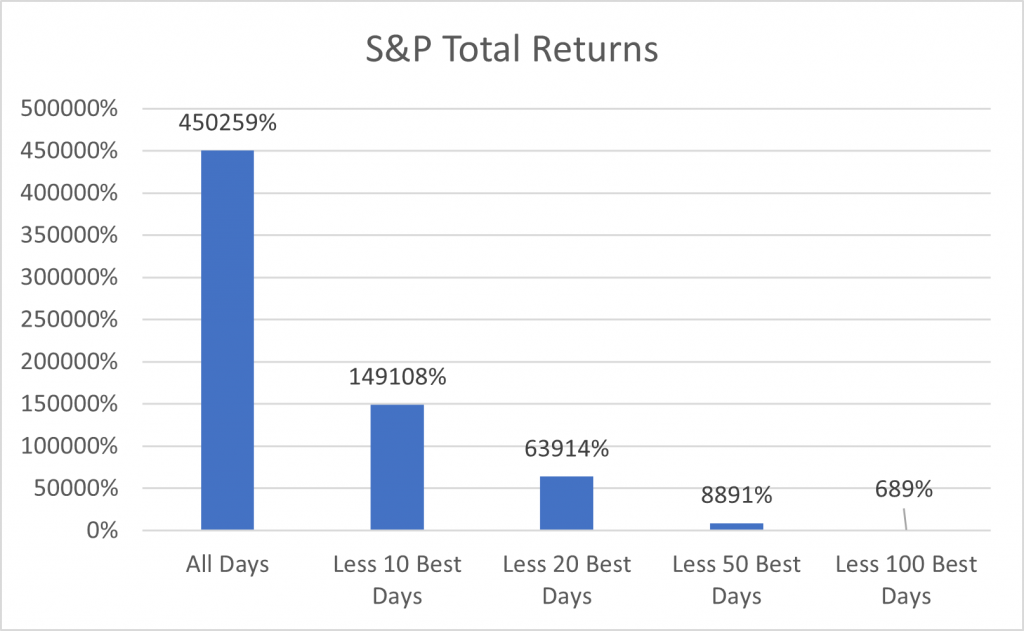
There may be a myriad of reasons for not staying invested, but we believe it is typically an individual’s fear of a large drawdown, or an attempt to time the market. Both can be detrimental to portfolio returns and increase longevity risk within portfolios. To illustrate what can happen from the failure to stay invested, we have calculated the impact on returns if we exclude some of the best days in the market, using the best daily percentage returns for the S&P 500 Total Return Index:
Source: Bloomberg. Returns are from S&P 500 from 12/31/1927 through 08/31/2020 with reinvested dividends.
Since the start of 1928, there have been 23,292 trading days with a cumulative total return in the S&P 500 of 450,259%. This an exceptionally large and difficult number to comprehend, mostly due to the extended time horizon that is much longer than the average investor’s. To help put into perspective, if you had invested $10,000 at the close on December 30, 1927 and not touched it, you would now have roughly $45,035,878.
If you had missed just the 10 best days in the market, a mere 0.04% of trading days, you would only have $14,920,820. That is a whopping $30 million less from missing just the 10 best trading days! It logically continues to get worse as you exclude more of the best days. For example, if you missed the top 100 days, only 0.43% of total trading days, you would only have $78,929, more than $44 million less than if you had stayed invested.
We would be remiss to not mention the exclusion of the worst market return days. Avoiding large down days can have major positive impacts on your portfolio, but the ability to time these is difficult, and often some of the best days in the market are during large bouts of volatility. In our opinion, it is much easier to invest in strategies that help to keep you invested, and avoid the “Big Miss” of not benefiting from the best return days that can cost investors thousands, and possibly millions of dollars over time.
Short Time Horizon
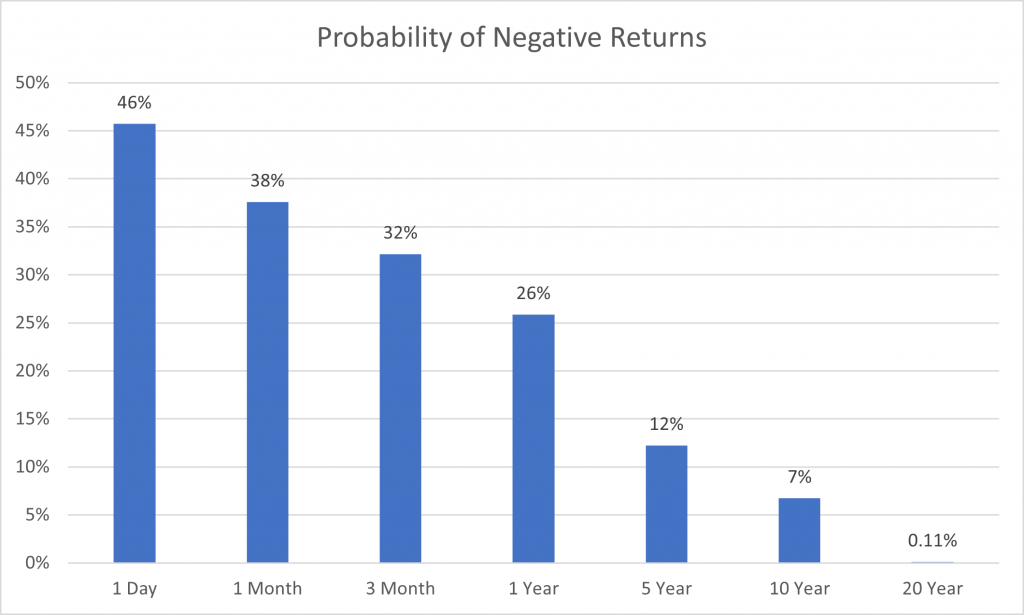
In our view, investors also tend to focus too much on the short-term “noise” in the market. There is usually great deal of variability in the day-to-day, with different economic, geopolitical, and company-specific news constantly moving markets. We believe the best method for loss avoidance is to expand your time horizon. Let’s take another look at the numbers:
Source: Bloomberg. Returns are from S&P 500 from 12/31/1927 through 08/31/2020 with reinvested dividends.
As the chart illustrates, you have roughly a coin-flips chance of losing money on any given day. Based on our calculation, your odds of losing money continue to decrease from there as you expand your time horizon. Less than 7% of rolling 10-year data points are negative in total return, and only 0.11% of rolling 20-year periods. There is just one time since 1928 that over a 20-year period you failed to make money when holding stocks.
From our perspective, failing to look through the short-term noise in the markets is akin to abandoning your golf round after one three-putt. In investing, as in golf, we believe the best method for loss avoidance is to expand your time horizon to tilt the odds in your favor for success.
Conclusion
Investor behavior is exceedingly difficult to change. We believe the numbers are clear, but these are complex behavioral and financial decisions. Studies that have expanded on Kahneman & Tversky’s 1979 piece on “loss aversion principles” suggest that the psychological pain investors feel from a loss is twice as strong as the joy they receive from a similar size gain.
We believe Aptus’ approach closes this psychological gap with disciplined Drawdown Patrol Investing, a suite of proprietary funds that complement a globally diversified portfolio. The funds seek to avoid large drawdowns and keep pace in up markets, creating a compelling long-term investment solution. By staying invested for the long-term, individuals can potentially avoid those “Big Misses” in investing.
Disclosures:
Past performance is not indicative of future results. This material is not financial advice or an offer to sell any product. The information contained herein should not be considered a recommendation to purchase of sell any particular security. Forward looking statements cannot be guaranteed.
This commentary offers generalized research, not personalized investment advice. It is for informational purposes only and does not constitute a complete description of our investment services or performance. Nothing in this commentary should be interpreted to state or imply that past results are an indication of future investment returns. All investments involve risk and unless otherwise stated, are not guaranteed. Be sure to consult with an investment and tax professional before implementing any investment strategy.
The S&P 500 Index is the Standard & Poor’s Composite Index and is widely regarded as a single gauge of large cap U.S. equities. It is market cap weighted and includes 500 leading companies, covering approximately 80% of available market capitalization.
Aptus Capital Advisors, LLC is a Registered Investment Advisor (RIA) registered with the Securities and Exchange Commission and is headquartered in Fairhope, Alabama. Registration does not imply a certain level of skill or training. More information about the advisor, and its investment strategies and objectives, is included in the firm’s Form ADV Part 2, which can be obtained, at no charge, by calling (251) 517-7198. The Funds are distributed by Quasar Distributors LLC, which is not affiliated with Aptus Capital Advisors, LLC. The information provided is not intended for trading purposes and should not be considered investment advice. Please carefully read the prospectus before making an investment decision. ACA-2009-20.