
The 10-year Treasury yield is sitting around 5.00%, and the 30-year at ~5.37% (as of 9/16/26) — both brushing up against levels last seen in 2007. The Fed met today and delivered a 25bps hike, and if you have followed the 2yr Treasury (4.65% going into the meeting, 90bps above the Fed Funds rate), this was hardly a surprise (more on the FOMC below). Before we comment on the FOMC meeting, we felt it was important to ask another question: what’s actually pushing yields higher, and how much of it is even the Fed’s to control?
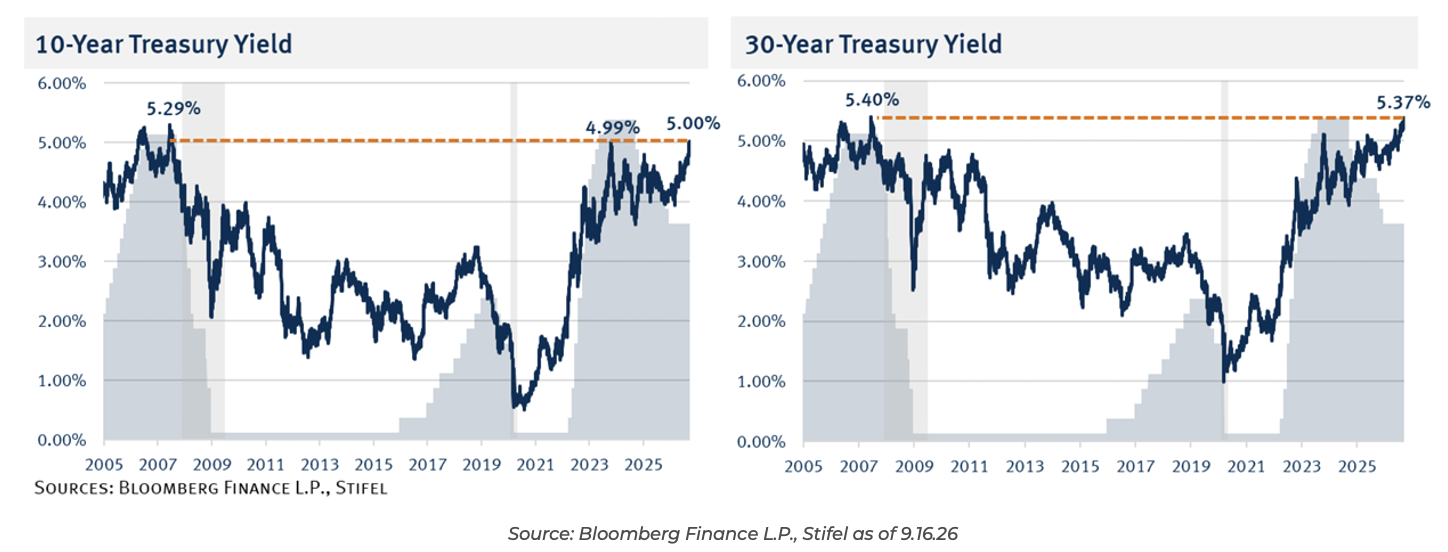
It’s worth keeping things in perspective: relative to the long-term average, current yield levels aren’t extreme (10-year UST average rate over the last 50 years = 5.7% and over the last 75 years = 5.4%). What feels jarring has been the recalibration. We spent over a decade in an artificially low-rate regime engineered by 0% rates and quantitative easing; what we’re seeing now looks more like a normal economy repricing back toward its long-run average, not so much reason for disaster.
Anatomy of the 10-Year Treasury Yield
It helps to break the 10-year yield into its component parts: expectations for the path of Fed policy, an inflation premium, and a term premium (compensation for real growth, deficits, and diminished demand for bonds as a hedge to stocks).
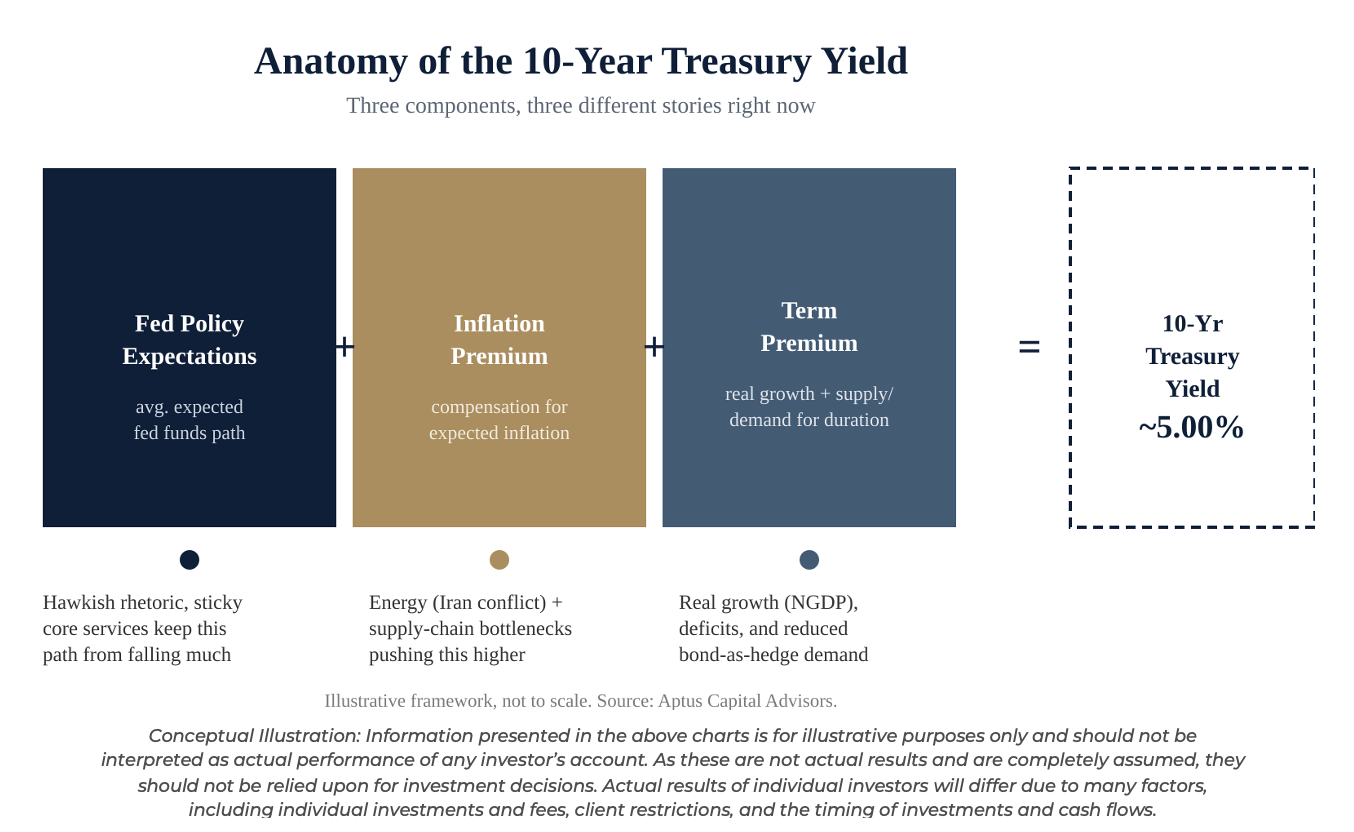
Right now, all three pieces are leaning in the same direction, but for different reasons.
Two Rate Stories, Not One
Rising rates this year have not been all about inflation. 10-year TIPS (Treasury Inflation Protected Securities) yields are up 53bps year-to-date, while the 10-year breakeven—the market’s inflation expectation embedded in the difference between nominal and real yields—is only up 15bps. The bigger driver of higher nominal rates has been real growth expectations, not inflation fears.
That distinction neatly explains why equities have stayed resilient in the face of higher rates. We believe stock prices ultimately follow earnings, and with nominal GDP (NGDP) running hot, earnings estimates keep grinding higher, even as the market multiple has declined. This is healthy. As long as that holds, any pullback in stocks is more likely to be a correction than the start of something structural.
The Inflation That Isn’t a Demand Problem
Suppose the Fed’s real worry is a broad-based inflation problem that, in our view, the data doesn’t back up. Durable goods aren’t pointing to one. Wage growth isn’t pointing to one. Shelter isn’t pointing to one. Basically, the only thing pointing to an inflation issue is energy.
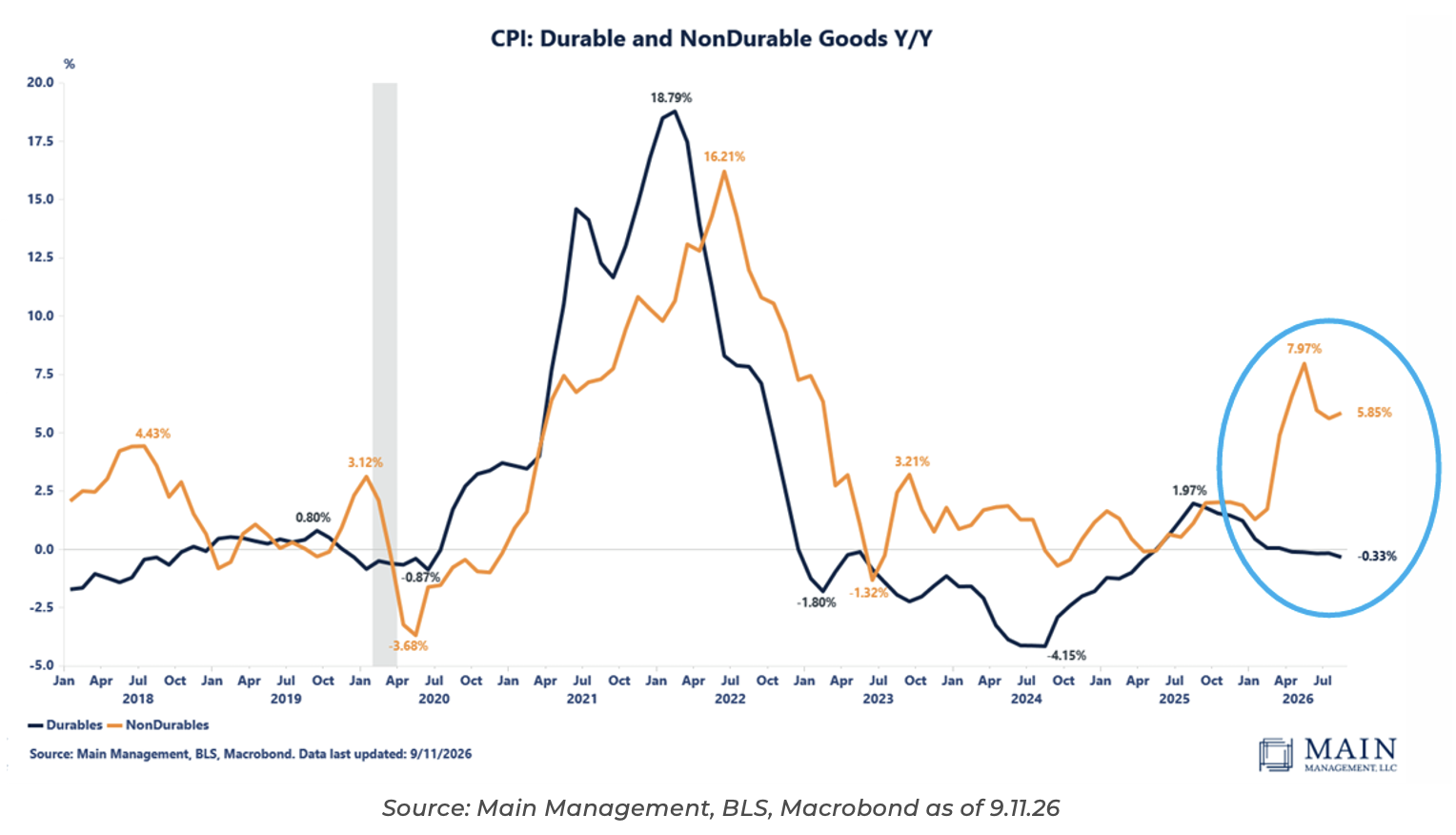
Look at the divergence between durable goods (black) and non-durable goods (orange) that opened up earlier this year, right around when the Iran conflict erupted. Petroleum and fuels sit inside the non-durables basket, so it’s not a coincidence that non-durables CPI ran up to 7.97% year-over-year at the peak before settling at 5.85% currently; however, durable goods are negative on a year-over-year basis at -0.33%. That’s an energy story wearing an inflation costume, not a demand-driven inflation problem that the Fed’s tools are built to fix.
The Other Half of the Equation: Growth
The other piece pushing yields higher is real growth, and the clearest evidence is the surge in non-residential fixed investment: the AI capex and data center buildout happening in real time.
Between the “One Big Beautiful Bill” incentives, massive AI-related capex, and a broader reshoring push, the demand for this kind of investment has been substantial, and the chart below closes in on levels last seen during the dot-com buildout in 2000.
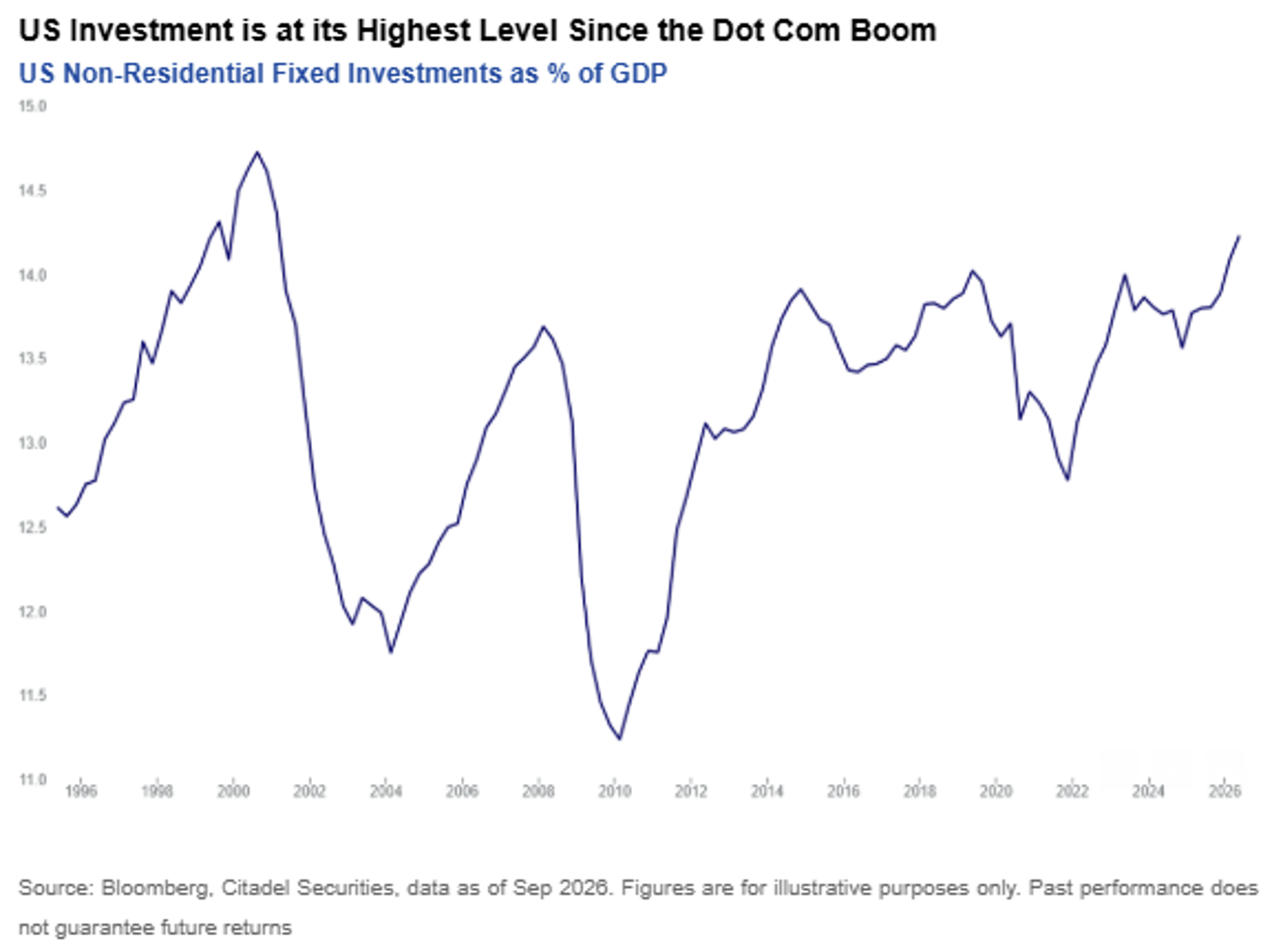
Time will tell how these investments pay off, but the build-out itself costs money, and companies underwriting 20-30+% ROIC projects don’t spend much time worrying about whether they’re borrowing at 5%, 6%, or 7% — the math still works. That’s created a genuine chase for capital, and a surge of issuance is one more factor pressuring the term premium higher, separate from anything the Fed is doing with the front end of the curve.
On The Other Hand: The Case for a Hike
Five years of cumulative inflation, a spike in energy prices, and core services inflation that refuses to fully cool are the most straightforward arguments for Fed tightening. The other question is where neutral actually sits. The move we’re seeing in long-term Treasury yields is itself a signal that the neutral rate (the Fed funds rate that neither stimulates nor restricts the economy) could be drifting higher. A higher neutral rate means the Fed has to hold (or increase) the Fed funds rate higher just to stay restrictive.
But the long end of the curve isn’t only pricing Fed policy. A handful of other forces are pressuring rates higher independent of anything Warsh does: bonds’ declining ability to hedge equity portfolios (the negative-correlation trade that worked for two decades has been unreliable), persistent fiscal deficits that weigh on the government’s credit quality over time, and energy prices.
The Iran conflict has kept a bid under fuel prices, and that pressure is showing up in the data. Energy is a global supply problem, not a local demand problem, which means it’s largely outside the Fed’s reach — the Fed can’t drill more oil or open up lanes in the Strait of Hormuz. Some of what we’re seeing in core inflation, even core services, is fuel costs working their way through supply chains as companies pass through higher costs. The problem with the current backdrop is that the longer an energy spike persists, the more of it gets passed through and the longer the inflation problem lingers. These pressures are still transitory in the textbook sense — but they’re harder for the Fed to wave off given the pressure felt following five years (and counting) of above-target inflation.
What concerns us has been the emotionally charged comments from Fed officials as they’ve talked about the need to hike rates for reasons the Fed has essentially no control over. Reacting to a supply-side shock with demand-side tools rarely ends well.
September FOMC: The Return of Hawkish Warsh
As expected, the Fed raised the funds rate by 25bps, moving the target rate range to 3.75% – 4.00%. The biggest uncertainty heading into the meeting wasn’t the rate hike itself (was priced at over 90% chance) but the updated dot plot.
In June, the Fed had the median funds rate for year-end 2026 at the pre-meeting level of 3.50% – 3.75%, implying no change at that time. Today, the 2026 year-end median rate is now 4.125%, implying a 4.00% – 4.25% range, or one more hike before year-end.
The median dot in both 2027 and 2028 rose ~50bps relative to June. The 2027 forecast implies rates will be held steady throughout all of next year. Updated dots don’t indicate an easing cycle until 2028. The repricing of the dots clearly reiterates Warsh means business. In its hawkish statement, the Committee acknowledges the still “elevated” level of inflation and goes on to say that today’s hike will “support a timelier return to the Committee’s 2% goal.”
In our opinion, today’s move was more of a recalibration of policy rather than the beginning of a new hiking cycle, but a move that should gain Warsh & Co. credibility.
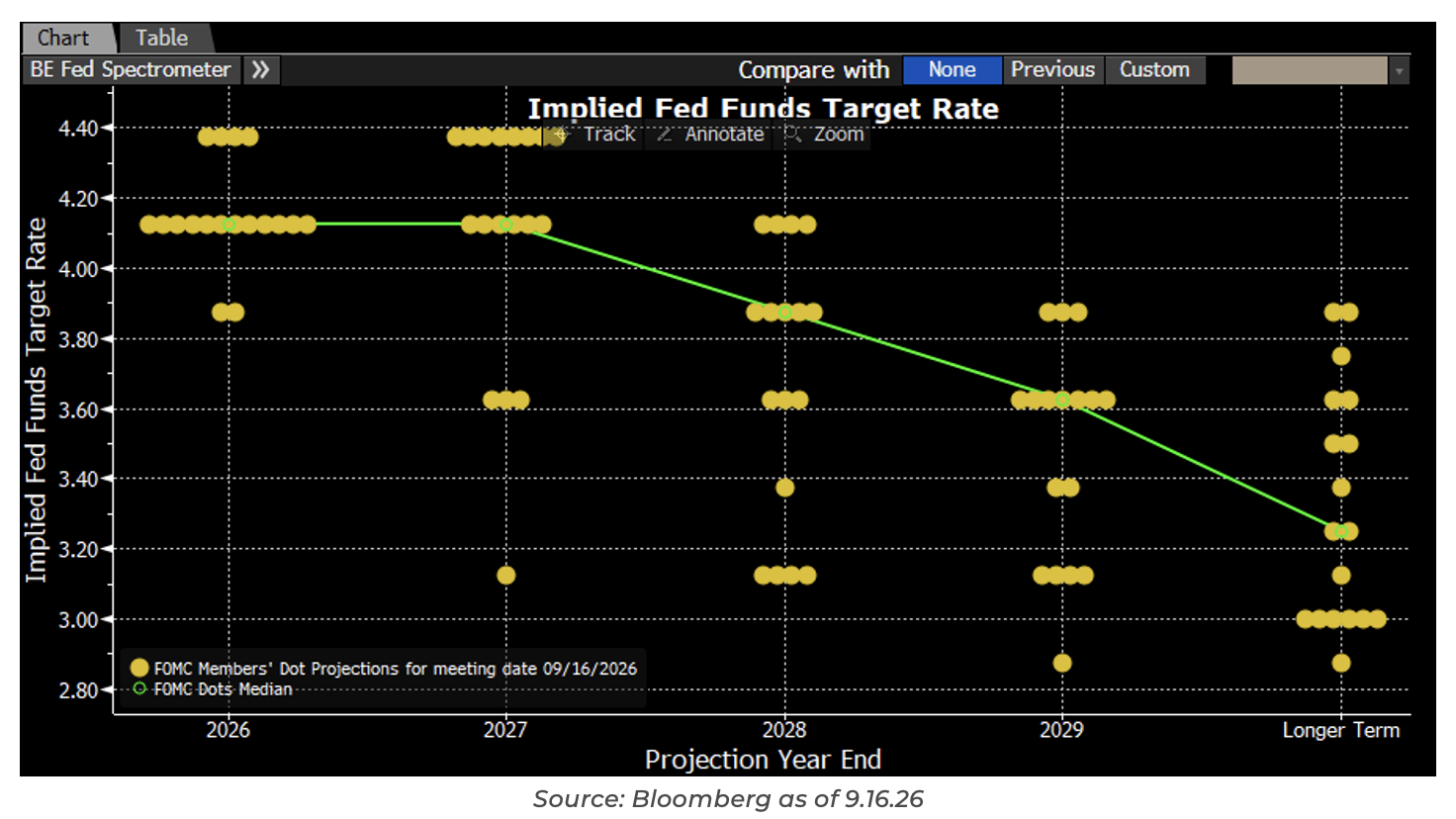
The Fed’s longer-term dot, or neutral rate, moved from 3.06% to 3.25%. Today’s hike puts us > 50bps in restrictive territory. However, many assume neutral is even higher than the freshly updated 3.25% number, which probably puts policy less restrictive than it might appear. Fed funds futures market expects the Fed to hike one more time over the last two meetings (Oct. or Dec.) before the calendar turns to 2027. I’d doubt October is in play given mid-term elections, where I’d also imagine the Fed will want more time to assess the data.
What This Means for a Bond Portfolio
We ran a straightforward exercise: a +100bps rate shock across the 1-year to 5-year part of the curve, starting from five different yield levels.
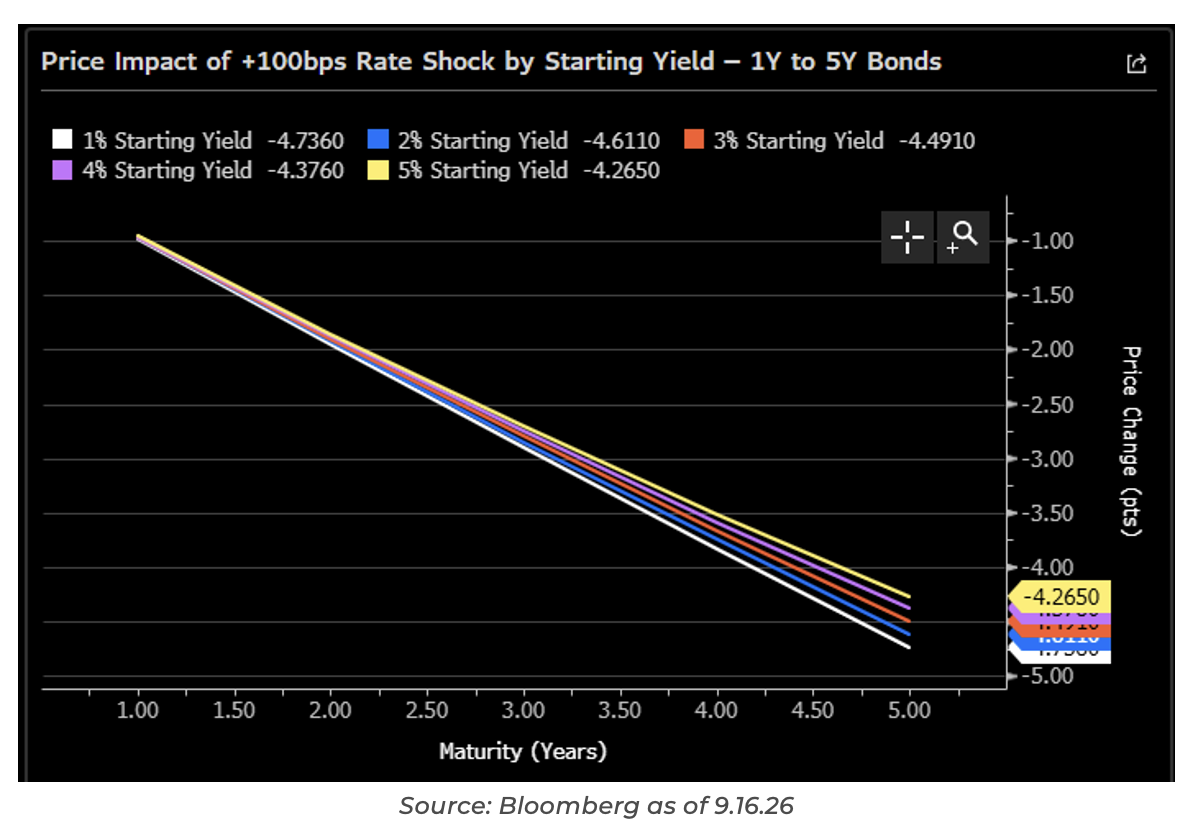
Were a 5-year bond with a starting yield of 5% to see a +100bps shock in rates, the 5-year bond would face a price decline of -4.26%. Higher starting yields cushion the price impact of the same rate move; that’s just math, but it’s math that gets lost in the “bonds are dead” narrative. Taking it a step further:
Price return is only half the story. Add back a year’s worth of income, and you get the full picture:
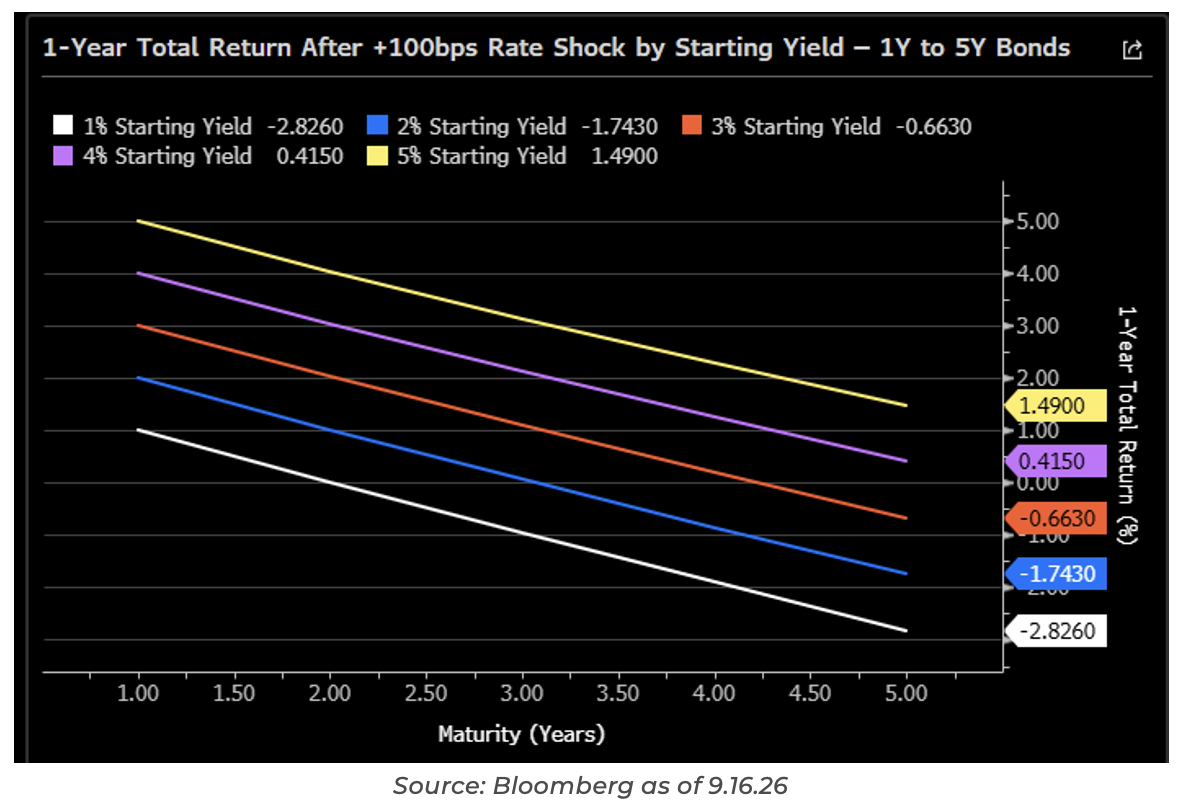
The key number here: at today’s starting yields — the 5-year part of the curve is closer to the 5% starting-yield lines on this chart. Over a 1-year period, the bonds’ total return stays positive even after a full 100bps rate shock. A 5% starting yield produces a +1.49% 1-year total return despite rates up by 100bps. Coupon income is doing enough work now to offset a meaningful chunk of the price hit, which wasn’t true when starting yields sat near zero. While we’re not banking on yields falling from here, if they do, the price return on top of that income cushion is the upside case most aren’t pricing in.
In Summary
With earnings growth where it is, a 25bps hike probably doesn’t do much to equities; it’s a rounding error against an NGDP-driven earnings backdrop. But if today’s hike buys Kevin Warsh credibility out of the gate and calms the back end of the curve, that’s a reasonable trade-off, even if the underlying data doesn’t demand it — it can always be walked back.
There are plenty of gloomers out there declaring bonds dead. We’ve been underweight bonds since before COVID…where were the naysayers when rates were near 0%? At this point, the nominal return on bonds is unlikely to get meaningfully worse from here (see analysis above).
The caveat to the question of “should I buy bonds” is that 7 of the last 8 hiking cycles (Baird Strategas/Bloomberg as of 9/12/26 ) have been bad for bonds. Will this time be different?
Taking that a step further, the Fed still doesn’t expect to meet its 2% inflation target until 2029 (a full year later than previously forecasted). Keep in mind we’ve had 66 months above target already and with January 2029 another 27 months away, that puts the total time above target at 93 months or 7.75 years. Sticky inflation continues to prolong the difficult environment for positive real returns in fixed income, while betting on a large decline in yields has at least thus far been a losing proposition. The backdrop in fixed income continues to be a gentle reminder to investors that other portfolio tools may be required to navigate your portfolio construction process.
Disclosures
Past performance is not indicative of future results. This material is not financial advice or an offer to sell any product. The information contained herein should not be considered a recommendation to purchase or sell any particular security. Forward looking statements cannot be guaranteed.
This commentary offers generalized research, not personalized investment advice. It is for informational purposes only and does not constitute a complete description of our investment services or performance. Nothing in this commentary should be interpreted to state or imply that past results are an indication of future investment returns. All investments involve risk and unless otherwise stated, are not guaranteed. Be sure to consult with an investment & tax professional before implementing any investment strategy. Investing involves risk. Principal loss is possible.
Advisory services are offered through Aptus Capital Advisors, LLC, a Registered Investment Adviser registered with the Securities and Exchange Commission. Registration does not imply a certain level of skill or training. More information about the advisor, its investment strategies and objectives, is included in the firm’s Form ADV Part 2, which can be obtained, at no charge, by calling (251) 517-7198. Aptus Capital Advisors, LLC is headquartered in Fairhope, Alabama. ACA-2609-17.