
TLDR: Earnings were great.
I considered using only a picture book to depict this past quarter’s earnings results because words simply can’t do it justice … and I’ve used a lot of words in my most recent Musings. Let’s touch on the following items:
-
- Let’s make sure we are looking at the correct earnings data;
-
- Overall earnings thoughts; and
-
- Was there any link between AI revenues and the massive Capital Expenditure (“Capex”) spending?
Looking at the Correct Data
Some people are citing enormous earnings growth numbers for the quarter. Don’t get me wrong, they were amazing, but EPS did not grow at a +52% year-over-year (“YoY”) clip in Q2 2026. This +52% figure included “Other Income” from Amazon and Alphabet’s enormous gains from their ownership in Anthropic and other investments (Amazon added $53.4B, while Alphabet gained $98B).
YoY Earnings Growth with “Other Income” –> +52%
YoY Earnings Growth without “Other Income” –> +32%
The big question is whether to include “Other Income” in earnings growth. I prefer that we don’t include it, but this is a new argument because “Other Income” tends to be a very trivial, one-time, non-cash line item, making exclusion defensible. However, non-operating income attributable to Anthropic alone was $122 billion in the second quarter. Those unrealized gains were marked using a valuation of $965B from May 2026. But, as we’ll hear closer to Anthropic’s IPO, it’s likely to go public at a $2T valuation in October. So, it’s likely that “Other Income” may be around for a little bit.
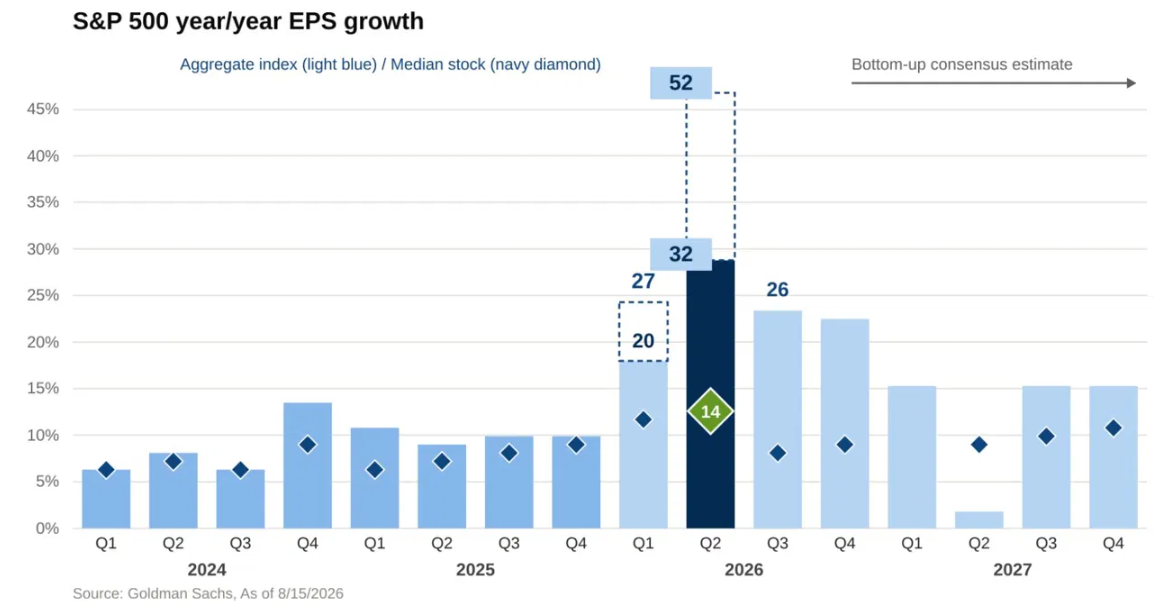
Now, don’t take this as a bearish take; it’s far from that. These companies made great investments in Anthropic and other entities like SpaceX, and they deserve credit. Take Anthropic & the non-operating income story out of the mix, and Q2 2026 has still been an absolute blowout quarter. Earnings growth is currently estimated at 32%, with fewer than 50 companies left to report.
Overall Earnings Thoughts
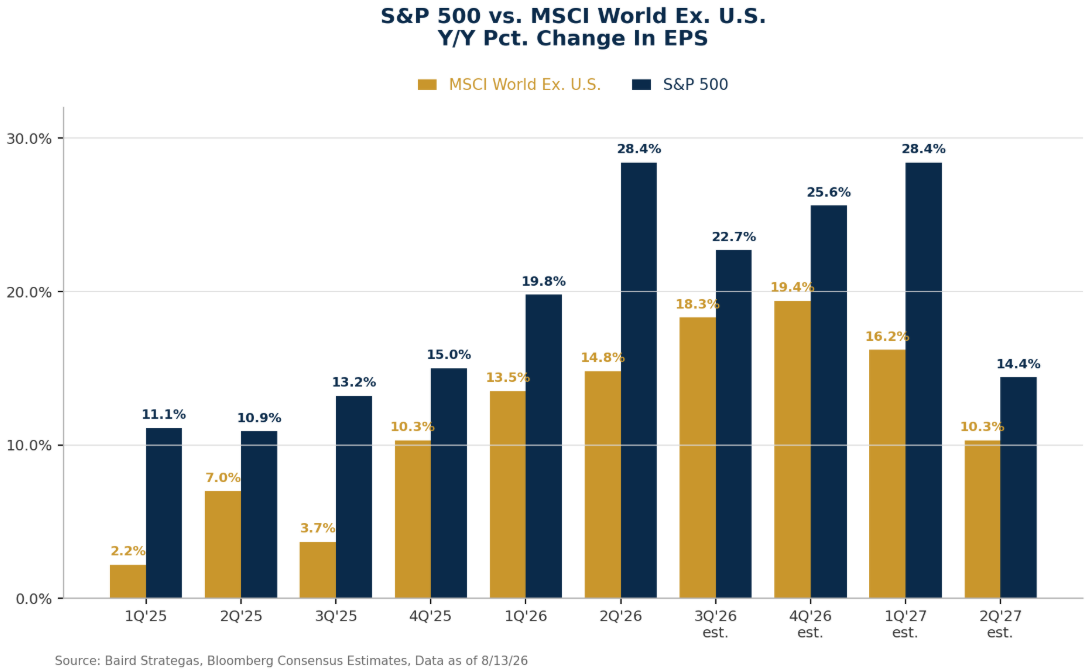
As mentioned above, while stripping out “Other Income,” underlying growth still landed around 32%. Notably, this all occurred against a backdrop where analysts had actually raised estimates heading into the season rather than the usual pre-season trimming, making the beats even more impressive. Mid-Caps grew at 16.6% and Small Caps at 14.2%
Also very impressive: both Q3 and Q4 are projected to see well above 20% growth, and Q1 2026 saw 29% growth (excluding non-operating income, it was in the 20-21% range). That would mark four consecutive quarters of growth greater than 20%. This isn’t only rare; it has never happened organically (excluding the base effect from COVID in 2021). And many analysts are calling for double digits in 2027!
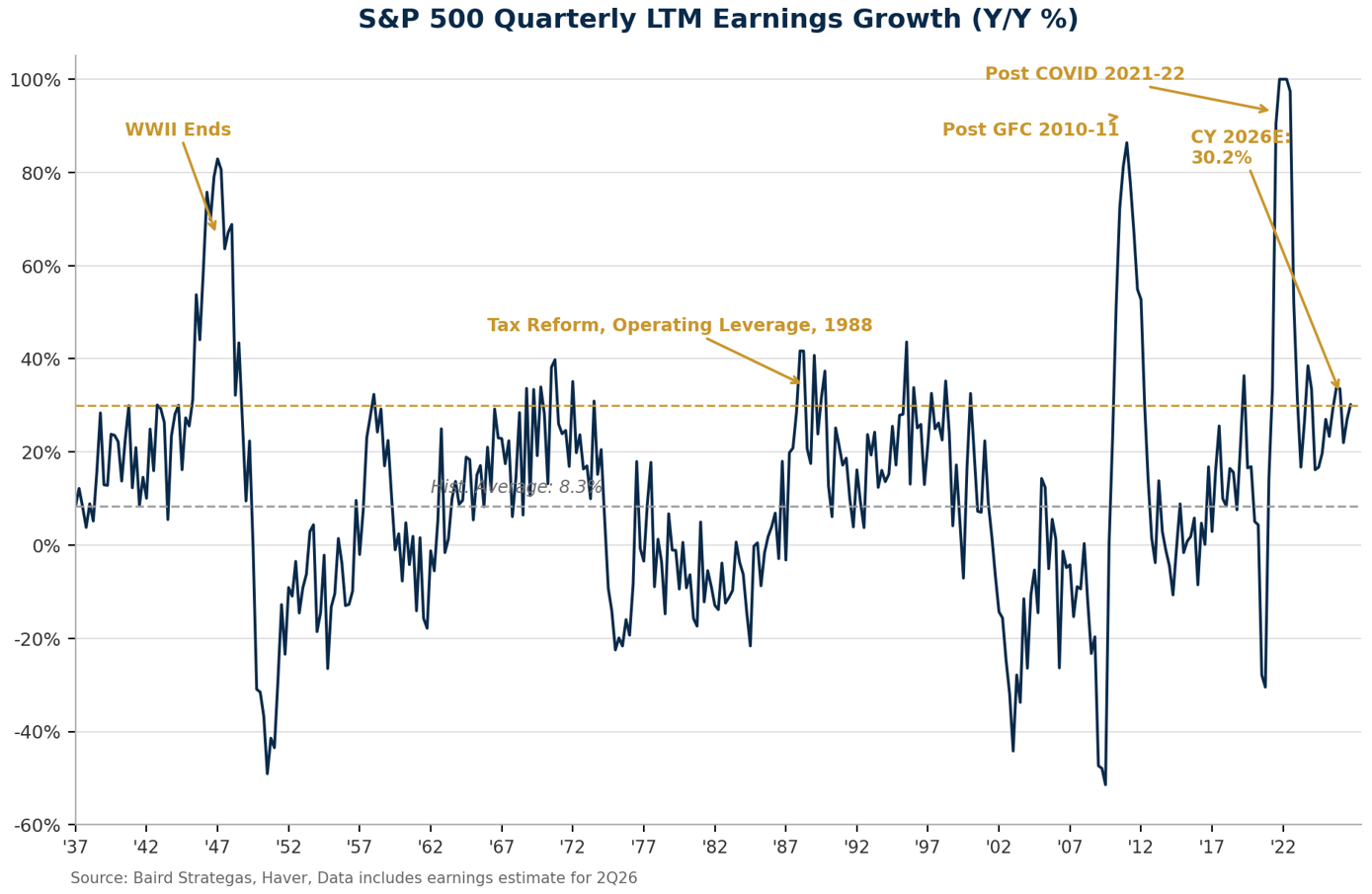
History is quite clear: fighting that magnitude of earnings strength is done at your peril.
But, at the same time, it’s hard not to wonder if the market will view a deceleration in the growth rate as underwhelming. Decelerating earnings growth is inevitable given the large numbers that we’ve recently witnessed.
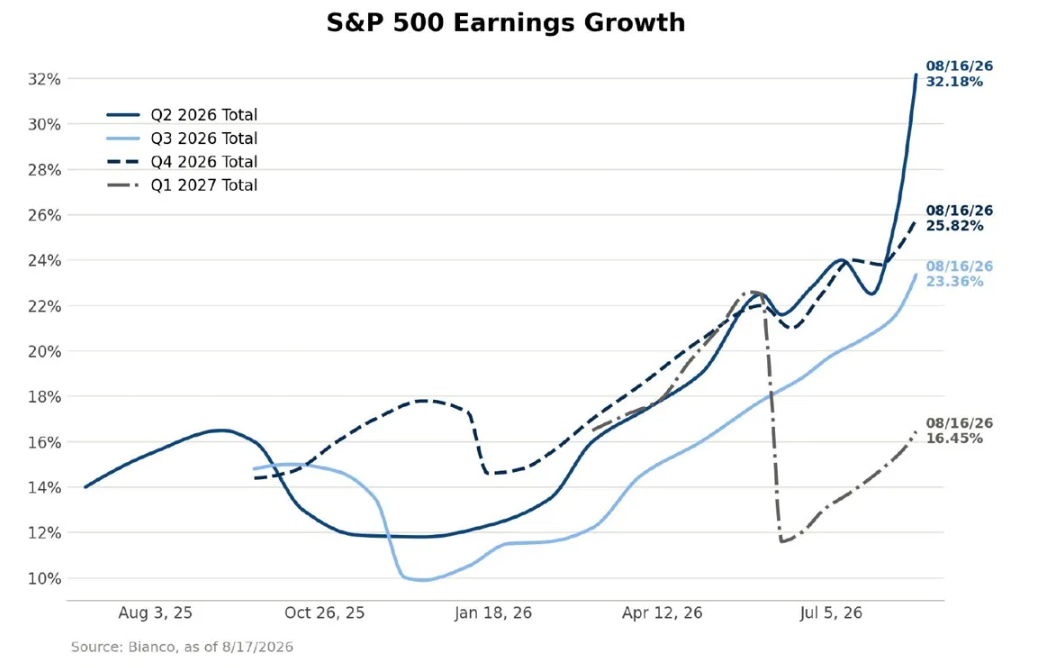
On the downside, it’s becoming more probable that earnings growth will slow as we head into next year. Two forces are behind this: the fiscal boost that’s been supporting results is losing steam, and AI-related capital spending—currently responsible for roughly half of S&P 500 EPS growth—will likely find it harder to sustain its pace given how large it’s already become and its dependence on outside funding. While one could reasonably assume that a downshift would remove some upside convexity from the market, I don’t want to confuse lower expected returns with a bear market.
That said, there’s reason for optimism too. Historically, a slowdown in growth tends to shift the market’s character rather than reverse its trajectory, provided growth doesn’t stall out entirely. Adding to that, Wall Street’s consensus estimates already bake in this deceleration, so there’s no strong case for expecting a sharp, sudden drop-off. That gap between cautious expectations and actual results leaves the door open for more upside surprises, much like what we just saw with Q2 earnings beating forecasts by a wide margin.
Was There Any Link Between AI Revenues and Massive Capital Expenditure (Capex) Spending?
The other thing from this earnings season that really stood out to me was how fast hyperscaler cloud revenue is growing. Tied to that, both Microsoft and Amazon did a better job this quarter of showing investors the connection between their AI spending and actual returns on invested capital. As long as that connection holds up – and the market keeps rewarding it – I don’t see much chance of capex slowing down anytime soon. If that read is right, it bodes well for infrastructure providers going forward (it also means we should expect hyperscalers to keep issuing more bonds to fund it all – cue last week’s musing).
To support this thought, I’d point out Andy Jassy’s comments and then a tidbit from their earnings report:
“We’ve done this before in the first era of cloud computing, just over a longer time horizon, where demand built more gradually than it has in AI, but we see the margins and returns in AI tracking what we saw with core at the same point of evolution, actually a little ahead.” – Jassy
- Amazon almost entered the “40-for-40” club –> Growing AWS at 40% while margins in this segment almost hit 40%. More importantly, as growth increased, the operating margins on AWS also increased (AWS Operating Margins: Q2 2025: 32.9%…Q1 2026: 37.7%…Q2 2026: 39.4%).
Alphabet, Amazon, and Microsoft each reported above-consensus revenue growth, with cloud revenues rising 48% YoY in Q2, an acceleration from 39% growth in Q1. Meta reported revenue growth of 28%, in line with consensus estimates. Continuing the trend of the last few quarters, consensus estimates for the group’s future revenues continued to accelerate, with analysts now expecting collective revenues across business segments to grow at an annualized rate of 18% over the next two years.
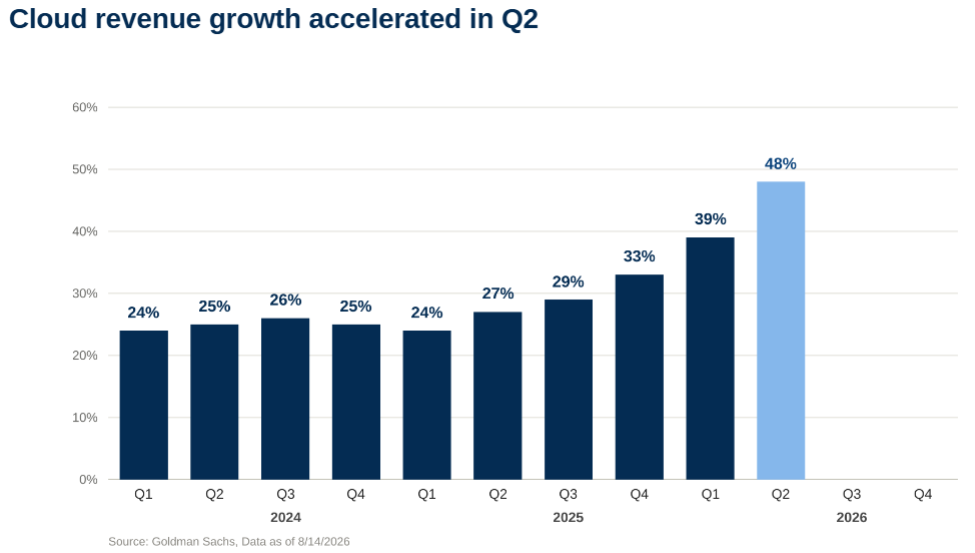
Q2 2026 earnings season offered some of the clearest evidence yet that AI investment is starting to translate into real revenue, rather than just capital spending. Several hyperscalers disclosed that their AI-specific businesses have crossed multi-billion-dollar annualized run rates, growing at triple-digit percentage rates year-over-year, and are now large enough to be broken out as standalone metrics rather than folded into broader cloud results.
Notably, these AI segments are tracking on margin trajectories similar to, or even slightly ahead of, the pace core cloud businesses saw in their own early growth stages, and cloud operating margins broadly expanded even as AI infrastructure spending surged. Taken together, the quarter marked a shift from “AI as promise” to “AI as a measurable, fast-growing line item” showing up directly in reported results.
My Initial Thoughts on This
This is exactly what I said on the last Musing. The S&P 500’s valuation has cooled off a bit as the index has gotten more capex-heavy, with all this AI spending eating into free cash flow in the near term. Again, that’s a shift from the last decade, when the market kept re-rating higher basically because free cash flow kept climbing and margins stayed fat. If all this capex actually turns into real profitability down the line instead of just being a drag, we could see the index re-rate nicely higher from here. We’re pretty optimistic about where this goes if the spending pays off.
Onward.
Disclosures
Past performance is not indicative of future results. This material is not financial advice or an offer to sell any product. The information contained herein should not be considered a recommendation to purchase or sell any particular security. Forward looking statements cannot be guaranteed. Hypothetical examples are for illustrative purposes only, do not reflect the deduction of fees or expenses, and are not indicative of any actual investment result.
This commentary offers generalized research, not personalized investment advice. It is for informational purposes only and does not constitute a complete description of our investment services or performance. Nothing in this commentary should be interpreted to state or imply that past results are an indication of future investment returns. All investments involve risk and unless otherwise stated, are not guaranteed. Be sure to consult with an investment & tax professional before implementing any investment strategy. Investing involves risk. Principal loss is possible.
Advisory services are offered through Aptus Capital Advisors, LLC, a Registered Investment Adviser registered with the Securities and Exchange Commission. Registration does not imply a certain level of skill or training. More information about the advisor, its investment strategies and objectives, is included in the firm’s Form ADV Part 2, which can be obtained, at no charge, by calling (251) 517-7198. Aptus Capital Advisors, LLC is headquartered in Fairhope, Alabama. ACA 2608-15.