
Everyone knows my favorite time of the year is earnings season. For a few weeks, the market gets real data on what should actually drive stock prices (i.e., earnings and profitability), and the macro noise finally takes a backseat. As the consumer sentiment chart below shows, macro news tends to stir up a lot more emotion than fundamental micro news.
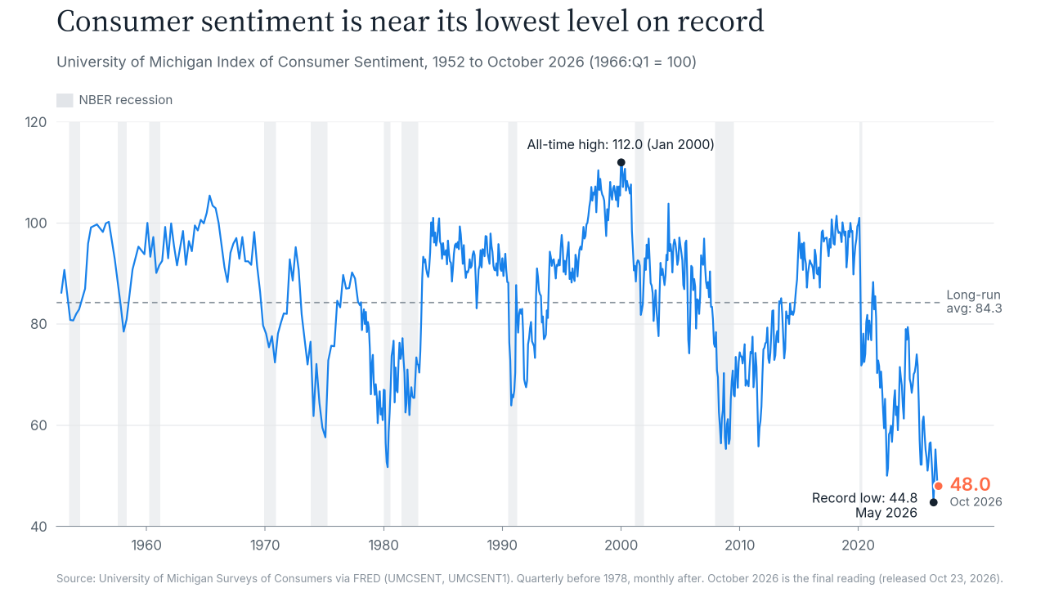
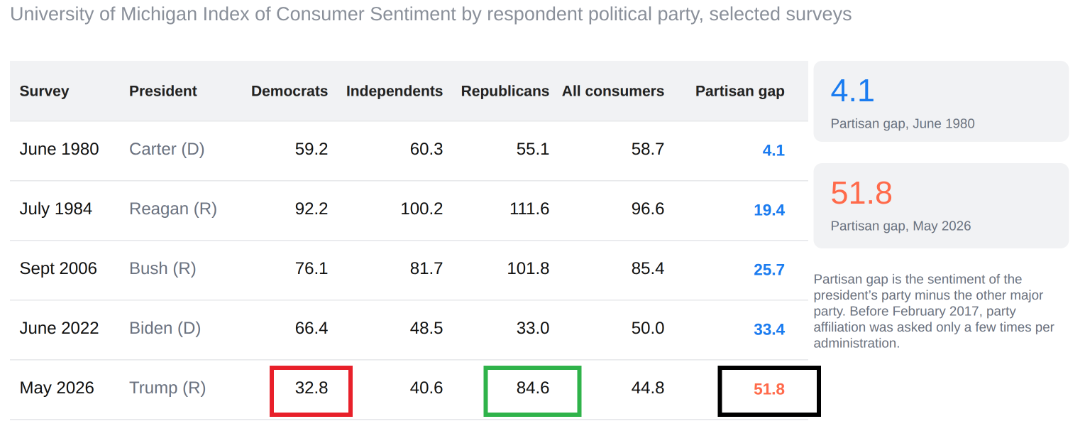
Let’s put this in perspective: consumers feel worse today than they did during COVID, when the economy was literally closed. Makes total sense to me. But as with any data, we need to dig deeper than the headline survey number, because the country remains deeply divided on how it feels right now:
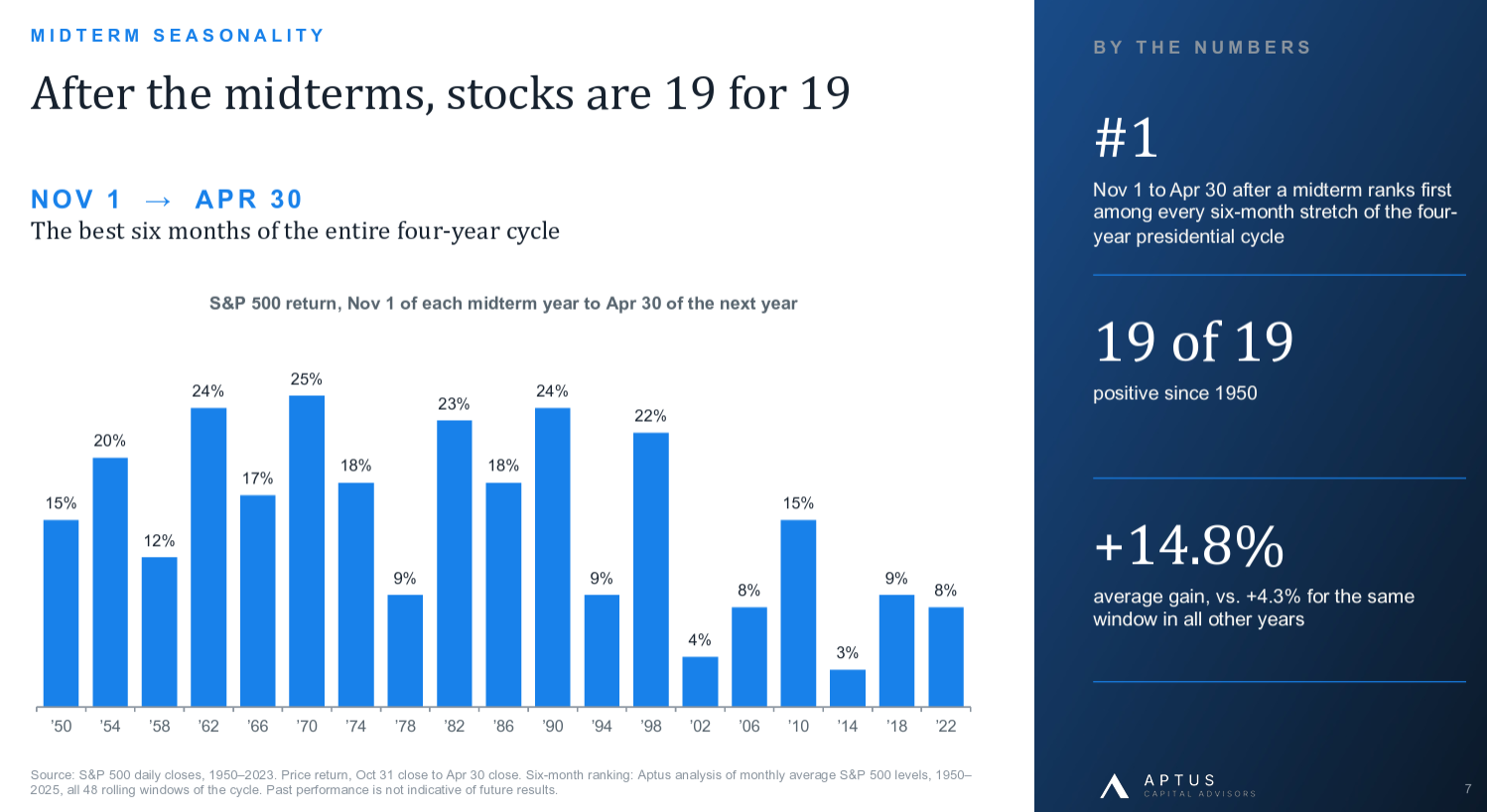
And talking about divided, please find the Aptus’ Midterm Election Slides here. FYI: I’ve got numerous client webcasts planned for our partners on the midterms; let me know if that interests you.
Here’s my favorite slide from the deck:
Onward.
Q3 2026 Earnings Preview
The bar for earnings has rarely been set this high. Q3 2026 year-over-year (YoY) growth is tracking at 29%, the highest estimate since 2021, which would mark a third straight quarter above 25% and an eighth straight quarter of double-digit growth. Revenue growth is running at 12.6%. What stands out to me is how we got here. Normally, analysts spend the quarter walking estimates down so companies can step over a lowered bar. This time they went the other way: expected Q3 growth was 26.7% at the end of June and 29.2% by the end of September. And history says the final number lands even higher. Actual growth has topped the end-of-quarter estimate in 37 of the past 40 quarters, and the typical improvement would put this quarter above 35%. The median stock is far more modest at 9% YoY (vs. 14% in Q2).
Here’s the only question the market is looking for an answer to during earnings season: Will Cap-Ex Stay Strong and Does AI Produce More Direct Revenue?
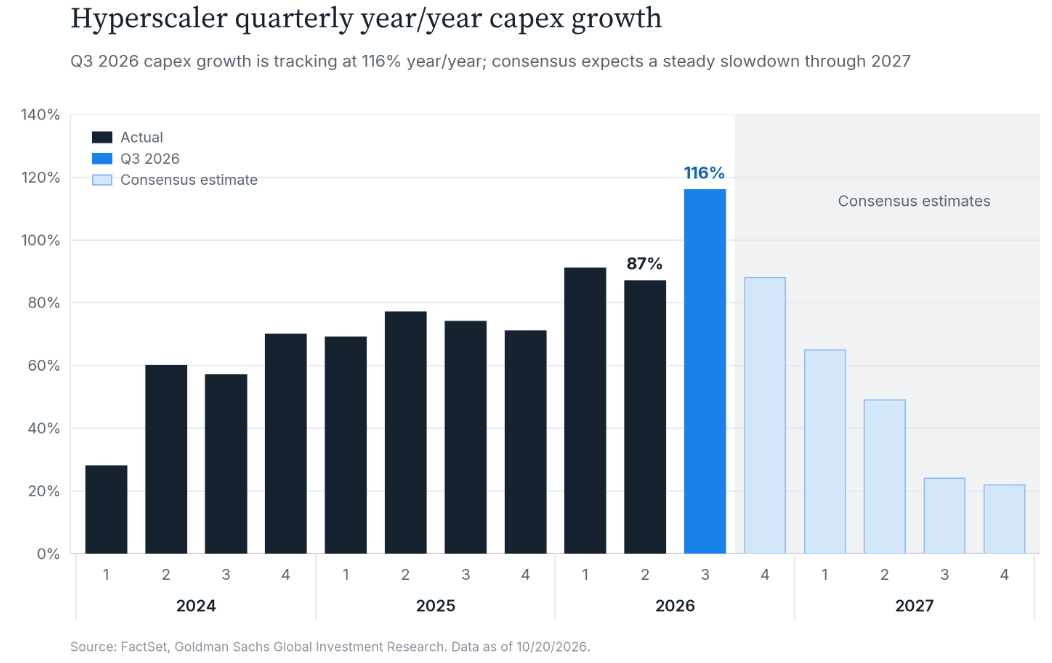
Markets will want to see (1) very strong order backlogs from the “AI infrastructure” names (semiconductors, memory, networking, cybersecurity) to reinforce that demand and AI spending are strong and accelerating. A sudden drop in backlog or an otherwise underwhelming growth rate will be a negative, as it could signal that AI cap-ex spend is starting to slow (not good for the economy). (2) Direct revenue from AI spend: The hyperscalers META, GOOGL, AMZN, MSFT and others have spent hundreds of billions on building computing and networking capacity. Last quarter, MSFT and AMZN reported stronger-than-expected revenue from those build-outs, and we will want to see more of the same to help ease cash flow concerns for these companies.
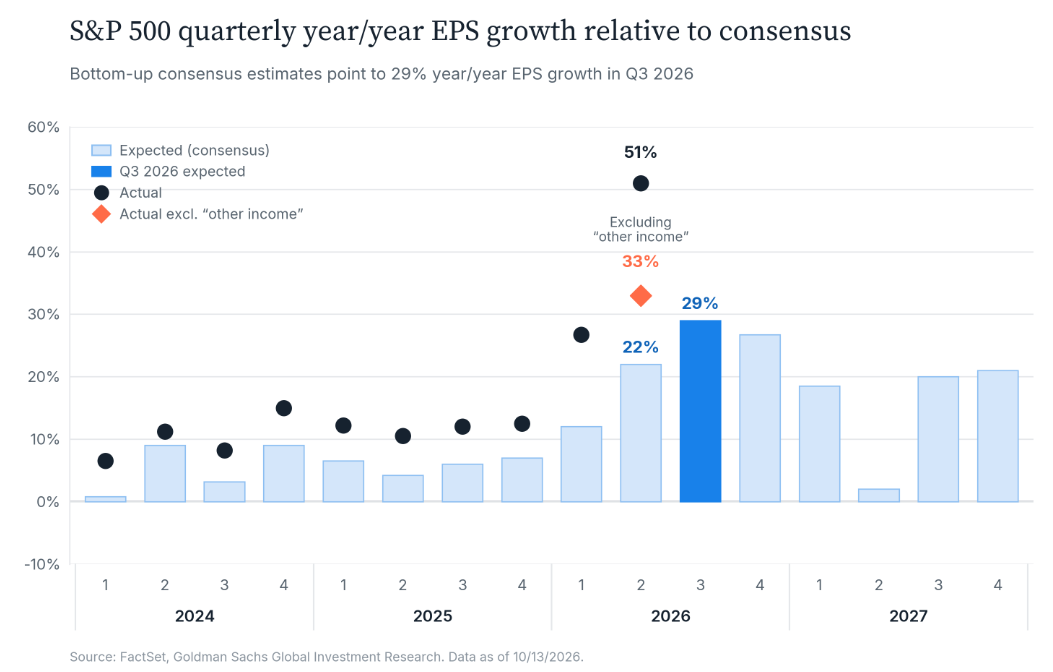
Concentration hasn’t gone away either. Take Micron and NVIDIA out and the quarter’s growth rate drops to 20% from 29%. That’s still a good number, but it shows how much weight two chip companies are carrying. The more interesting shift is one quarter out: analysts expect the other 493 to outgrow the Magnificent 7 in Q4 (30.6% vs. 23.6%), which would be the first time since Q4 2022. A market whose earnings base is broadening is a healthier setup than one led by a handful of names. But at the end of the day, concentrated or not, these earnings are real.
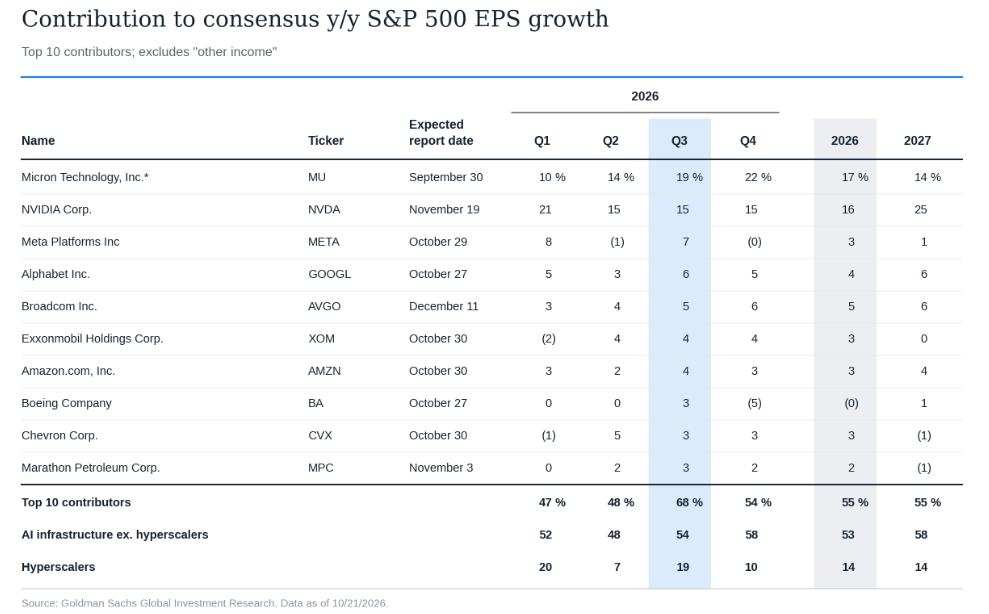
Last quarter, hyperscaler cloud revenue growth accelerated to 48% while revenue backlogs surged, which gave investors more confidence that the AI spend will eventually pay off. Estimates call for another step up to 55% in Q3. On the productivity side, company commentary last quarter suggested we’re still in the early innings, but we expect both the commentary and the income statements to show more of it in the coming quarters.
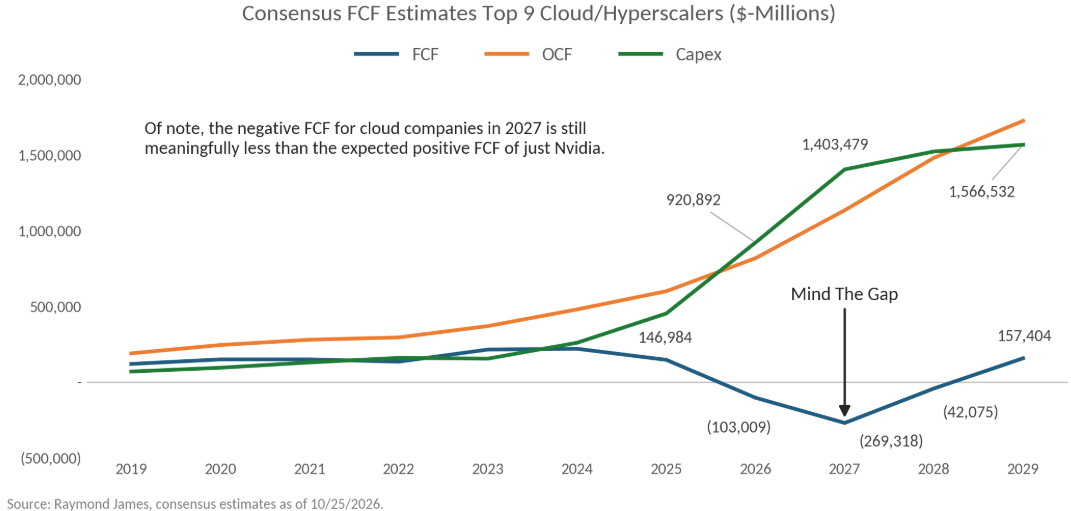
Performance has been just as concentrated, which keeps reviving the year-old question about return on invested capital (“ROIC”) and free cash flow for the hyperscalers. It’s no secret that AI-related capital spending keeps climbing. A year ago, consensus had the top nine cloud and hyperscale companies spending about $520 billion in 2027. Today that estimate sits above $1.4 trillion, nearly triple. Operating cash flow expectations have risen too, by roughly $300 billion, but capex estimates have jumped close to $900 billion over the same stretch. The result: a year ago, the Street expected these nine companies to generate about $300 billion of free cash flow in 2027. Today it expects them to burn nearly that much. On current numbers, 2027 marks peak negative free cash flow. Our guess? They stay in the red until the credit market forces them to stop.
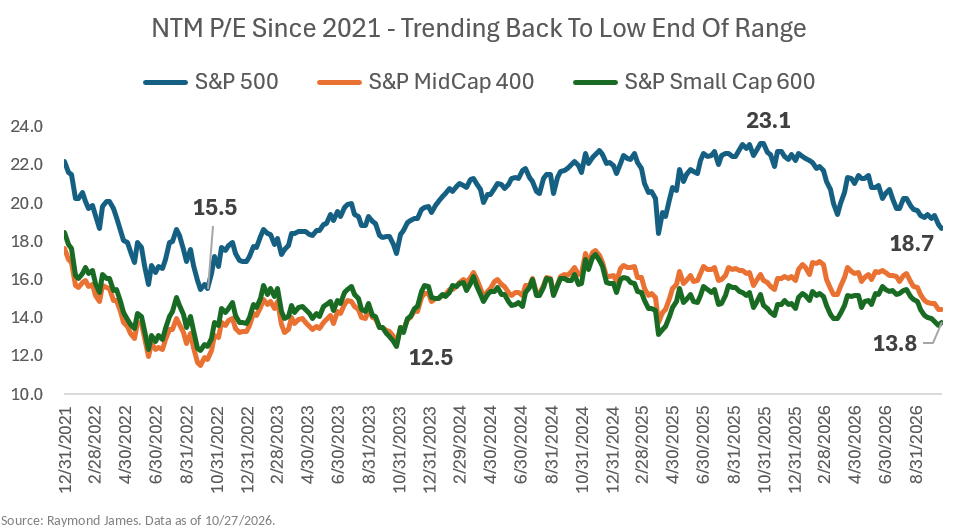
Valuations have de-rated meaningfully since the S&P 500’s P/E peak a year ago.
The spring is coiled if a few events break the right way, most importantly a resolution in Hormuz. Global asset prices are clearly bracing for further hostilities: oil is up more than 15% in October, credit spreads sit at 52-week highs, long-term yields are suddenly under pressure, and multiples have compressed quickly. Late October and early November have a funny way of marking major turning points.
Bottom line: the earnings are real, they’re finally starting to broaden out, and history says this high bar gets cleared. What we’ll watch most closely this season isn’t the beats; it’s the capex guides and whether the market keeps rewarding the spending. When investors stop asking how much is being spent and start asking what it’s earning, leadership can change in a hurry. Stocks will tell investors the truth before the CEOs do.
Disclosures
Past performance is not indicative of future results. This material is not financial advice or an offer to sell any product. The information contained herein should not be considered a recommendation to purchase or sell any particular security. Forward-looking statements cannot be guaranteed.
This commentary offers generalized research, not personalized investment advice. It is for informational purposes only and does not constitute a complete description of our investment services or performance. Nothing in this commentary should be interpreted to state or imply that past results are an indication of future investment returns. All investments involve risk and, unless otherwise stated, are not guaranteed. Be sure to consult with an investment & tax professional before implementing any investment strategy. Investing involves risk. Principal loss is possible.
Advisory services are offered through Aptus Capital Advisors, LLC, a Registered Investment Adviser registered with the Securities and Exchange Commission. Registration does not imply a certain level of skill or training. More information about the advisor, its investment strategies and objectives, is included in the firm’s Form ADV Part 2, which can be obtained, at no charge, by calling (251) 517-7198. Aptus Capital Advisors, LLC is headquartered in Fairhope, Alabama. ACA-2610-34.