
Not every dollar an investment pays out is income. And not every dollar is taxed the same (or, in some cases, taxed at all).
Return of capital (RoC) does not change what an investment earns. It changes when the tax bill arrives for an investor and what that bill looks like when it does. For a distribution strategy inside a taxable account, that difference is worth more than most investors realize.
We have been getting good questions from advisors about return of capital, or RoC, in distributions. It is one of the most misunderstood lines on a 1099. So let’s walk through what it actually is, why we believe it is a feature rather than a flaw, and one underrated benefit that rarely gets discussed.
What RoC Is Not
Return of capital has a reputation problem. The knock goes something like this: the fund is just handing you your own money back and calling it yield.
That criticism is fair for some products. Plenty of high distribution strategies pay out more than they earn, and the NAV erodes over time to fund the payout. That is destructive RoC, and in our opinion, it deserves the skepticism it gets.
But RoC itself is a tax characterization, not a performance verdict. The question that matters is simple: is total return covering the distribution over time? If a fund compounds at a healthy rate and pays a portion of its distribution as RoC, nothing is being destroyed. We view an investor receiving cash flow with more favorable tax treatment as constructive RoC.
Tax Bill That Waits
Here is the headline benefit. Return of capital is not taxed when you receive it.
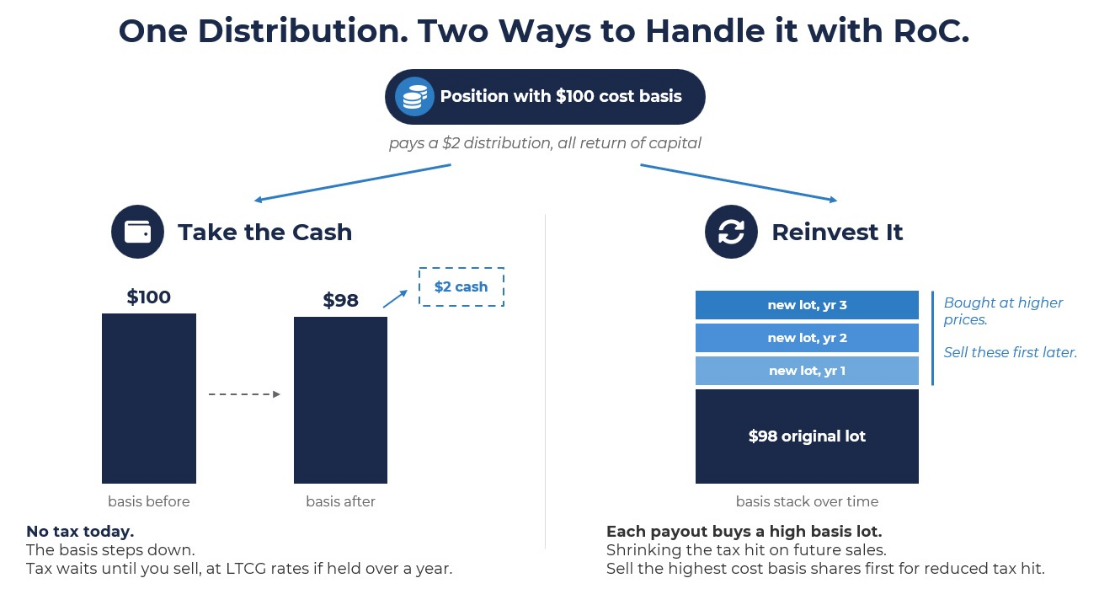
Instead, it reduces your cost basis (or, read on to see how you can keep your cost basis stable). Say you buy a position with a $100 basis and receive a $2 distribution that is entirely RoC. If you take the cash and continue to hold onto the positions, your basis drops to $98. No tax owed today.
Compare that to a traditional income fund. A $2 distribution of ordinary income is taxed now, at ordinary rates, whether you needed the cash or not. For clients in high brackets, that can mean losing as much as half of every distributed dollar the moment it arrives.
RoC shifts both the timing and, potentially, the character of that liability. The tax comes due when you eventually sell, not when the cash shows up. And if the position has been held longer than a year, the gain created by that lower basis is taxed at long-term capital gains rates rather than ordinary rates. Deferred and discounted. That is a meaningful upgrade over income that gets taxed in full, every year, at the highest rates in the code.
One honest footnote: basis cannot go below zero. Once RoC has walked your basis all the way down, further RoC distributions are taxed as capital gains. For most investors, that is a distant scenario, and even then, the character can remain favorable.
The Misunderstood Extra Benefit
Here is the part we find most interesting, and it applies to investors who do not actually need the income.
If a distribution gets reinvested, something quietly useful happens to the tax lot structure of the position. The RoC still reduces the basis on the original shares. But the reinvested cash buys new shares at the current market price, and those new shares carry that price as their basis. In aggregate, the total basis is unchanged. Using the same example, a $100 basis position paying a $2 RoC distribution that gets reinvested still carries $100 of total basis afterward.
But the composition of that basis has changed. Assuming the fund has appreciated since the original purchase, the new lots were bought at higher prices than the original ones. The position is steadily accumulating high basis lots on top of the low basis foundation.
Why does that matter? Because portfolios are not static. At some point, most clients need to raise cash. Spending needs a rebalance, a tax loss harvest elsewhere that needs an offset. When that day comes, the investor can sell the newest, highest basis lots first and realize far less gain than if the entire position sat at the original basis.
In other words, the distribution builds optionality even when it is not spent. Each reinvested payout is quietly pre-funding a lower tax future sale. Traditional income cannot do that. Ordinary income taxed today is simply gone. A reinvested RoC distribution is a future exit ramp.
Conceptual Illustration Only. Information presented in the above chart is for illustrative purposes only and should not be interpreted as actual performance of any investor’s account. As these are not actual results and are completely assumed, they should not be relied upon for investment decisions. Actual results of individual investors will differ due to many factors, including individual investments and fees, client restrictions, and the timing of investments and cash flows. Not to Scale. Not tax Advice.
Agnostic to Account Type
A side effect of this structure is flexibility. A strategy built on heavy ordinary income generally belongs in a qualified account, where the tax drag can be shielded. A strategy where a meaningful portion of the distribution is RoC can live comfortably in either. In a taxable account, the characterization does the work described above. In a qualified account, nothing is lost. In our opinion, that makes portfolio construction conversations simpler because the location decision no longer drives the allocation decision.
For those estimating income for planning purposes, current non-tax-adjusted characterization estimates are published throughout the fund’s fiscal year via each fund’s 19a-1 notices. Fact sheets also show both SEC yield and distribution rate. The gap between those two figures is a reasonable proxy for the portion of the distribution that is not underlying income.
One timing nuance is worth understanding. Distribution character is finalized after the fund’s fiscal year end, while 1099s follow the calendar year. Because those 2 reporting periods rarely line up, the RoC reported at tax time can differ from the estimates published along the way or fall in a different tax year than the distribution itself. Nothing about the economics of the distribution changes. Only the final label is settled later. In practice, intra-year estimates are best used directionally, with the 1099 serving as the final word.
Income Without the Trade-Off
We believe cash flows do not have to come at the expense of total after-tax return. Most covered call strategies make that trade explicitly, capping the upside to fund the payout, then taxing the payout at unfavorable rates for good measure. That is paying twice for the same cash flow.
A distribution with a meaningful RoC component flips both sides of that trade. The investor receives the cash flow. The tax bill waits, shrinks, or both. And if the cash is not needed, reinvestment builds a better tax structure for the day it is needed.
Return of capital does not change what a strategy earns. It changes how much of it the investor keeps. In taxable accounts, we believe that it is one of the most underappreciated advantages available to long-term investors.
Disclosures
Past performance is not indicative of future results. This material is not financial advice or an offer to sell any product. The information contained herein should not be considered a recommendation to purchase or sell any particular security. Forward looking statements cannot be guaranteed. Hypothetical examples are for illustrative purposes only, do not reflect the deduction of fees or expenses, and are not indicative of any actual investment result.
This commentary offers generalized research, not personalized investment advice. It is for informational purposes only and does not constitute a complete description of our investment services or performance. Nothing in this commentary should be interpreted to state or imply that past results are an indication of future investment returns. All investments involve risk and unless otherwise stated, are not guaranteed. Be sure to consult with an investment & tax professional before implementing any investment strategy. Investing involves risk. Principal loss is possible.
Advisory services are offered through Aptus Capital Advisors, LLC, a Registered Investment Adviser registered with the Securities and Exchange Commission. Registration does not imply a certain level of skill or training. More information about the advisor, its investment strategies and objectives, is included in the firm’s Form ADV Part 2, which can be obtained, at no charge, by calling (251) 517-7198. Aptus Capital Advisors, LLC is headquartered in Fairhope, Alabama. ACA 2607-16.
Copyright © 2026 All Rights Reserved
Aptus Capital Advisors
Client Relationship Summary
ADV Disclosure
info@apt.us
251.517.7198
314 Magnolia Ave, Fairhope, AL 36532
For more information about our firm or to receive a copy of our disclosure form ADV and Privacy Policy, contact us. Thank you for visiting our site. Information presented is for educational purposes only and does not intend to make an offer or solicitation for the sale or purchase of any securities. Aptus Capital Advisors’ website and its associated links offer news, commentary, and generalized research, not personalized investment advice. This website is for informational purposes only and does not constitute a complete description of our investment services or performance. Nothing on this website should be interpreted to state or imply that past results are an indication of future results. All investments involve risk and, unless otherwise stated, are not guaranteed. Be sure to consult with a tax professional before implementing any investment strategy. Aptus Capital Advisors is a Registered Investment Advisor (RIA) registered with the Securities and Exchange Commission and is headquartered in Fairhope, Alabama. Registration does not imply a certain level of skill or training.