
Investors constantly ask us about the macro environment. Whether it is a spike in energy prices, a shift in interest rates, or a headline about geopolitical tension, the questions usually follow a familiar pattern: Are you making a bet on this? Are you positioned for this trend to continue?
These are fair questions, and the honest answer is no. But we believe the more important answer is that we don’t need to be.
Playing the Shift: A Lesson from Baseball
Think about how baseball defense worked before the analytics era. Nine players stood in nine fixed positions. Not because the math supported it, but because that’s how it had always been done.
When data-driven teams introduced the Shift, they stopped asking ‘where has a fielder always stood’ and started asking ‘where is the ball actually going to go?’ They moved defenders into high-probability zones before the pitch. Today, outfielders carry positioning cheat sheets because their alignment is not a guess about any one swing. It’s a structural habit built on probability.
Most portfolios are still playing traditional defense. They own bonds because bonds are what you always hold to try to mitigate risk. They then wait for volatility to show up, then react. Our allocation plays the Shift. We pre-position with Long Hedges before the market steps to the plate, placing our defense where the math says the left tail is most likely to hit. We are not reacting to damage. We are deterring it.
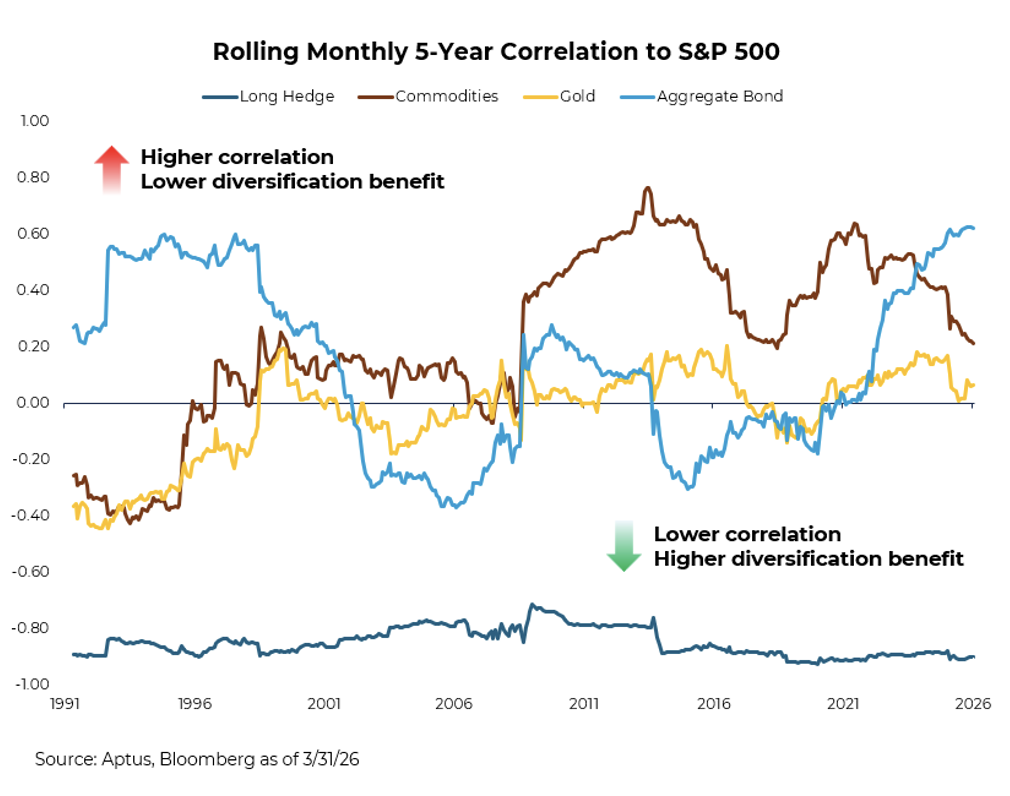
Improved Defense Allows for More Offense
Championship basketball coaches don’t just put in their best scorers without thinking about the optimal lineup. Even the best scoring teams benefit from an elite shot-blocker that can change the outcome without touching the ball. Their presence in the paint changes what the opponent even attempts. When the rim is protected, the risk of easy high-percentage looks disappears.
We believe that’s like the Long Hedge at work. It doesn’t just aim to absorb losses when markets fall. It changes the possibilities of the entire portfolio. If we have conviction in our shot-blocker, we can afford to run more offense elsewhere.
The Result: We believe this allows an investor to carry more stocks, less bonds than a traditional benchmark without increasing net risk.
The Reality: Better defense makes better offense possible. That’s not a metaphor. It’s the structure.
Navigating the Unknown
Whenever a specific macro event dominates the news cycle, the pressure to “do something” is high. However, the macro picture is always uncertain. Instead of trying to guess which way the wind will blow, we focus on a structure that handles a range of outcomes. For example:
Reduced Bond Exposure: We hold fewer traditional bonds than a standard benchmark. Historically, these assets have been challenged to keep pace with inflation, especially after accounting for taxes. By limiting this exposure, we reduce our reliance on an asset class that often fails to provide real growth or reliable protection in a changing economy.
Overweight Equities: We prioritize equities that benefit from economic expansion and productivity. If we live in a world with a robust economy and risk assets benefit, we participate. The engine is running.
Hedges: If market volatility picks up due to broader stress or economic challenges, we have hedges (such as long puts) already in place. The brakes engage at the allocation level with the goal of preventing the damage from compounding.
Notice what we did not do. We did not predict the direction of a single index or policy decision.
That is the Shift. That is the shot-blocker. That is a structure designed to perform across a range of outcomes, not one that requires us to get a single variable right.
Structure Does Not Mean Passive
Playing the Shift is not passive. It requires pre-positioning, discipline, and a willingness to look unconventional before it looks smart.
Most investors are still standing in traditional positions. Bonds as the diversifier. Cash as the defense. A balanced allocation between these three is the definition of prudence.
We have a different definition. Prudence is building a portfolio that can withstand a range of outcomes and create the highest compounded return for a given level of risk, not one that is comfortable only when things go according to plan.
When markets move, we do not need to call an audible. The structure already accounts for it. When rates move, when growth slows, when sentiment shifts, the Long Hedges are already in position, and the equity engine is already running.
We built the team before the season started. Now we let the game come to us.
Disclosures
Past performance is not indicative of future results. This material is not financial advice or an offer to sell any product. The information contained herein should not be considered a recommendation to purchase or sell any particular security. Forward looking statements cannot be guaranteed.
This commentary offers generalized research, not personalized investment advice. It is for informational purposes only and does not constitute a complete description of our investment services or performance. Nothing in this commentary should be interpreted to state or imply that past results are an indication of future investment returns. All investments involve risk and unless otherwise stated, are not guaranteed. Be sure to consult with an investment & tax professional before implementing any investment strategy. Investing involves risk. Principal loss is possible.
The opinions expressed are those of the Aptus Capital Investment Team. The opinions referenced are as of the date of publication and are subject to change due to changes in the market or economic conditions and may not necessarily come to pass. Forward looking statements cannot be guaranteed.
Advisory services are offered through Aptus Capital Advisors, LLC, a Registered Investment Adviser registered with the Securities and Exchange Commission. Registration does not imply a certain level of skill or training. More information about the advisor, its investment strategies and objectives, is included in the firm’s Form ADV Part 2, which can be obtained, at no charge, by calling (251) 517-7198