
As our resident “trend guy,” I sometimes get pulled into conversations with advisors about trend-following strategies. While we as a firm are strictly strategic at the allocation level, we do incorporate trend as a component in some of our funds. I figured I’d share a few thoughts on the concept and how we think about it within Aptus.
Respecting price trends can help keep investors invested through the proverbial wall of worry, while also offering an extra layer of protection from sustained downtrends. But it is really hard as a standalone, which is why our use of trend is just a small piece of a puzzle that leans initially on thoughtful diversification and active hedging.
“Invert, always invert.” Charlie Munger
The investment legend’s most famous quote captures a principle of problem-solving that means looking at a situation backward to avoid failure rather than just chasing success.
If you were starting from scratch, would you rebuild the traditional 60/40? Would you rely on bonds for defense when after-tax yields sit near inflation levels and diversification may not hold when needed? Would you anchor static equity exposure to a market increasingly concentrated in a few stretched mega caps?
Or would you start with tools that make more sense for today’s world, strategies that adapt as conditions change?
Before diving in, here’s where we’re going:
-
- Protect and Participate: How hedging through options and trend shares the same goal
-
- Trend as a Building Block: What it is, why it works
-
- When Trend Struggles: Where its limits show up
-
- Integrating Trend into a Multi-Asset Framework: How it fits within portfolios
-
- Always Invert: The Modern Choice
Protect and Participate
We often talk about how options help investors protect and participate. Trend is another tool with that same goal, an approach we use selectively within several Aptus strategies, not as a standalone engine.
What clients value most is participation when markets rise and protection when they fall, without having to worry about valuations, the Fed, or tariffs. In their own complementary ways, hedging and trend following mitigate risk across different types of drawdowns. Over the past five years, markets have seen three corrections of roughly 20%. Options helped in two, trend helped in one, and bonds in none. Use all the tools.
Trend as a Building Block
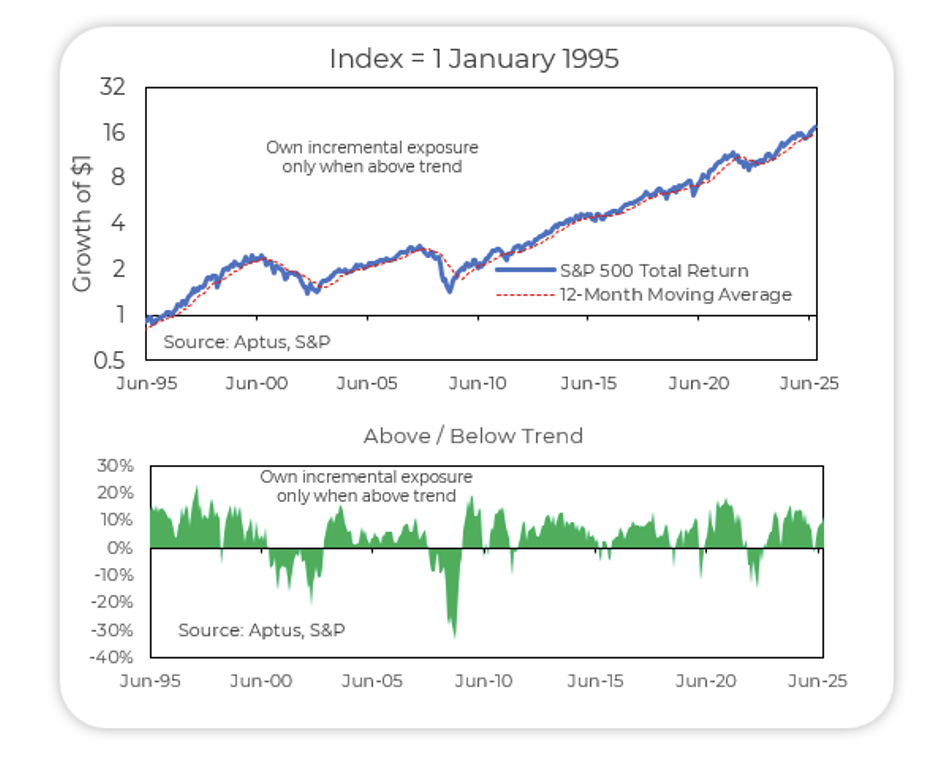
Trend following is a systematic approach that reacts to markets rather than predicting them. A simple form is owning stocks when they are above a long-term trend, such as a 12-month moving average, and reducing exposure when they fall below.
 Data as of September 2025
Trend can help investors participate when conditions are favorable and protect when they are not. It captures long-term moves in either direction, relying on the historical pattern that equities have stronger risk-adjusted performance (higher returns per unit of risk) when in an uptrend. It removes the need for forecasts or Fed speculation, relying instead on observable data.
 Data as of September 2025
Implementation varies. Some strategies adjust exposure gradually, increasing participation in strength and reducing it in weakness. Others adapt by shifting between strategies depending on recent strength. The goal is the same: improve the shape of returns through responsiveness.
Potential Benefits of Trend-Following
When integrated properly, trend can improve a portfolio’s structure in several important ways. First, it can reduce reliance on bonds for defense. During uptrends, trend following can stay in higher returning, more tax-efficient allocations with the objective of side stepping weakness without a permanent allocation to fixed income. This allows the portfolio to play both offense and defense without depending on a single market relationship between equities and interest rates to hold.
Trend can also add asymmetric return potential. By scaling exposure in line with favorable market conditions, trend strategies can compound more efficiently in upward markets while maintaining controlled downside when conditions deteriorate. This helps improve the overall shape of return rather than simply chasing yield.
Finally, trend provides real-time diversification. Because its adjustments are driven by data rather than correlation assumptions, it can deliver protection during periods when traditional assets are both under pressure. This ability to adapt dynamically to changing market environments is what makes trend such a powerful complement within a broader allocation framework.
When Trend Struggles
Trend tends to underperform an always long approach during bull markets since its benefit shows up through downside protection. A simple S&P 500 trend model, owning equities when above a 12-month trend and T Bills when below, has provided a more consistent return path over time, but lagged during strong markets like the late 1990s and 2020s.
 September 1980 – September 2025
Trend approaches can also face challenges during abrupt market reversals before longer trends have time to establish. That is where they complement portfolio hedges, which typically perform best in those sharp, short-lived dislocations. Within a modern multi-asset framework, this adaptability and complementarity can be invaluable, adding an incremental source of diversification.
Trend is not a replacement for stocks or bonds, but a bridge between them, an element that adjusts risk in real time and keeps portfolios aligned with evolving market conditions. At Aptus, we integrate trend components across several strategies to systematically adjust exposure, capturing rising markets while improving defensiveness during drawdowns.
Integrating Trend Into a Multi-Asset Framework
The most resilient portfolios are defined less by what they own and more by how they adapt. Trend can be incorporated in multiple ways. Within equities, a trend-following sleeve can increase exposure in favorable markets and reduce it when conditions weaken. As an overlay or dedicated allocation, it can scale up when momentum is strong and de-risk when it fades, bridging the gap between static stock and bond allocations.
Instead of the traditional 60% stocks and 40% bonds, a more modern structure might hold 45% equities, 30% trend-based strategies, and 25% bonds or other diversifiers.

This mix may enhance growth potential, add flexibility for defense, and improve tax efficiency by owning less tax inefficient fixed income.
Always Invert: The Modern Choice
If you already hold a modern, trend-aware, tax-efficient multi-asset solution, would you want to switch back to a static 60/40 that relies on bonds for defense and is statically exposed to the largest stocks at today’s valuations?
Always invert.
That answer tells you everything about where modern portfolio construction is headed, and why Aptus continues to design solutions that help investors pursue participation and protection within a single framework.
Disclosures
This commentary offers generalized research, not personalized investment advice. It is for informational purposes only and does not constitute a complete description of our investment services or performance. Nothing in this commentary should be interpreted to state or imply that past results are an indication of future investment returns. All investments involve risk and unless otherwise stated, are not guaranteed. Be sure to consult with an investment & tax professional before implementing any investment strategy. Investing involves risk. Principal loss is possible.
*Conceptual Illustration: Information presented in the above charts are for illustrative purposes only and should not be interpreted as actual performance of any investor’s account. As these are not actual results and completely assumed, they should not be relied upon for investment decisions. Actual results of individual investors will differ due to many factors, including individual investments and fees, client restrictions, and the timing of investments and cash flows.
Advisory services are offered through Aptus Capital Advisors, LLC, a Registered Investment Adviser registered with the Securities and Exchange Commission. Registration does not imply a certain level of skill or training. More information about the advisor, its investment strategies and objectives, is included in the firm’s Form ADV Part 2, which can be obtained, at no charge, by calling (251) 517-7198. Aptus Capital Advisors, LLC is headquartered in Fairhope, Alabama. ACA-2510-26.