
At Aptus, we are obsessed with the “math of investment”—from drawdown management to the nuances of the CAPE ratio. But for the select circle of advisors we partner with, the conversation often shifts to the most predictable form of alpha available: tax efficiency.
The reality is that while many treat taxes as an “after-the-fact” accounting problem, our most successful advisor partners recognize it as a core component of portfolio construction.
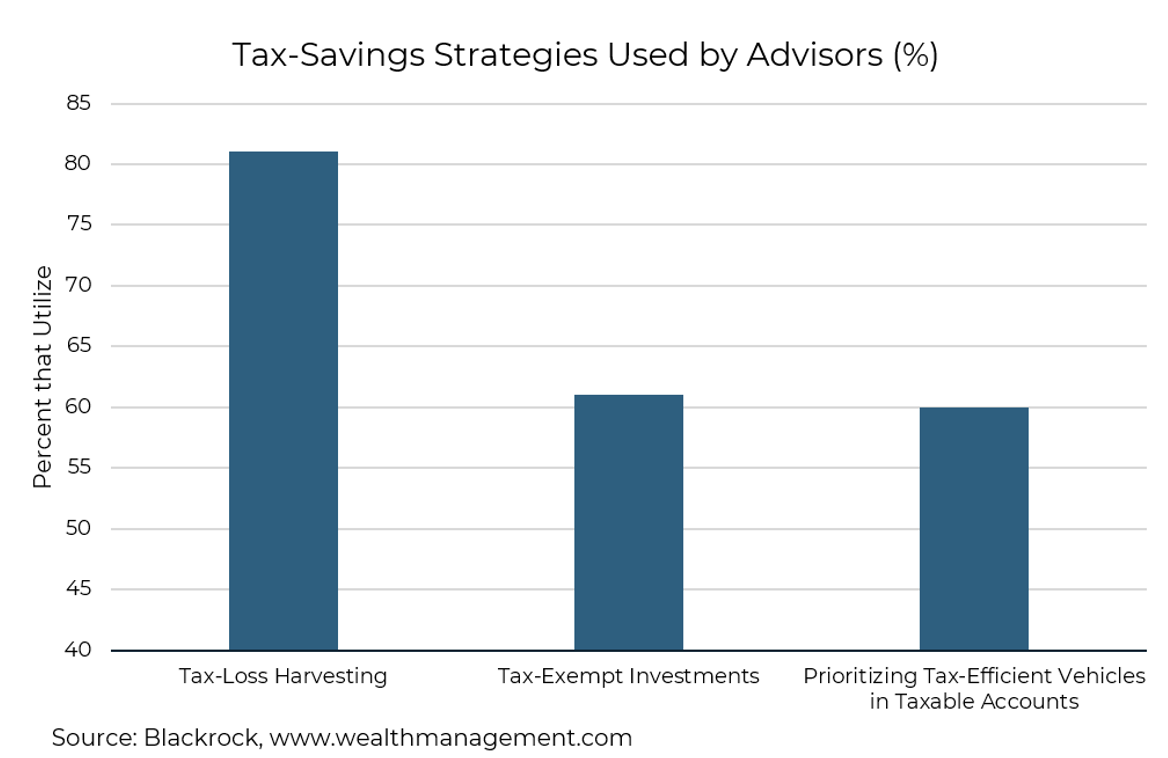
I recently saw data from a BlackRock Advisor Trends survey that perfectly captures the disconnect between what advisors could do and what they actually do.
The Gap Between Strategy and Execution
This data highlights a massive disconnect in the industry. While most advisors utilize basic “blocking and tackling” like tax-loss harvesting, we believe a significant portion of high-net-worth (HNW) strategies remain underutilized. Our partners don’t just “pick stocks”; they manage the entire “net” experience. They understand that a 6% return losing 1-2% to taxes is effectively only a 4-5% return. By overlooking advanced tools, such as tax-deferred fixed income alternatives or using put options to replace a portion of tax-inefficient bond exposure, many advisors are inadvertently leaking alpha that belongs to the client.
The New Frontier for Tax-Efficient Investors
Today’s most sophisticated advisors and tax-aware investors have moved beyond chasing gross alpha; they are focused on building the “machinery” that eliminates structural tax leaks. The industry is shifting from simply managing portfolios to optimizing the very wrappers that house them.
Key areas where the tax-aware elite are currently breaking new ground:
Bond Alternatives with Capital Gains Characterization: Investors are seeking out strategies designed to mirror bond-like return streams with returns shifting towards capital gains rather than ordinary taxable interest. This shift allows for more flexible timing on realizations and potentially lower tax rates.
Tax-Advantaged Hedged Equity: High-net-worth investors are moving away from traditional balanced funds, which often trigger frequent distributions, toward hedged alternatives within an ETF wrapper. This structure aims to defer the majority of equity gains, allowing capital to compound internally with significantly fewer taxable events.
In-Kind Swap Integration: Investment managers may utilize Swaps that can be processed through the ETF creation/redemption mechanism. This is an operational evolution that provides more tax-efficiency during the normal course of portfolio rebalancing allowing for the potential deferral of liabilities on derivative-based returns that were historically treated as “costs of doing business.”
The Bottom Line
The difference between an annually-taxed 5% return and a tax-deferred 5% return over 30 years could be the difference between $253,558 and $365,755 on a $100,000 investment.
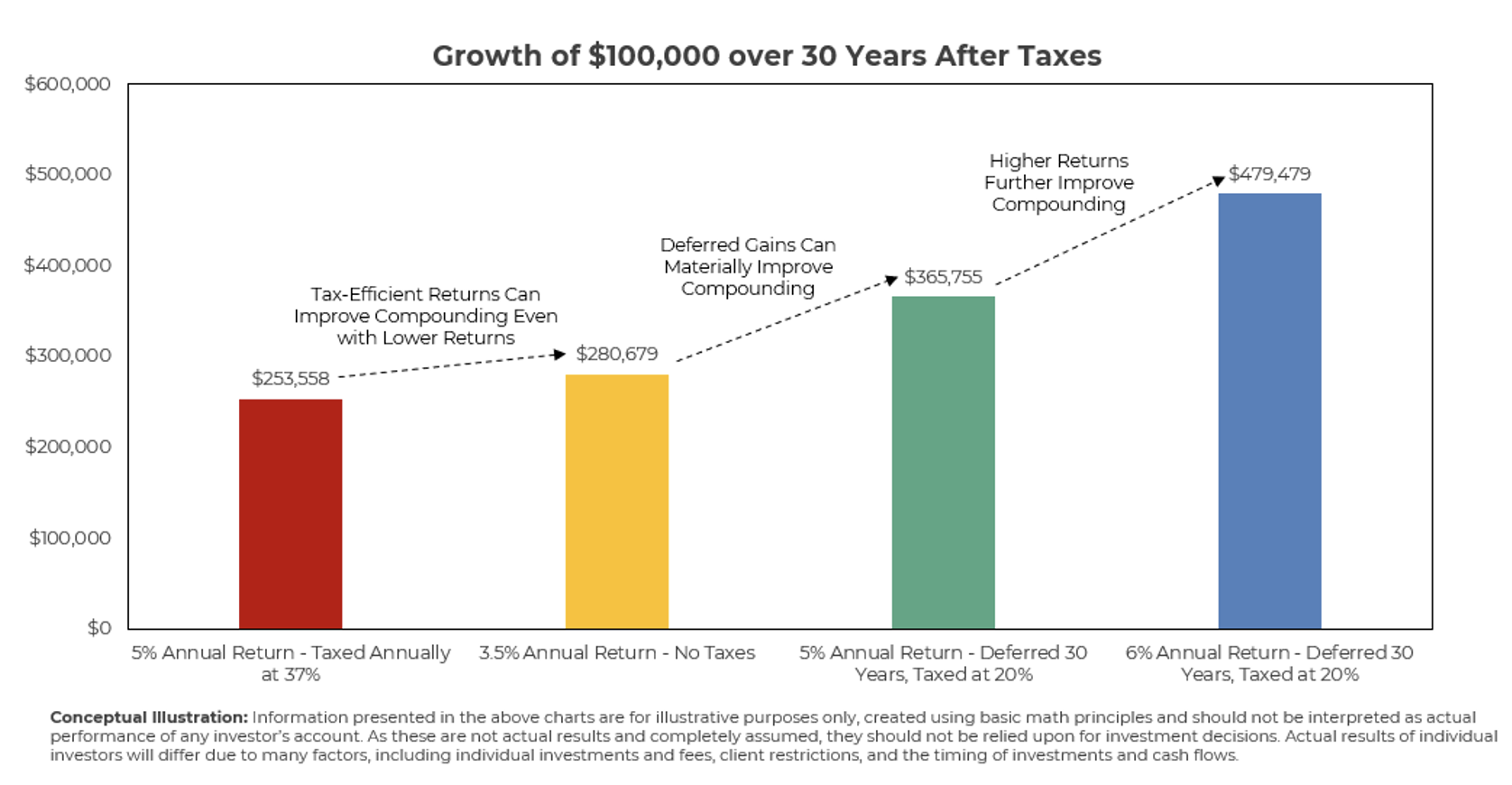
We believe the best advisors to HNW clients don’t just pick funds, they manage the entire “net” experience. If you aren’t looking at strategies that minimize distributions and maximize deferral, you’re leaving the most predictable form of alpha on the table.
Stay focused on what you can control. Tax efficiency is a choice.
Disclosures
Past performance is not indicative of future results. This material is not financial advice or an offer to sell any product. The information contained herein should not be considered a recommendation to purchase or sell any particular security. Forward looking statements cannot be guaranteed.
This commentary offers generalized research, not personalized investment advice. It is for informational purposes only and does not constitute a complete description of our investment services or performance. Nothing in this commentary should be interpreted to state or imply that past results are an indication of future investment returns. All investments involve risk and unless otherwise stated, are not guaranteed. Be sure to consult with an investment & tax professional before implementing any investment strategy. Investing involves risk. Principal loss is possible.
Advisory services are offered through Aptus Capital Advisors, LLC, a Registered Investment Adviser registered with the Securities and Exchange Commission. Registration does not imply a certain level of skill or training. More information about the advisor, its investment strategies and objectives, is included in the firm’s Form ADV Part 2, which can be obtained, at no charge, by calling (251) 517-7198. Aptus Capital Advisors, LLC is headquartered in Fairhope, Alabama. ACA-2602-6.