
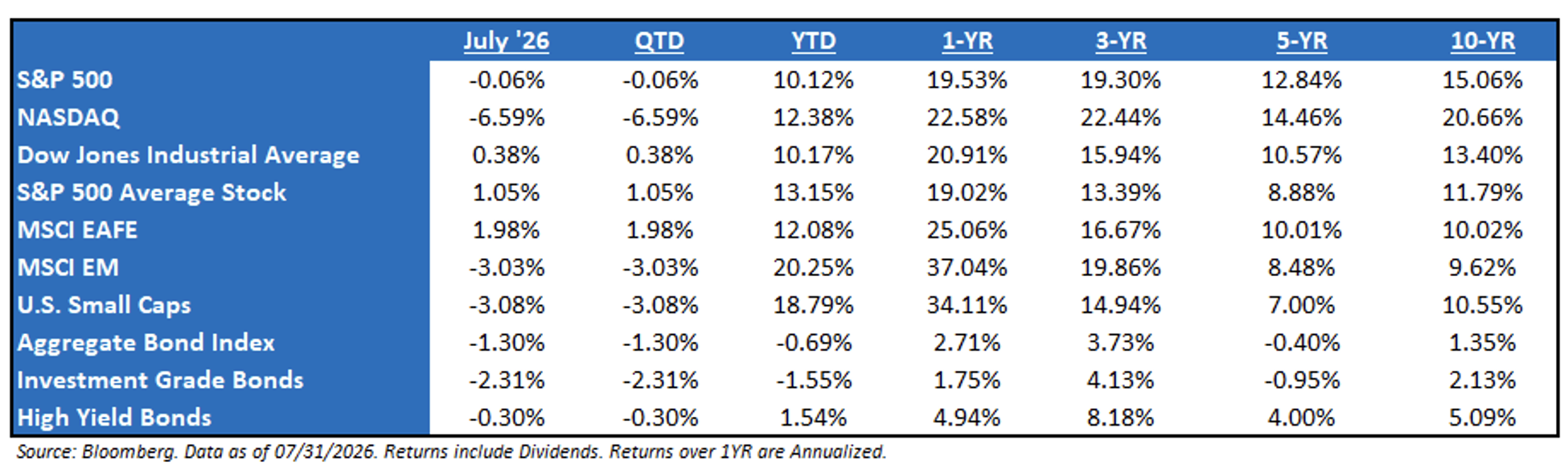
All things considered, a flat month for the S&P in July feels pretty heroic given the headlines – a hedge fund implosion, historic Yen intervention, and a post-FOMC breakout in 30-year yields (and that was just last week), not to mention the renewed tension in the Middle East and the broader momentum unwind that’s been with the tape all last month. Yet, we keep our messaging easy: Focus on the simplicity of the market –> (1) Earnings, and (2) Profitability. Both of which are doing amazing.
While I usually stay out of the Fed commentary game and leave that to John Luke Tyner, CFA (Head of Fixed Income), I had to weigh in with a few thoughts, given the amount of pessimistic rhetoric around last Wednesday’s press conference. More importantly, I want to focus on what this means for portfolios and asset allocations into the future. But, for a recap of the recent Fed meeting, here is John Luke’s latest message: FOMC: One Last Pause?
If you read this past quarter’s Aptus newsletter, Succession Plan, it centered around the necessity of embracing and adapting to change.
“The worst personality trait of an investment professional is to resist this change. Markets are constantly evolving, and the investors who fail to adapt are the ones who get left behind. Stubbornly clinging to outdated frameworks, familiar names, or comfortable narratives is not a sign of discipline – it is a blind spot. The greatest opportunities in markets have almost always emerged from change, and the greatest losses have often come from those who refused to see it coming. An open mind is not optional in this profession; it is the job.“
Right now, it doesn’t feel like market participants are willing to embrace a mindset change at the Fed, specifically around a couple of variables: 1)Speak Less; Think More 2)Kevin Warsh’s Reaction Function.
In my opinion, that gives everyone reading this Musing an advantage, and I have a feeling that this Musing will get a lot of responses; but, as you know, I’m a taker of feedback.
There are two segments to this Musing: 1) My Opinion on Warsh’s Reaction Function, and 2) What this Means for Markets and Asset Allocations.
Chasing Warsh’s Reaction Function
My Opinion on Warsh’s Reaction Function
The only thing tracking more data than the investors desperately trying to figure out Kevin Warsh’s “reaction function” are the Flock cameras popping up across many metro-cities. To me, it felt like every piece of commentary on the recent Fed meeting boiled down to everyone bashing Warsh for being too vague, while reporters practically begged him to define his “reaction function”.
What struck me most was seeing investors now call for a rate hike to combat inflation that has run above target for 64 months. Where were these same participants during that stretch? Few were pressing as hard for hikes under Powell, which suggests this shift may be driven more by who now sits in the chair than by the underlying policy case. I don’t intend that as a political statement, but it’s worth noting that inflation has tempered somewhat since Warsh took over as chairman, especially if you look at the Truflation reading. FYI, there’s an enormous spread between CPI and PCE, which I’m sure is part of Kevin Warsh’s frustration with the data the Fed uses to calculate everything.
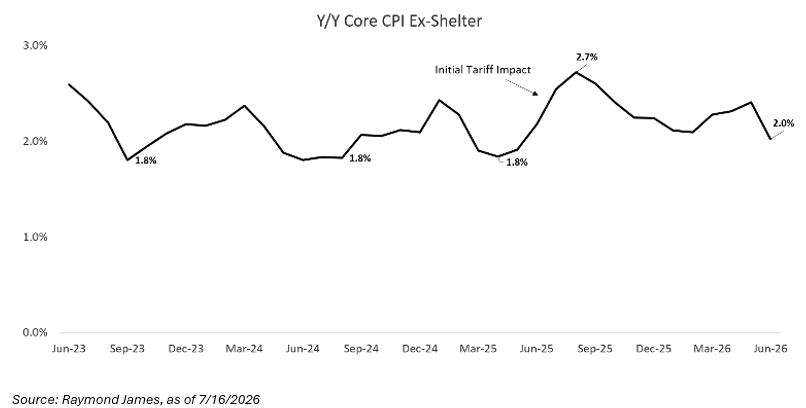
What is a Fed “Reaction Function”? A Fed reaction function is the (often informal) rule or pattern describing how the Federal Reserve adjusts its policy tools, mainly the federal funds rate, in response to changes in economic conditions. It’s essentially a model of “if the economy does X, the Fed will do Y”. A reaction function tries to capture how much weight the Fed puts on each of its mandates and how aggressively it moves rates when those rates deviate from the target. The most famous formalized reaction function is the Taylor Rule.
Kevin Warsh has stripped back forward guidance; something I agree with. With this, he has set up five task forces (on communications, data, the balance sheet, and the Fed’s inflation/jobs framework) and isn’t fully spelling out what his reaction function will be until their reports land later this year. In the meantime, he’s largely declined to specify what data or conditions would trigger a rate move, leaving markets to wait alongside him. And the pundits didn’t like that.
While many may chastise Warsh for this, specifically previous NY Fed President William Dudley, some want the Fed to publish the reaction function outright. But whose reaction function are we talking about?
Warsh just took three dissents and characterized that split as a ‘design feature’, meaning the FOMC no longer operates off a single, shared reaction function. Instead, we effectively have 12 voters running 12 different rules. Before Warsh can hand investors his own function, he first has to settle on the metric underlying it. And even then, we’d still be missing the other 11 rules to fully understand how rate policy will actually play out at the Fed.
Have market participants forgotten how to price risk without the Federal Reserve guiding them? For years, markets have been spoon-fed the rules of the game rather than forced to reason through them; a sign of how dependent participants have become on being told what to do rather than thinking for themselves. But that dependency cuts both ways: The moment forward guidance disappears, the edge shifts back to whoever can actually get ahead of the Fed’s next move and call it right. That’s where the real money gets made. And that, to me, is what a free market is supposed to look like.
The real cost of forward guidance is that markets stopped treating it as guidance and started treating it as a promise, and that mispricing of certainty has broken things more than once.
-
- 2003–2004: Greenspan’s “measured pace” language allowed the Fed to hike in steady 25bp steps for 17 straight meetings. The predictability made mortgage financing cheap and encouraged leverage that later amplified the 2008 crisis.
- Late 2018: Powell’s “long way from neutral” and “autopilot” balance-sheet comments spooked markets into a ~20% S&P selloff, forcing the “Powell Pivot” and three rate cuts in 2019.
- 2023: SVB, Signature, and First Republic failed after loading up on long-duration bonds during a “rates near zero, staying there” era, only for 425bps of hikes in 2022–23 to wipe out their equity.
This likely means more volatility in the near term as everyone relearns the rules, but it also means risk gets priced closer to what it actually is, rather than what the Fed implied it would be.
But the Fed’s Reputation is Now Tarnished Because of Warsh: What’s really changed is how the Fed operates internally. It used to be the chairman who set the direction, and everyone fell in line (in the chart below, only presidents dissented for 20 years, not a single voting Governor). That’s gone. Voters are acting independently now, and the hawkishness we’re seeing wasn’t manufactured overnight; it was there all along, just kept in check. Now it isn’t.
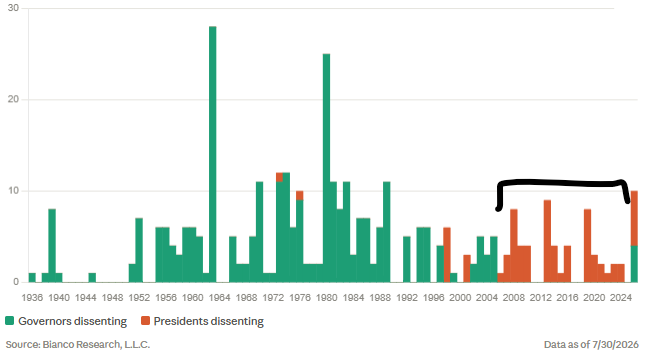
Dissents at the Fed are, if anything, a sign of institutional health rather than dysfunction. When individual Governors and reserve bank Presidents feel free to vote against the chair, it demonstrates that policy decisions are driven by each member’s independent read of the data and their mandate, not by deference to a single leader or, by extension, outside political pressure.
A Fed where dissent is possible and even expected is one where groupthink has less room to take hold, and where the public and markets can see that decisions reflect genuine debate among diverse viewpoints rather than a rubber stamp. In that sense, a healthy rate of dissent is less a symptom of disarray and more a visible signal that the institution’s independence is functioning as intended.
What This Means For Markets and Asset Allocation
At the end of the day, does a 25 basis point hike or cut here and there really affect an asset allocation and its performance? Absolutely not. But recognizing that the rules of engagement have evolved over time as the market digests different policy styles within both fiscal and monetary policy is the understanding of change needed by investors. We think that starts with proper allocation, specifically one built to perform in both the left and right tails.
Said differently, with debt issuance running at this pace—and roughly a third of outstanding Treasury debt maturing within the next twelve months— markets are increasingly treating fiscal policy, not monetary policy, as the dominant driver of yields. That dynamic is compounded by the fact that the U.S. government is running a deficit of roughly 6% of GDP even at full employment, a level of stimulus that would typically only be seen during a downturn.
Heavy near-term refinancing needs mean the Treasury must continually find buyers for enormous volumes of paper, and if demand doesn’t keep pace with supply, investors will demand more compensation for holding duration. That repricing shows up as a higher term premium, which pushes long-end rates up independent of what the Fed does with the front end. In other words, even if the Fed eases, elevated issuance and structurally large deficits could keep 10- and 30-year yields higher than they’d otherwise be; a dynamic that increasingly ties long-end rates to Washington’s borrowing needs rather than to Fed policy alone. All of this has occurred while the Fed cut rates.
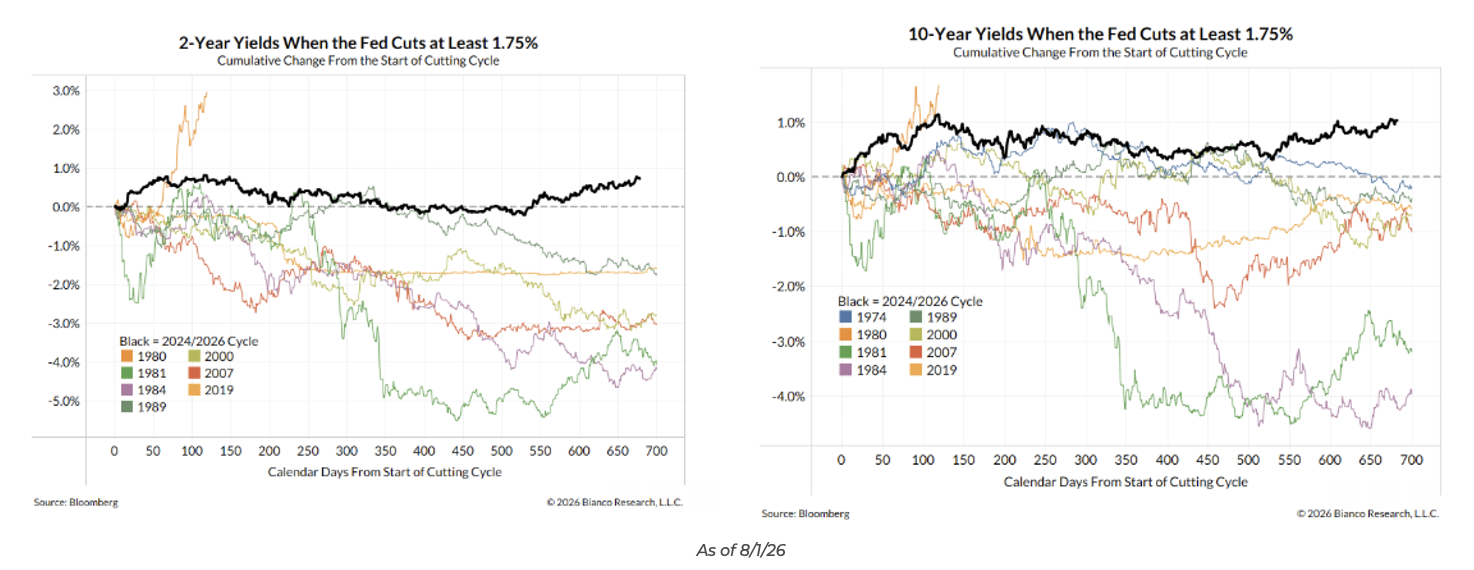
Quantitative Easing’s (“QE”) greatest sin wasn’t its use during the financial crisis; that emergency arguably justified it. The problem is what came after. Once QE became “the only game in town,” it gave Congress a permanent excuse to abandon fiscal discipline altogether. Lawmakers no longer had to make hard choices about spending because the Fed absorbed the consequences by buying up the debt. That arrangement quietly shifted responsibility for controlling the nation’s finances away from elected officials and onto an unelected group of technocrats, and predictably, politicians whose careers depend on spending other people’s money were more than happy to let that responsibility go and take all the credit for it.
This is why investors need to think about portfolio protection differently today when compared to 20 years ago. It’s another great example of why investors need to embrace change: An open mind is not optional in this profession; it is the job, which is why the chart below is my favorite.
Think about Fixed Income differently; it’s not about taking less risk. It’s about taking the most optimal calculated risks to protect the downside and get the most out of your portfolio.
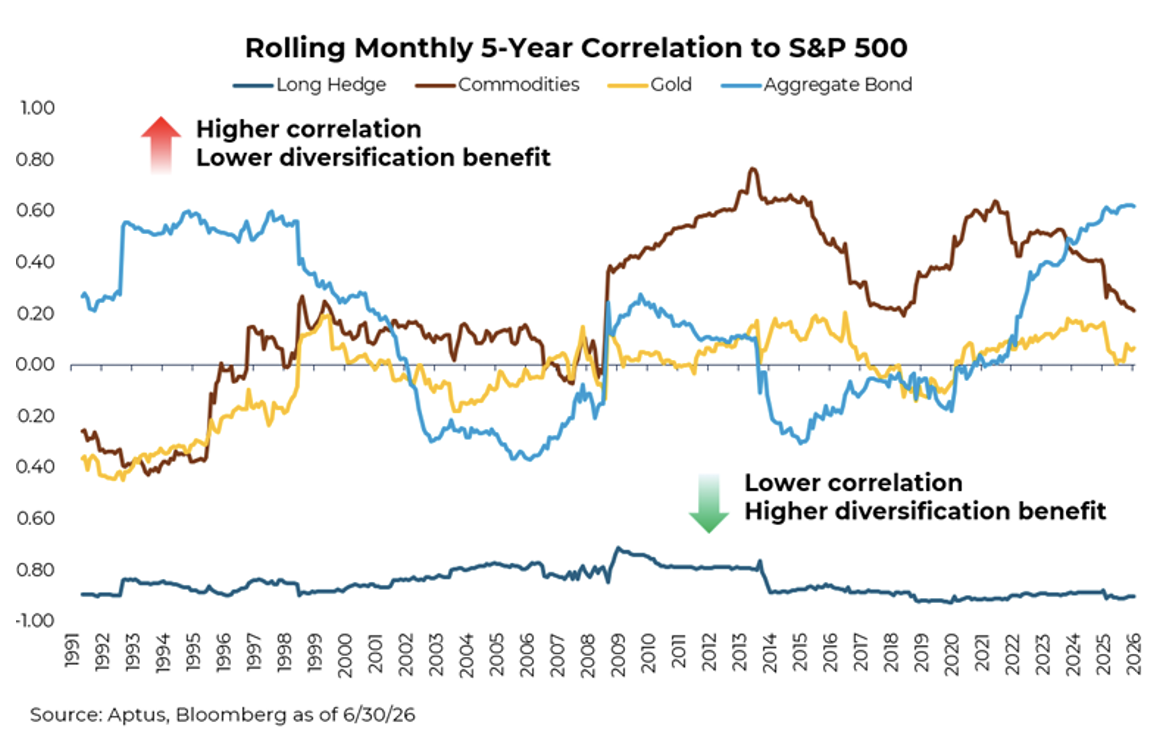
At Aptus, we use hedges to manage risk, not reduce it, allowing us to confidently take on more equity market exposure while keeping potential drawdowns in check with less reliance on fixed income. The hedges we employ are designed to provide consistency in protection during large market declines to maximize compounded returns.
Disclosures
Past performance is not indicative of future results. This material is not financial advice or an offer to sell any product. The information contained herein should not be considered a recommendation to purchase or sell any particular security. Forward looking statements cannot be guaranteed.
This commentary offers generalized research, not personalized investment advice. It is for informational purposes only and does not constitute a complete description of our investment services or performance. Nothing in this commentary should be interpreted to state or imply that past results are an indication of future investment returns. All investments involve risk and unless otherwise stated, are not guaranteed. Be sure to consult with an investment & tax professional before implementing any investment strategy. Investing involves risk. Principal loss is possible.
Advisory services are offered through Aptus Capital Advisors, LLC, a Registered Investment Adviser registered with the Securities and Exchange Commission. Registration does not imply a certain level of skill or training. More information about the advisor, its investment strategies and objectives, is included in the firm’s Form ADV Part 2, which can be obtained, at no charge, by calling (251) 517-7198. Aptus Capital Advisors, LLC is headquartered in Fairhope, Alabama. ACA-2608-9.