
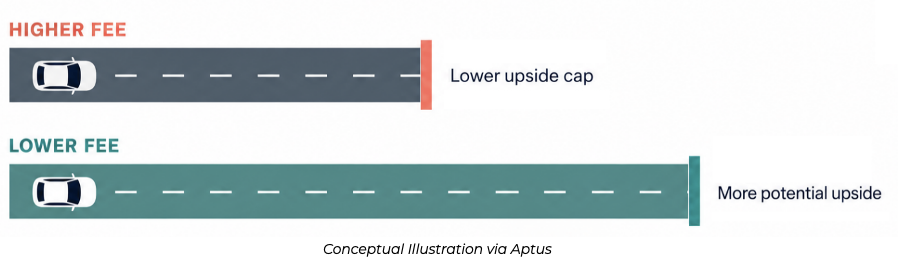
Picture the same car lease at two different dealers: same exact car, same monthly payment, same coverage if something breaks. The only difference is that one lets you drive 2,500 more miles a year.
Dealer A keeps its full fee. It’s built into your payment, and none of it goes back into the lease. You get 10,000 miles a year.
Dealer B earns its return over the life of the relationship, not at the signing table. It keeps a fraction of that same fee and puts the rest back into the lease. You don’t pay a dollar more, and you get 12,500 miles a year.
What Does This Have to Do with a Buffer?
Ask most investors what they’re paying for in a buffer fund, and they’ll say downside protection, but we view that as half the story. The other half is the upside cap, the point where you stop capturing the market’s gains, and the two are connected in a way most people never think about.
A buffer fund (also called a defined outcome ETF) tracks an index like the S&P 500 over a set outcome period, usually 12 months. Using options, it absorbs a defined slice of losses, say the first 15%, in exchange for a ceiling on the gain you keep. If the index falls 25%, you’re down roughly 10% before expenses.
That protection isn’t free. It’s built by buying puts, paid for by selling calls, and those calls are what set the cap (your mileage allowance). The expense ratio and the cost of the options come out of the same pool of money, and that pool determines where the cap lands. Charge more to run the strategy, and there’s less left to push the cap higher. The expense ratio isn’t just a fee line on a fact sheet. It can quietly be setting your ceiling.
Back to the Lease
Buffer funds work the same way as those two dealers. Most charge 75 to 85 bps, and that money goes to the fund company, leaving less in the budget for the cap. A manager that charges 25 bps and puts the roughly 50 bps difference into the options structure, the same way Dealer B puts the rest of its fee back into the lease instead of its own pocket, buys a higher cap.
The coverage carries over too. The buffer works like that fixed warranty: the first 15% of losses (or whatever level a fund is built around) is baked into the structure, not into the fee. Two buffer funds with the same stated net protection are equally covered if the market breaks down. The only thing separating them is how far each one lets you drive.
The coverage tells you how protected you are, the cap tells you how far you can go, and the price should be judged by how it splits its budget between the two.
So the question to ask about a buffer fund is the same question you would ask at a dealership: if two leases cost me the same each month and cover me the same way, why does one let me drive 2,500 more miles?
The answer, in both cases, is that somebody decided to spend the fee on the customer instead of keeping it.
Disclosures
The opinions expressed are those of the Aptus Capital Investment Team as of the date of publication and are subject to change due to market or economic conditions and may not come to pass.
This material is not financial advice or an offer to sell any product. The information contained herein should not be considered a recommendation to purchase or sell any particular security. Material presented has been derived from sources considered to be reliable, but the accuracy and completeness cannot be guaranteed. Forward-looking statements cannot be guaranteed. Conceptual examples are for illustrative purposes only, do not reflect the deduction of fees or expenses, and are not indicative of any actual investment result.
This commentary offers generalized research, not personalized investment advice. It is for informational purposes only and does not constitute a complete description of our investment services or performance. Nothing in this commentary should be interpreted to state or imply that past results are an indication of future investment returns. All investments involve risk and unless otherwise stated, are not guaranteed. Investing involves risk. Principal loss is possible.
Options carry unique risks and are not suitable for all investors. Selling call options limits the upside potential of the underlying position, and purchased put options may expire worthless, resulting in the loss of the premium paid. There is no guarantee that a hedging strategy will achieve its objective or protect against loss.
Call options give the owner the right to buy the underlying security at the specified price within a specific time period. Put options give the owner the right to sell the underlying security at the specified price within a specific time period.
Advisory services are offered through Aptus Capital Advisors, LLC, a Registered Investment Adviser registered with the Securities and Exchange Commission. Registration does not imply a certain level of skill or training. More information about the advisor, its investment strategies and objectives, is included in the firm’s Form ADV Part 2, which can be obtained, at no charge, by calling (251) 517-7198. Aptus Capital Advisors, LLC is headquartered in Fairhope, Alabama. ACA-2609-22.