
Back in 1900, you didn’t take a great family picture so much as you had one painted. John Singer Sargent, a successful portrait painter at the time, charged ~$5,000 a portrait at a time when the average American earned about $450 a year. The fee bought months of sittings with the artist himself and a result that would hang over the family mantel for generations.
That same year Eastman Kodak introduced the Brownie for $1 with film at 15 cents a roll. Eastman had already made his famous promise back in 1888: “You press the button, we do the rest.” The Brownie made that promise almost free, and Kodak marketed it to children as proof of how simple photography had become. None of the underlying work got easier. The chemistry and the developing process stayed the same, but all of it moved inside the box and into Kodak’s labs, where the customer never had to think about it.

The Tax Playbook for the Rich
The tax code has always had a made-to-order tier of its own, and it belongs to the very wealthy. The signature move is buy, borrow, die. An investor holds appreciated stock for decades without ever selling and borrows against the shares to fund their lifestyle because loan proceeds aren’t taxable income. Then they die. Their heirs receive the position with a stepped-up basis and the embedded gain leaves the tax system for good. Dynasty trusts extend the same logic across generations by letting assets compound outside the reach of estate and gift taxes for a century or more.
None of this has ever required a ticker symbol, but it may require a $10 million minimum, a family office, and estate attorneys on retainer. It’s a portrait painted to order with the sittings included.
What changed is that the tax code finally got its Brownie. The made-to-order tier still requires the specialist and probably always will, but a real set of tools within the Exchange-Traded Fund (“ETF”) has now been folded inside a wrapper anyone can buy for the price of one share.
Three Tools, Now Inside the Box
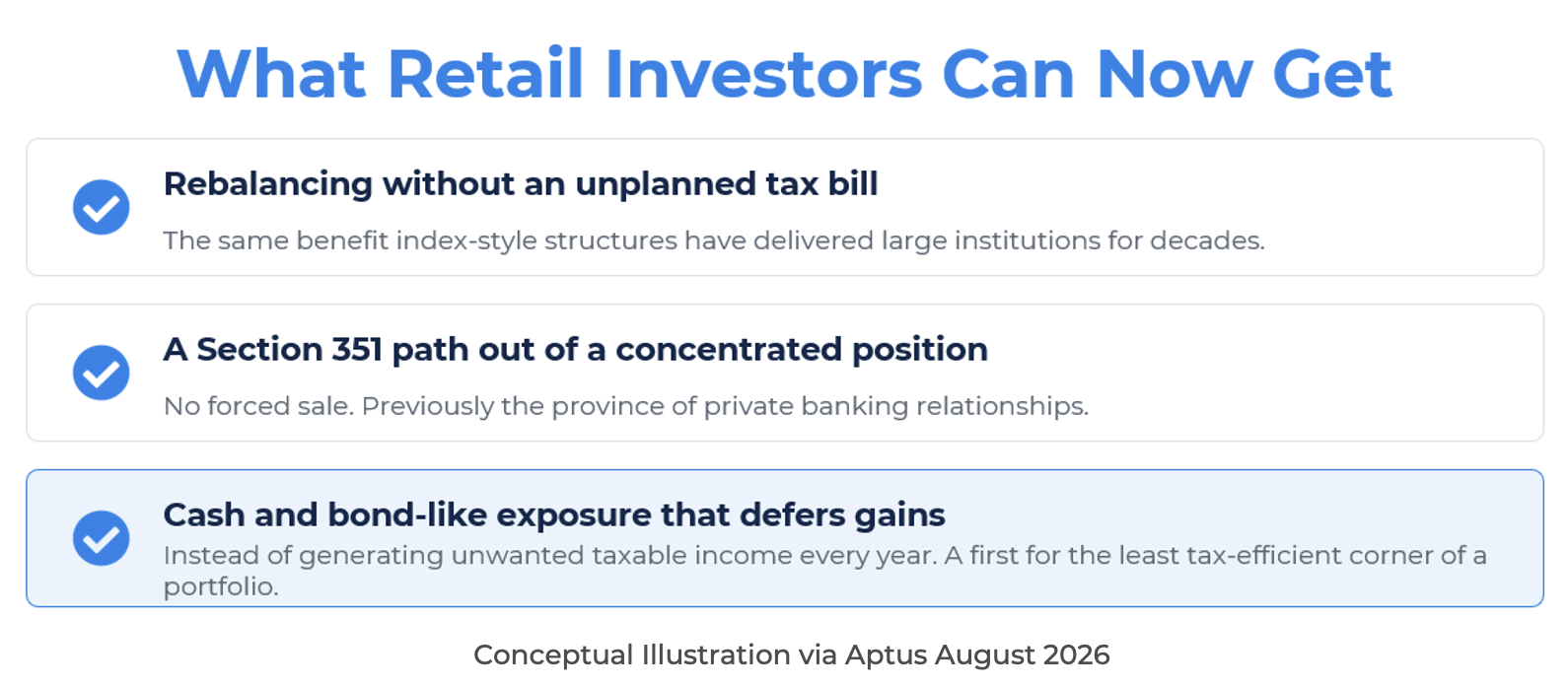
Redemption in kind is the plumbing underneath every ETF on the market you already own. A fund manager who needs to trim a position hands the shares to an authorized participant instead of selling them on the open market. No sale gets booked, and no gain gets realized, and no surprise capital gains distribution ever lands on shareholders who never touched their accounts. Congress wrote the rule under Section 852(b)(6) so funds could rebalance without spraying phantom gains across millions of investors, and it has quietly made the ETF more tax-efficient than a mutual fund for a generation. Here’s the part I like best: investors who own an ETF in a taxable account collect this benefit today whether or not they’ve ever heard of the section number.
Section 351 solves a narrower problem, and it honestly isn’t for everyone. Picture the employee holding 25 years of company stock or the founder who never sold a share and now faces a painful tax bill on any normal sale. Under Section 351, that investor can contribute the position to a fund and receive a diversified basket of shares back without triggering the gain as long as the fund meets certain diversification requirements. Private banks arranged versions of this for their wealthiest clients starting in the 1960s as made-to-order work. Today it ships in the box to anyone with a brokerage account.
The third one is the piece I find myself explaining most in advisor conversations. There’s now a category of ETFs built to act like cash or a short-term bond fund without kicking off ordinary income every year. Anyone who’s held a money market fund knows the drill where the yield lands on a 1099 and gets taxed at ordinary rates every year, whether you needed the money or not. These new funds structure the return so any gain waits until you choose to sell. The mechanics differ from fund to fund, and that’s sort of the point because the structure handles the machinery for you. You end up holding something that looks like cash or a bond on your statement in terms of volatility and return as a patient long-term holder on your tax return. Trusts and exchanges solve special situations, while this applies to money almost everyone already holds.
Deferral, Not Avoidance
The laziest critique of these tax-efficient funds deserves pushback because it claims they let investors dodge tax when they simply don’t. Congress wrote the realization principle into the code from the start, and gains aren’t taxed until you sell. Every buy-and-hold investor already leans on that rule whether they hold an index fund for 30 years or a single stock through a decade of gains. Deferral just lets the bill grow alongside the balance so the check to the Internal Revenue Service (“IRS”) is bigger when you finally sell. I believe the honest description is less dramatic than the critics want it to be. These funds run on the same realization principle the whole code is built on, and the wrapper is the only new part. It’s a smaller and fully paid version of the game the wealthy have played all along.
Press the Button
None of this took a new statute or a private ruling. It took companies willing to do for these tools what Eastman did for the photograph, which is move the complexity inside the box and put the box on a shelf anyone can reach. Portraits painted to order didn’t vanish in 1900, and the made-to-order tier of the tax code isn’t vanishing now either. If history is any guide, buy/borrow/die will outlive every product cycle this industry produces. Eastman never claimed a Brownie was a $5000 painting, but rather that a picture no longer required the artist. I believe that’s the right way to read this moment. A growing share of the playbook now just requires a button.
Disclosures
Past performance is not indicative of future results. This material is not financial advice or an offer to sell any product. The information contained herein should not be considered a recommendation to purchase or sell any particular security. Forward looking statements cannot be guaranteed. Hypothetical examples are for illustrative purposes only, do not reflect the deduction of fees or expenses, and are not indicative of any actual investment result.
This commentary offers generalized research, not personalized investment advice. It is for informational purposes only and does not constitute a complete description of our investment services or performance. Nothing in this commentary should be interpreted to state or imply that past results are an indication of future investment returns. All investments involve risk and unless otherwise stated, are not guaranteed. Be sure to consult with an investment & tax professional before implementing any investment strategy. Investing involves risk. Principal loss is possible.
Advisory services are offered through Aptus Capital Advisors, LLC, a Registered Investment Adviser registered with the Securities and Exchange Commission. Registration does not imply a certain level of skill or training. More information about the advisor, its investment strategies and objectives, is included in the firm’s Form ADV Part 2, which can be obtained, at no charge, by calling (251) 517-7198. Aptus Capital Advisors, LLC is headquartered in Fairhope, Alabama. ACA 2608-14.