
Plenty of bottled fruit smoothies carry as much sugar as a can of Coke, and does anybody drink a Coke at 8 am and feel good about it? The smoothie has a strawberry on the front and the word “natural” somewhere on the label, so it goes in the cart next to the eggs.
Something close to that happened in a FINRA arbitration case that just went against Charles Schwab and TD Ameritrade, where a group of investors was awarded more than $4.5 million over losses in structured notes. The headline is about Schwab, but the more interesting story is about the product.
According to AdvisorHub, the investors were mostly retired teachers in their mid-60s to 70s investing proceeds from state retirement pensions. They held self-directed accounts and bought “worst-of” autocallable structured notes tied to volatile stocks, and their attorney said many of those notes ultimately lost, essentially, all of their principal. The panel awarded roughly $4.4 million in compensatory damages plus costs. Schwab disputes the decision and says the investment decisions were made by the clients and their independent advisor rather than by Schwab.
There is a real debate about where a custodian’s responsibility begins and ends in a self-directed account, and this award may end up mattering well beyond structured notes. Setting that aside, the question we keep coming back to is why this product exists in the form it does, and why it is suddenly everywhere.
Turning a Risky Trade Into an Income Product
Structured notes are not inherently bad, and they can customize market exposure, reshape the distribution of returns, and solve portfolio problems that are genuinely hard to solve with plain instruments. What they also do, though, is change how risk feels.
Imagine sitting across from a retired investor and saying this:
We are going to sell options against several highly volatile small-cap stocks. If things go well, you collect income. Your upside is capped either way. If any one of those stocks collapses far enough, you can lose a very large portion of your principal.
That sounds like exactly the risk that it is. Now take the same economic exposure, put it inside a bank-issued note or an ETF, attach a coupon, describe it with words like autocallable, contingent income and downside barrier, and present the whole thing as a fixed income alternative. The wrapper didn’t make the underlying exposure conservative.
The “Worst-Of” Part Is Doing a Lot of Work
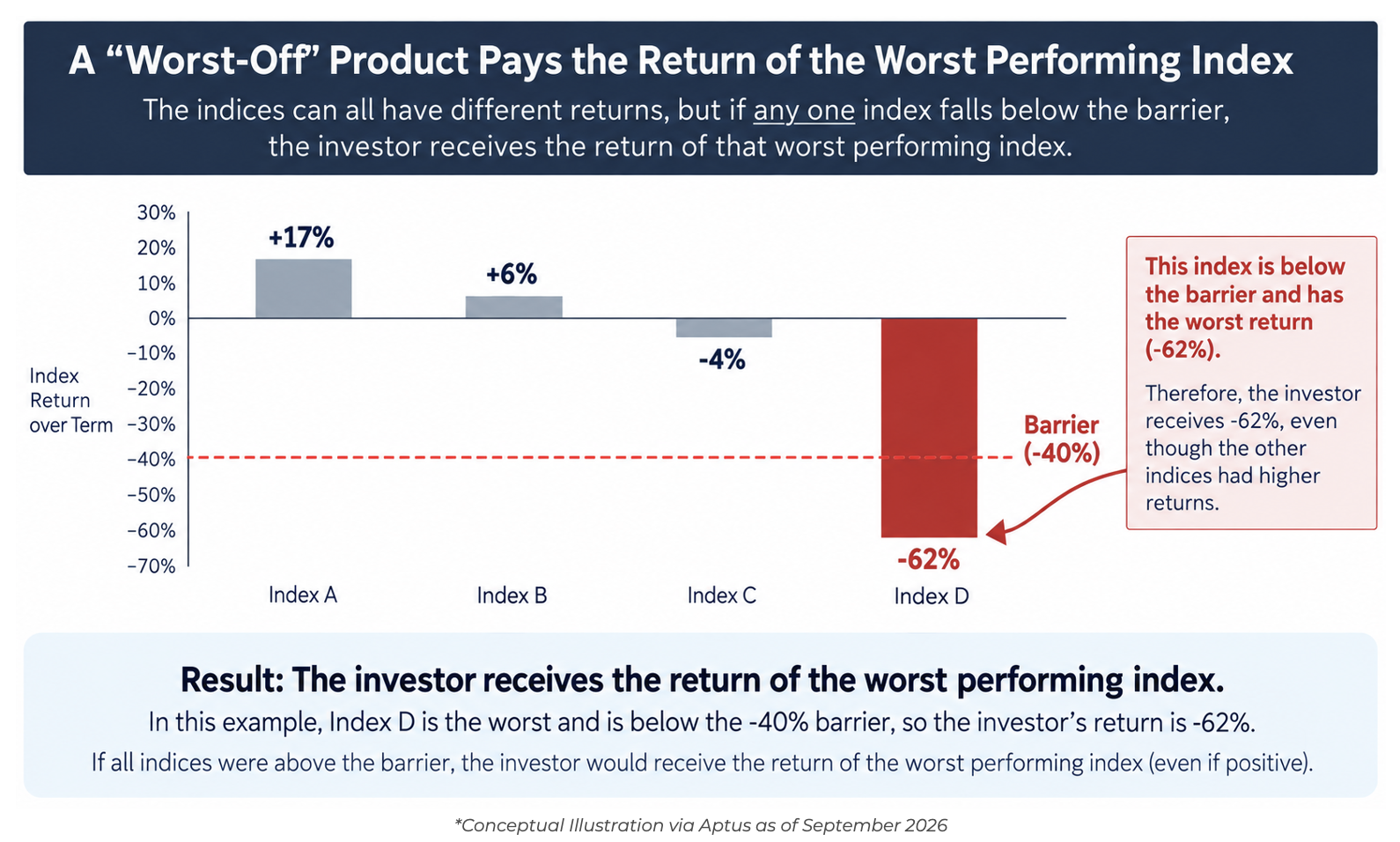
The notes at issue were reportedly worst-of autocallables, and that first phrase carries most of the risk. A worst-of note can be linked to several references, but the downside depends on whichever one performs worst. If all of the references hold up, the investor collects the coupon and may get called away early. The important part is what happens at maturity: the note has a downside barrier, say 40% below the starting level, so the worst-performing reference could be down 20%, 30%, or even 39%, and the investor still receives full principal back. But if that one reference finishes below the barrier, the protection can disappear entirely, and the investor generally takes the full decline from the original starting level. A 41% decline does not mean a 1% principal loss; it can mean a 41% principal loss.
So the diversification can be largely illusory, because you aren’t getting the average outcome of the indices; you’re getting the worst name in it, with the other names along for decoration. FINRA has specifically flagged structured notes with worst-of features as complex products.
The Same Payoff Now Has a Ticker
It would be easy to read this case as a story about a product on its way out, but it isn’t. The same payoff is now an ETF, and autocallable income funds have gathered billions in a little more than a year, largely in the kind of self-directed accounts those retired teachers were sitting in.
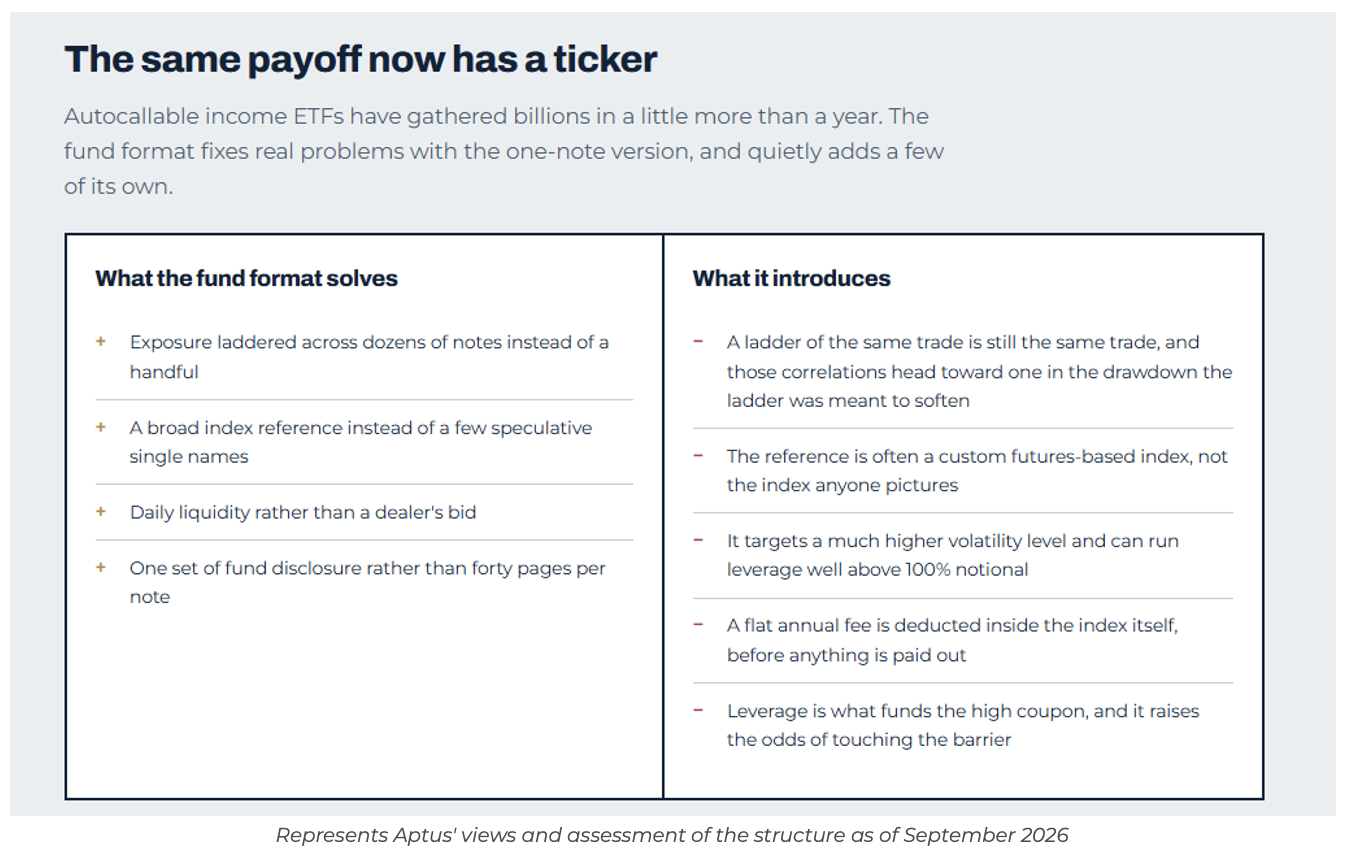
The fund versions do solve part of what went wrong here, since exposure is laddered across dozens of notes instead of concentrated in a handful, and you get daily liquidity along with one set of disclosures. And in many cases the underlying notes may be tied to a single index or a worst-of basket. All else equal, we would rather see this type of exposure held in a fund than one note at a time.
But the funds introduce problems of their own, because a ladder of the same trade is still the same trade. While the ETFs may no longer always be tied to a “worst-of” basket, where a sufficiently large loss in any one reference can determine the outcome, but it can instead be tied to a single index that may itself be custom, futures-based, and leveraged. The barrier remains the critical feature. And if the reference index uses leverage or a volatility-targeting structure, it can fall more than 40% even when a familiar benchmark such as the S&P 500 is down materially less.
All of that now sits on the same screen as bond funds, with the yield figure the first thing anyone looks at, so the strawberry is back on the label. The comparison below reflects our view of what the fund structure improves and where we believe the trade-offs remain.
Translate It Back Into Plain English
When we look at a complicated investment, we try to write it out in the language a client would use:
1. What am I exposed to?
2. What am I short?
3. Where is the yield actually coming from?
4. What happens in the bad scenario, and what am I giving up in the good one?
5. Why would I own it?
“It pays an 11% coupon” is not an acceptable answer to that last question; it’s the place where the analysis starts.
None of that gets easier because the exposure has a ticker, a daily NAV, and a fact sheet, and one-click access makes the translation more important rather than less, because nothing in the buying process forces anyone to do it. When something offers unusually high income with unusually little apparent risk, there are only two possibilities: either you found a remarkable inefficiency, or you haven’t found the risk yet, and in our experience, it is almost always the second one.
Disclosures
The arbitration matter described above is summarized from public reporting by AdvisorHub. Charles Schwab disputes the decision and has stated that the investment decisions at issue were made by the clients and their independent advisor. Nothing herein is a statement of fact regarding the conduct of any party, and no outcome of any legal or regulatory proceeding should be inferred.
References to structured notes, autocallable notes, exchange-traded funds or any other product type, strategy or issuer are for illustrative and educational purposes only and are not a recommendation to buy, sell or hold any security or to adopt any investment strategy. Any yields, coupons, barriers, leverage levels or index characteristics described are hypothetical and illustrative, do not represent any specific security, and are not indicative of any actual investment result.
Structured notes are complex products that may involve, among other risks, the credit risk of the issuing bank, limited or no secondary market liquidity, capped upside, contingent income that may not be paid, embedded derivatives and leverage, and the potential loss of a substantial portion or all of principal. Funds that provide similar exposures carry their own risks, including derivatives risk, leverage risk, index construction and tracking risk, counterparty risk, and the risk that income is not paid as anticipated. Investors should read the relevant prospectus, offering documents or pricing supplement carefully before investing.
Conceptual Illustration: Information presented in the above charts are for illustrative purposes only and should not be interpreted as actual performance of any investor’s account. As these are not actual results and completely assumed, they should not be relied upon for investment decisions. Actual results of individual investors will differ due to many factors, including individual investments and fees, client restrictions, and the timing of investments and cash flows.
Past performance is not indicative of future results. This material is not financial advice or an offer to sell any product. The information contained herein should not be considered a recommendation to purchase or sell any particular security. Forward looking statements cannot be guaranteed. Hypothetical examples are for illustrative purposes only, do not reflect the deduction of fees or expenses, and are not indicative of any actual investment result.
This commentary offers generalized research, not personalized investment advice. It is for informational purposes only and does not constitute a complete description of our investment services or performance. Nothing in this commentary should be interpreted to state or imply that past results are an indication of future investment returns. All investments involve risk and unless otherwise stated, are not guaranteed. Be sure to consult with an investment & tax professional before implementing any investment strategy. Investing involves risk. Principal loss is possible.
Advisory services are offered through Aptus Capital Advisors, LLC, a Registered Investment Adviser registered with the Securities and Exchange Commission. Registration does not imply a certain level of skill or training. More information about the advisor, its investment strategies and objectives, is included in the firm’s Form ADV Part 2, which can be obtained, at no charge, by calling (251) 517-7198. Aptus Capital Advisors, LLC is headquartered in Fairhope, Alabama. ACA 2609-21.